
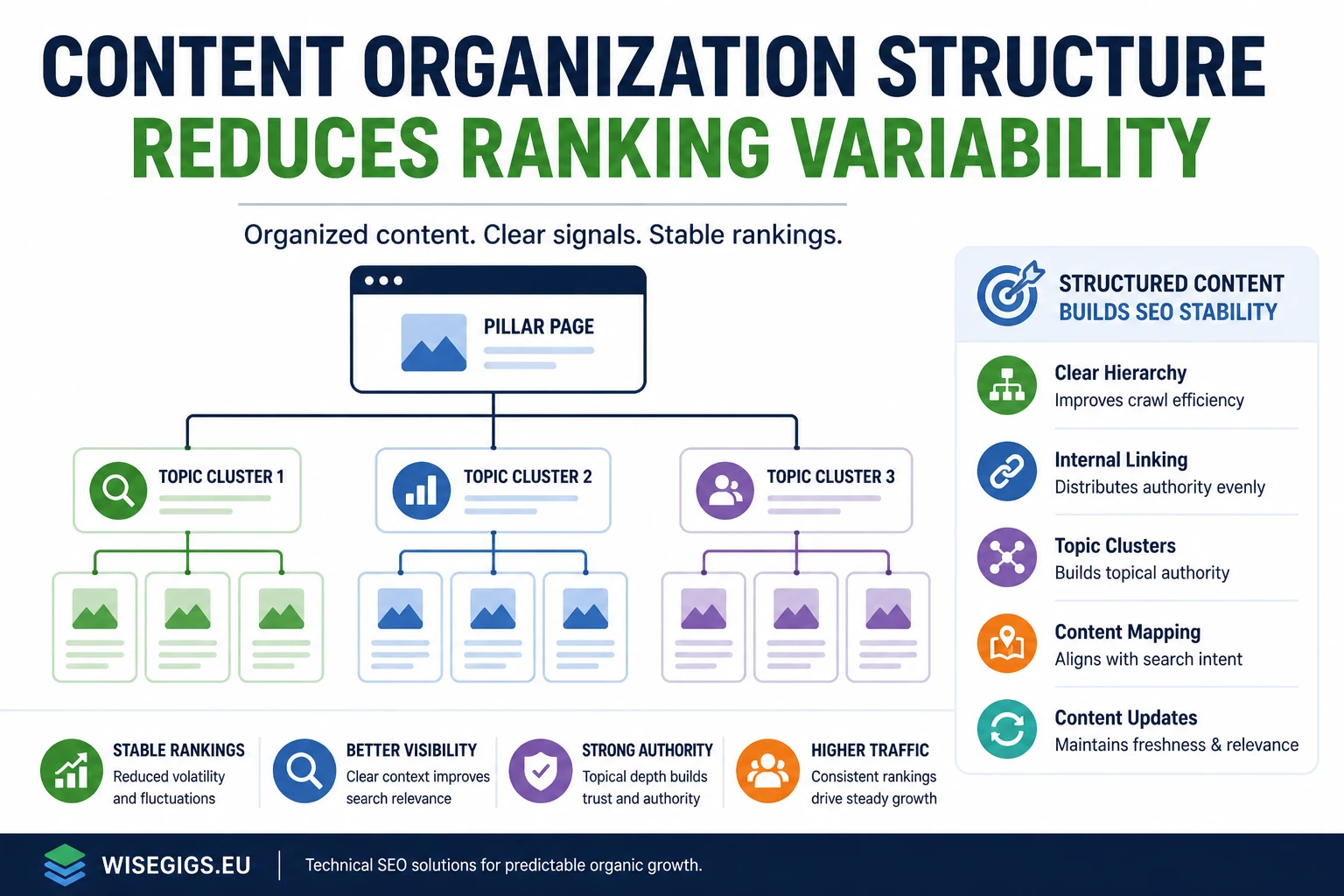
Search rankings rarely fluctuate without cause.
Most variability comes from inconsistent content organization. When pages are disconnected, poorly structured, or misaligned with intent, search engines struggle to interpret relevance. As a result, rankings become unstable.
Structure determines visibility consistency.
At Wisegigs.eu, SEO audits consistently show that ranking volatility is driven more by content structure issues than by backlinks or keyword targeting. Content often exists, yet without clear organization, it fails to perform reliably.
Predictable organization reduces ranking variability.
Structured content improves search stability.
Content Organization Defines Search Context
Search engines evaluate relationships between pages.
Unstructured content creates ambiguity. Consequently, relevance signals become weak.
Clear organization defines how pages connect.
Common organization inconsistencies include:
- isolated pages without contextual links
- overlapping topics causing keyword cannibalization
- unclear content hierarchy
- fragmented topic coverage
Structured organization improves context clarity.
Clear context improves ranking stability.
Content Hierarchy Influences Crawl Efficiency
Hierarchy determines how content is discovered.
Poor hierarchy slows crawling. As a result, important pages receive less visibility.
Clear hierarchy improves crawl paths.
Common hierarchy inconsistencies include:
- deep page nesting
- missing parent-child relationships
- inconsistent URL structures
- unclear category grouping
Structured hierarchy improves crawl efficiency.
Efficient crawling improves index stability.
Google explains how site structure affects crawling:
https://developers.google.com/search/blog/2009/08/optimize-your-crawling-indexing?hl=en
Internal Linking Improves Signal Distribution
Links connect content signals.
Unstructured linking isolates pages. Consequently, authority is unevenly distributed.
Clear linking structure distributes relevance.
Common linking inconsistencies include:
- missing internal links between related topics
- overlinking without relevance
- inconsistent anchor text usage
- fragmented linking logic
Structured linking improves signal flow.
Balanced signals improve ranking predictability.
Topic Clustering Improves Authority Consistency
Content should be grouped by topic.
Unstructured topics dilute authority. As a result, search engines struggle to identify expertise.
Clear clustering organizes related content.
Common clustering inconsistencies include:
- scattered articles on similar topics
- missing pillar pages
- inconsistent topic depth
- fragmented content strategy
Structured clustering improves topical authority.
Strong authority improves ranking stability.
Ahrefs explains topic clustering and authority building:
https://ahrefs.com/blog/topic-clusters/
Content Mapping Improves Relevance Alignment
Content must match search intent.
Unmapped content misses intent. Consequently, rankings fluctuate.
Clear mapping aligns pages with queries.
Common mapping inconsistencies include:
- multiple pages targeting the same keyword
- unclear user intent alignment
- missing content for key search stages
- fragmented keyword strategy
Structured mapping improves relevance.
Relevant content improves ranking consistency.
URL Structure Improves Indexing Clarity
URLs signal content relationships.
Inconsistent URLs create confusion. As a result, indexing becomes less reliable.
Clear URL structure improves clarity.
Common URL inconsistencies include:
- random URL naming
- inconsistent folder structure
- missing keyword signals
- fragmented URL hierarchy
Structured URLs improve indexing accuracy.
Clear indexing improves visibility stability.
Content Updates Improve Ranking Stability
Search engines favor maintained content.
Unstructured updates create inconsistency. Consequently, rankings fluctuate over time.
Clear update strategy improves stability.
Common update inconsistencies include:
- outdated content left unchanged
- inconsistent update frequency
- missing performance reviews
- fragmented content revisions
Structured updates improve freshness.
Fresh content improves ranking consistency.
What Reliable Content Organization Structures Prioritize
Stable rankings depend on predictable content relationships.
Reliable content systems typically prioritize:
- clear content hierarchy
- structured internal linking
- defined topic clusters
- aligned content mapping
- consistent URL structure
- ongoing content updates
These characteristics reduce ranking volatility.
Reduced volatility improves search performance.
At Wisegigs.eu, SEO strategy focuses on structuring content systems to ensure clear relationships, consistent signals, and stable organic visibility.
Structured organization improves long-term growth predictability.
Need help structuring your content for more stable SEO performance?
Contact Wisegigs.eu