
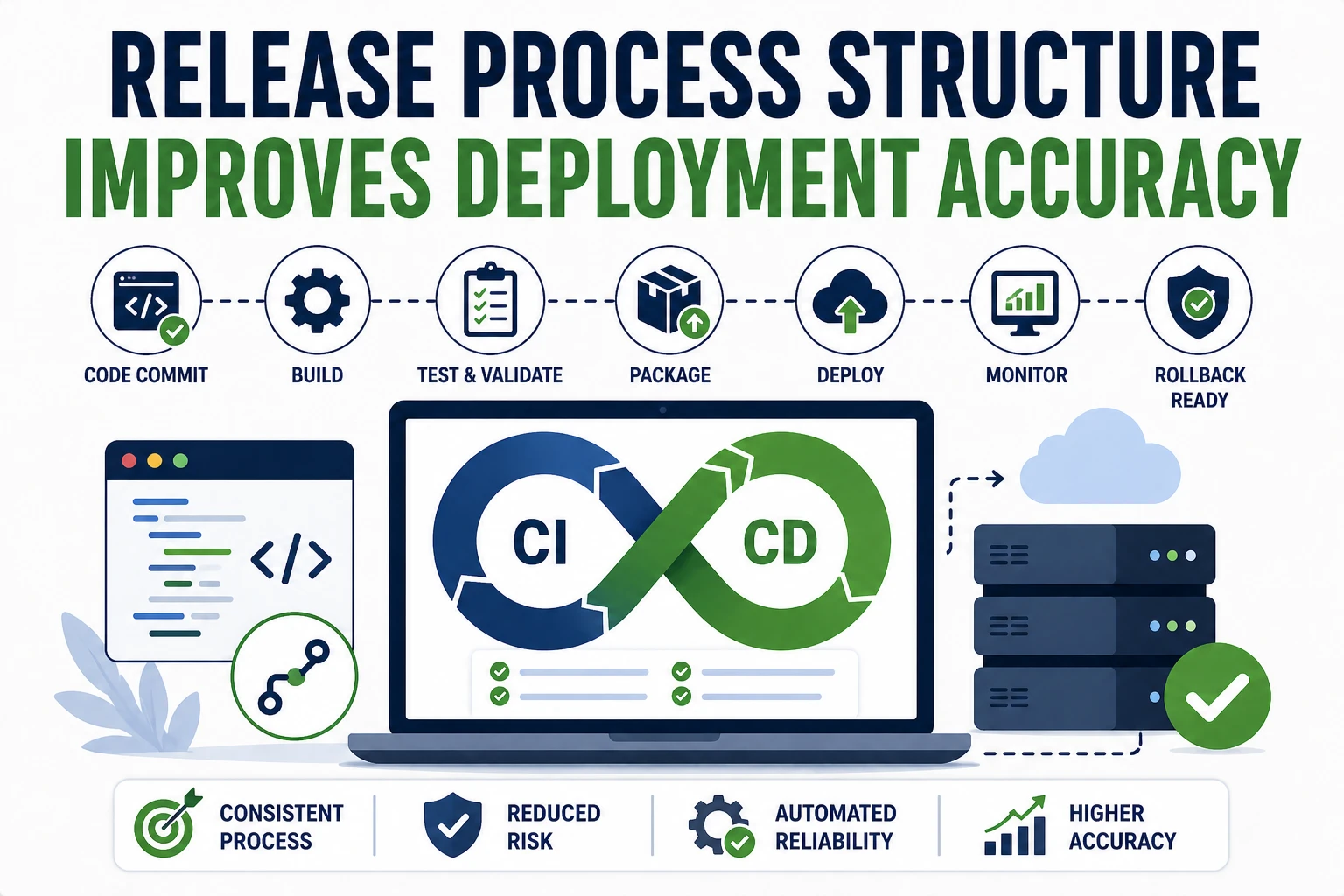
Deployment failures rarely originate from code alone.
Most issues occur because release processes are inconsistent, fragmented, or loosely defined. When deployment steps vary across environments, outcomes become unpredictable even if the application itself is stable.
Structure determines release reliability.
At Wisegigs.eu, DevOps audits consistently show that deployment errors are caused by inconsistent release workflows rather than tooling limitations. Systems often pass staging checks, yet fail in production due to process misalignment.
Predictable release structure improves deployment accuracy.
Structured workflows reduce operational risk.
Release Process Defines Deployment Behavior
A release process is a sequence of controlled steps.
Unstructured processes introduce variability. Consequently, deployments behave differently across environments.
Clear process structure defines how builds move from development to production.
Common process inconsistencies include:
- manual steps without validation
- inconsistent environment configurations
- fragmented deployment sequences
- unclear rollback procedures
Structured processes improve execution predictability.
Predictable execution improves deployment accuracy.
Environment Consistency Influences Release Reliability
Applications move through multiple environments.
Inconsistent environments introduce hidden differences. As a result, deployments fail when conditions change.
Consistent environments reduce variability.
Common environment inconsistencies include:
- different dependency versions across stages
- configuration drift between environments
- missing parity between staging and production
- inconsistent infrastructure setup
Structured environment alignment improves reliability.
Consistent conditions improve deployment accuracy.
Version Control Structure Improves Traceability
Release processes depend on version tracking.
Unstructured versioning reduces visibility. Consequently, debugging becomes difficult.
Clear version control enables traceability.
Common versioning inconsistencies include:
- unclear version naming conventions
- missing release tagging
- fragmented branching strategies
- inconsistent commit structure
Structured versioning improves traceability.
Traceable systems improve deployment reliability.
Validation Workflow Improves Release Safety
Validation ensures releases meet requirements.
Unstructured validation introduces risk. Therefore, issues reach production environments.
Clear validation workflows improve safety.
Common validation inconsistencies include:
- missing automated checks
- inconsistent testing coverage
- fragmented validation steps
- unclear pass/fail criteria
Structured validation improves deployment confidence.
Reliable checks improve release accuracy.
Google Cloud documentation explains structured release validation principles:
https://cloud.google.com/architecture/devops/devops-tech-test-automation
Deployment Automation Improves Consistency
Automation reduces human error.
Manual processes introduce variability. Consequently, deployments become inconsistent.
Structured automation standardizes execution.
Common automation inconsistencies include:
- partial automation across environments
- inconsistent deployment scripts
- missing error handling
- fragmented automation pipelines
Structured automation improves consistency.
Consistent execution improves deployment accuracy.
Rollback Strategy Improves Failure Recovery
Failures are inevitable.
Without rollback structure, recovery becomes slow and unpredictable.
Clear rollback strategies reduce impact.
Common rollback inconsistencies include:
- missing rollback procedures
- unclear rollback triggers
- inconsistent backup mechanisms
- fragmented recovery workflows
Structured rollback improves resilience.
Predictable recovery improves deployment stability.
Monitoring Integration Improves Release Visibility
Releases must be observed after deployment.
Without monitoring, issues remain undetected. Consequently, failures escalate.
Structured monitoring improves visibility.
Key monitoring areas include:
- deployment success rates
- error rates after release
- performance degradation
- system behavior changes
Unmonitored releases increase risk.
Observed systems improve reliability.
What Reliable Release Process Structures Prioritize
Accurate deployments depend on predictable execution.
Reliable release systems typically prioritize:
- consistent process sequencing
- environment alignment across stages
- structured version control
- automated validation workflows
- standardized deployment automation
- defined rollback strategies
- continuous monitoring integration
These characteristics reduce variability.
Reduced variability improves deployment accuracy.
At Wisegigs.eu, DevOps strategy focuses on structuring release processes to ensure predictable deployments and minimize operational risk.
Structured releases improve long-term system stability.
Need help structuring your CI/CD release process for more accurate deployments?
Contact Wisegigs.eu