
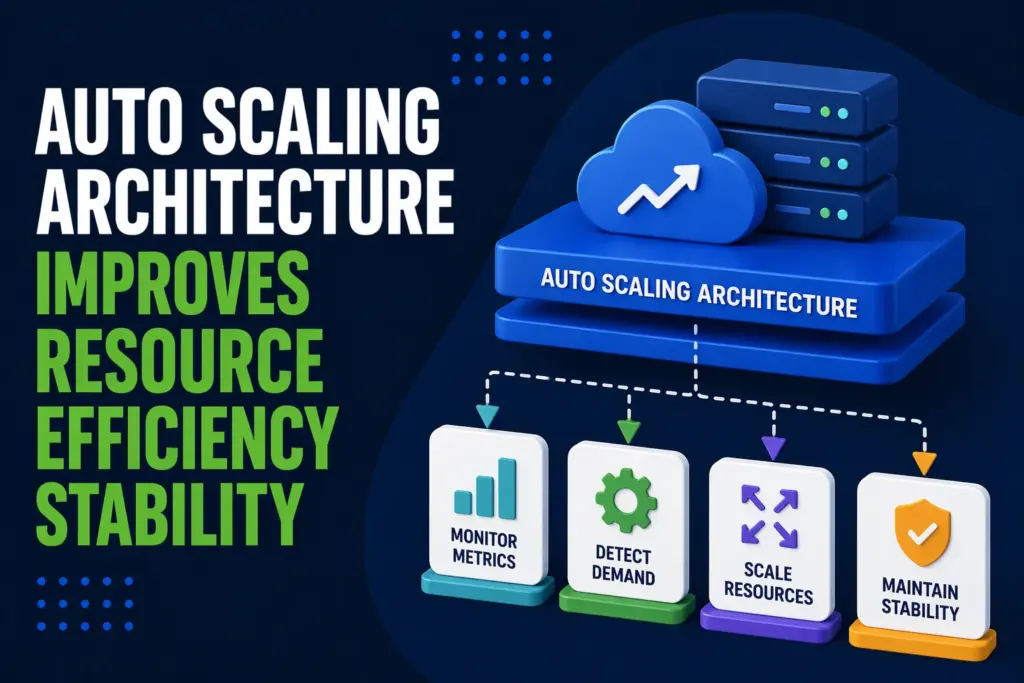
Auto Scaling Defines Resource Behavior
Infrastructure must respond to demand changes.
Static resource allocation creates inefficiency. During low traffic, resources are underutilized. During spikes, systems become overloaded.
Auto scaling adjusts resources dynamically. Therefore, capacity aligns with real-time demand.
Unstructured scaling introduces instability.
Structured scaling improves efficiency predictability.
Trigger Structure Influences Scaling Accuracy
Scaling decisions depend on defined triggers.
Incorrect triggers cause delayed or excessive scaling. As a result, performance becomes inconsistent.
Clear trigger logic improves response timing.
Common trigger inconsistencies include:
- relying on a single metric (e.g., CPU only)
- missing traffic-based signals
- inconsistent threshold definitions
- delayed metric collection affecting responsiveness
Structured triggers improve scaling precision.
Predictable signals improve system stability.
AWS documentation explains scaling trigger behavior:
https://docs.aws.amazon.com/autoscaling/
Resource Grouping Improves Allocation Efficiency
Scaling operates on grouped resources.
Poor grouping mixes unrelated workloads. Consequently, scaling actions become inefficient.
Clear grouping aligns scaling behavior with workload type.
Common grouping issues include:
- combining CPU-intensive and I/O-heavy services
- mixing stateless and stateful workloads
- unclear service boundaries
- fragmented grouping logic
Structured grouping improves allocation efficiency.
Efficient allocation improves performance stability.
Scaling Thresholds Control Stability
Thresholds determine when scaling occurs.
Improper thresholds cause oscillation or delay. Therefore, systems either over-scale or under-scale.
Balanced thresholds improve stability.
Common threshold issues include:
- thresholds set too low causing frequent scaling
- thresholds set too high delaying response
- inconsistent threshold logic across services
- lack of adaptive threshold tuning
Structured thresholds improve predictability.
Predictable scaling improves resource efficiency.
Load Balancing Alignment Improves Distribution
Scaling without load balancing creates imbalance.
Uneven traffic distribution reduces efficiency. As a result, some nodes overload while others remain idle.
Aligned load balancing ensures even distribution.
Common issues include:
- poor routing algorithms affecting balance
- missing health checks
- inconsistent traffic distribution logic
- fragmented integration between scaling and routing
Structured load balancing improves stability.
Balanced distribution improves system efficiency.
Cooldown Logic Prevents Instability
Scaling actions must stabilize before repeating.
Without cooldown periods, systems oscillate. Consequently, resources scale up and down rapidly.
Clear cooldown logic improves control.
Common cooldown issues include:
- missing cooldown intervals
- inconsistent timing across services
- ignoring stabilization signals
- fragmented scaling logic
Structured cooldown improves system stability.
Predictable pacing improves efficiency.
Monitoring Validates Scaling Performance
Scaling systems require continuous evaluation.
Without monitoring, inefficiencies remain hidden.
Structured monitoring improves optimization accuracy.
Key metrics include:
- scaling frequency
- resource utilization efficiency
- response time under load
- cost-performance balance
Unmonitored scaling leads to inefficiency.
Measured systems maintain stability.
Google Cloud explains monitoring importance in scaling systems:
https://cloud.google.com/monitoring
What Reliable Auto Scaling Structures Prioritize
Stable infrastructure depends on predictable scaling behavior.
Reliable auto scaling systems typically prioritize:
- clear trigger definitions
- structured resource grouping
- balanced scaling thresholds
- aligned load balancing integration
- controlled cooldown logic
- continuous monitoring visibility
These characteristics reduce resource waste.
Reduced waste improves efficiency stability.
At Wisegigs.eu, infrastructure strategy focuses on designing scaling systems that react predictably to demand while maintaining performance consistency.
Structured scaling improves long-term reliability.
Need help designing auto scaling architecture for stable and efficient infrastructure?
Contact Wisegigs.eu