
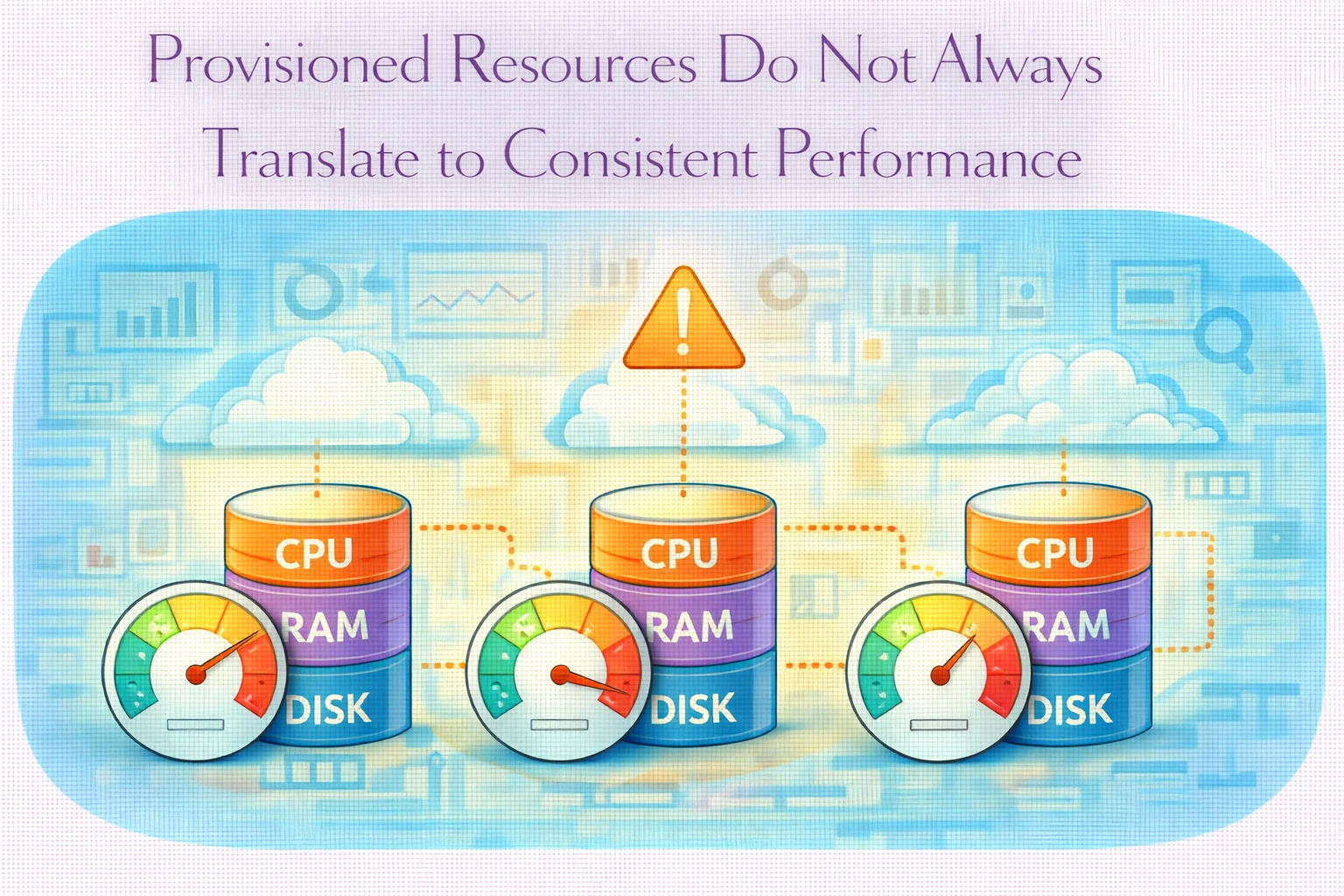
Cloud specifications describe allocated capacity.
VPS and cloud platforms present CPU cores, memory allocation, and storage capacity as quantifiable resources. These metrics help estimate potential workload capability and infrastructure scaling requirements.
However, allocation does not guarantee deterministic performance.
At Wisegigs.eu, infrastructure diagnostics frequently identify environments where provisioned resources appear sufficient, yet latency variability and throughput inconsistency persist. Performance fluctuations often originate from underlying infrastructure dynamics rather than application inefficiency.
Capacity describes potential.
Behavior defines reliability.
Performance stability depends on infrastructure context.
Resource Allocation Does Not Guarantee Deterministic Performance
Virtualization separates workloads from physical hardware.
Hypervisors allocate CPU time, memory access, and storage operations dynamically across multiple tenants. These scheduling mechanisms balance resource utilization efficiency across infrastructure nodes.
As a result, resource availability varies across time intervals.
Provisioned resources represent entitlement, not exclusive access.
Performance becomes probabilistic.
Understanding virtualization behavior improves expectation alignment.
OpenStack architecture documentation describes virtualization resource allocation concepts:
Abstraction introduces variability.
Shared Infrastructure Introduces Contention Variability
Multiple workloads share physical hosts.
Neighboring instances may compete for CPU time, memory bandwidth, and storage throughput. Resource contention introduces variability independent of application configuration.
Common contention scenarios include:
- burst workloads affecting CPU scheduling
- high I/O demand from adjacent instances
- memory pressure affecting allocation timing
- competing network throughput demand
These effects produce intermittent latency spikes.
Shared infrastructure introduces variability patterns.
Consistency requires tolerance for contention dynamics.
AWS documentation discusses shared responsibility and performance variability:
Infrastructure context influences performance stability.
CPU Scheduling Influences Execution Consistency
Hypervisors coordinate CPU scheduling.
Virtual CPUs are mapped to physical cores dynamically. Scheduling algorithms distribute processing time across active workloads.
CPU availability may fluctuate due to:
- host-level scheduling priorities
- concurrent instance demand
- workload burst behavior
- background infrastructure processes
Execution consistency depends on scheduling fairness.
Short-term CPU availability may vary significantly.
CPU allocation does not imply constant execution priority.
Storage Abstraction Affects Latency Stability
Cloud storage relies on distributed architecture.
Network-attached storage behaves differently from local disks.
Data travels through additional infrastructure layers. Therefore, response time includes network latency, replication coordination, and cache synchronization effects.
As a result, storage timing becomes less predictable.
Performance variation commonly appears in:
- slower database queries
- delayed log writes
- inconsistent file upload speed
- variable backup duration
Consequently, storage consistency depends on overall infrastructure conditions rather than disk specifications alone.
I/O latency influences application responsiveness.
Distributed storage improves resilience but introduces variability.
DigitalOcean storage documentation explains network-attached storage behavior:
https://www.digitalocean.com/docs/
Storage abstraction influences response time predictability.
Network Virtualization Introduces Throughput Variation
Virtualized networking abstracts physical connectivity.
Traffic flows through software-defined networking layers that manage routing, segmentation, and bandwidth allocation.
Network throughput may vary due to:
- shared bandwidth utilization
- routing optimization adjustments
- congestion management mechanisms
- load balancing distribution patterns
Network variability affects response time consistency.
Throughput availability fluctuates across intervals.
Network abstraction improves flexibility but introduces variability.
Burst Capacity Does Not Equal Sustained Performance
Burstable resource models allow temporary performance increases.
Some cloud providers offer burstable CPU or I/O credits enabling short-term performance acceleration. Sustained workload demand may exhaust burst capacity, reducing available performance levels.
Burst behavior affects:
- sustained background processes
- batch processing workloads
- queue-based job execution
- analytics computations
Short bursts do not guarantee continuous performance.
Sustained workloads require consistent baseline capacity.
Burst capacity introduces performance variability.
Workload Characteristics Influence Resource Efficiency
Application behavior affects resource utilization.
Compute-heavy, memory-intensive, and I/O-bound workloads interact differently with virtualized infrastructure layers.
Workload sensitivity factors include:
- query complexity
- concurrency levels
- request distribution patterns
- dependency interaction frequency
Workload design influences infrastructure efficiency.
Application characteristics shape performance patterns.
Optimization requires workload awareness.
Observability Reveals Infrastructure Behavior Patterns
Metrics reveal variability sources.
Monitoring CPU utilization patterns, I/O latency distribution, and network throughput trends improves understanding of performance behavior.
Observability signals often reveal:
- recurring latency spikes
- periodic throughput variation
- burst capacity depletion patterns
- contention timing correlation
Visibility improves infrastructure evaluation accuracy.
Measurement supports realistic performance expectations.
Observability improves resource planning discipline.
Hetzner documentation emphasizes monitoring resource utilization:
Measurement improves predictability.
What Reliable VPS Performance Evaluation Prioritizes
Performance evaluation requires behavioral observation.
Reliable infrastructure assessment typically prioritizes:
- long-term workload observation
- latency distribution analysis
- contention pattern identification
- storage latency consistency evaluation
- network throughput variability awareness
- workload-specific performance validation
These practices improve expectation accuracy.
Predictability improves planning reliability.
At Wisegigs.eu, VPS performance evaluation focuses on sustained behavior rather than nominal specifications alone.
Behavior defines infrastructure reliability.
Conclusion
Provisioned resources describe potential capacity.
They do not guarantee consistent performance.
To recap:
- virtualization introduces probabilistic performance behavior
- shared infrastructure creates contention variability
- CPU scheduling affects execution consistency
- storage abstraction influences latency stability
- network virtualization introduces throughput variation
- burst capacity does not ensure sustained performance
- workload characteristics influence resource efficiency
At Wisegigs.eu, reliable VPS and cloud performance emerges from understanding infrastructure behavior patterns rather than relying solely on allocated specifications.
If performance fluctuates despite adequate resource allocation, underlying infrastructure dynamics may require evaluation.
Need help assessing VPS or cloud performance consistency? Contact Wisegigs.eu