
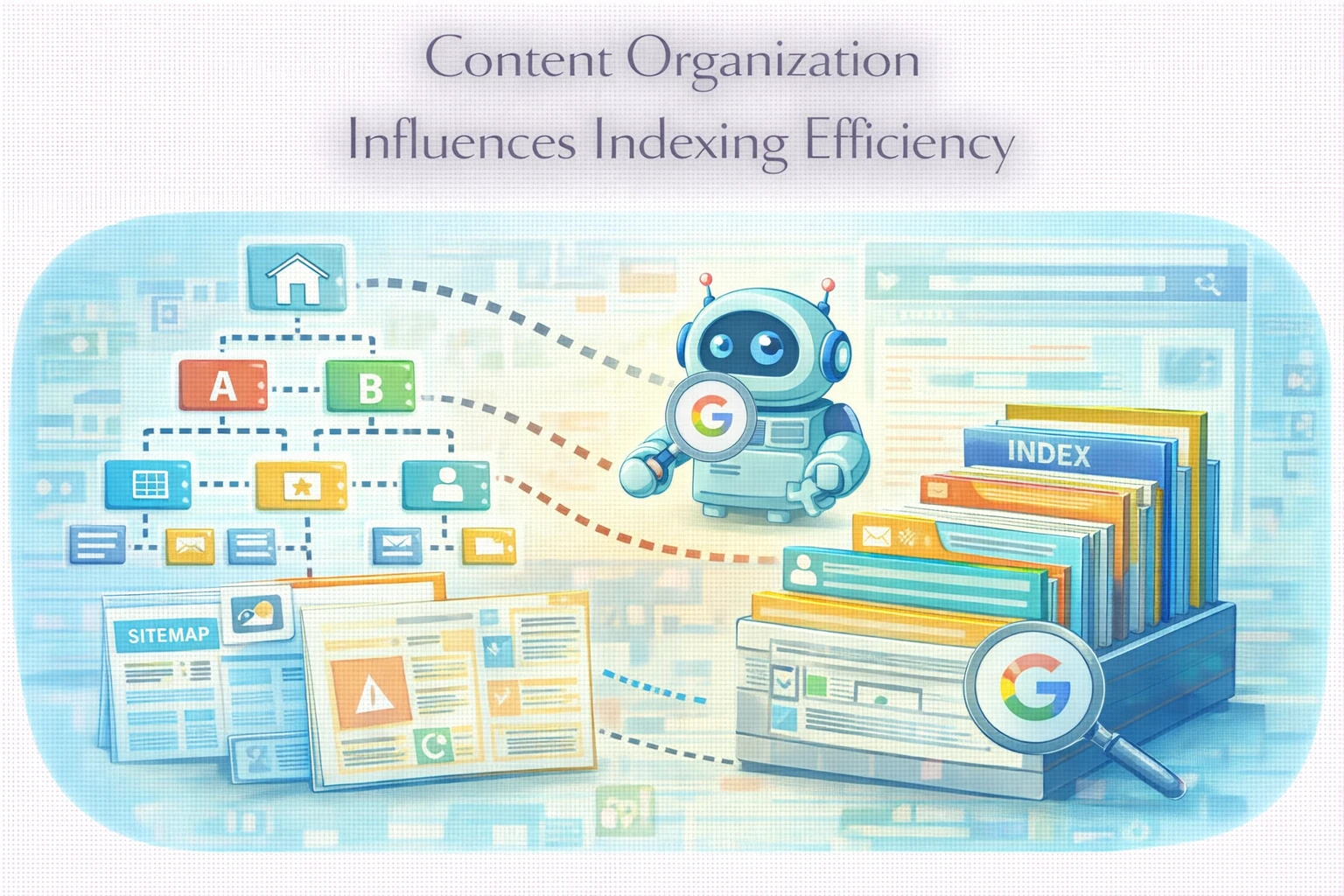
Search engines evaluate structure to interpret meaning.
Content relevance is not determined solely by keyword presence. Instead, search engines analyze relationships between pages, headings, internal links, and semantic signals to determine contextual alignment.
When structure lacks clarity, indexing becomes less efficient.
At Wisegigs.eu, SEO audits frequently identify websites with valuable content that remains under-indexed due to unclear relationships between topics. Content exists, yet search engines struggle to interpret hierarchy or contextual relevance.
Organization improves discoverability.
Clarity improves indexing consistency.
Search Engines Interpret Structural Signals
Search engines process structural indicators.
HTML headings, internal links, schema markup, and contextual relationships define how pages connect conceptually. These signals help search engines determine topic coverage and semantic relevance.
Structural signals include:
- heading hierarchy relationships
- contextual internal linking patterns
- semantic keyword distribution
- topical relevance consistency
When signals align, indexing becomes more predictable.
Google Search documentation emphasizes structured content relationships:
https://developers.google.com/search/docs
Clarity improves interpretation accuracy.
Information Hierarchy Improves Content Understanding
Hierarchy defines importance.
Structured heading relationships help search engines understand primary topics and supporting concepts. Clear hierarchy improves topic segmentation and indexing relevance.
Hierarchy clarity includes:
- logical H1 to H3 structure
- consistent topic segmentation
- supporting content grouped logically
- avoidance of mixed thematic sections
Unclear hierarchy introduces ambiguity.
Ambiguity reduces indexing efficiency.
Clear structure improves content classification.
Internal Linking Defines Topical Relationships
Internal links create contextual pathways.
Search engines use internal linking structures to identify relationships between pages. Linking related content strengthens topical signals and improves crawl pathways.
Effective internal linking typically:
- connects related concepts
- reinforces semantic relevance
- distributes contextual authority
- clarifies content relationships
Disconnected pages weaken contextual clarity.
Connected content improves topical coherence.
Google internal linking recommendations emphasize structured navigation:
https://developers.google.com/search/docs/crawling-indexing/links-crawlable
Relationships improve indexing accuracy.
Content Fragmentation Reduces Context Clarity
Fragmented content weakens semantic signals.
When related topics are distributed inconsistently across pages, search engines may interpret content coverage as incomplete or redundant.
Fragmentation patterns include:
- overlapping topics across multiple pages
- partial topic coverage without supporting context
- inconsistent terminology usage
- disconnected supporting articles
Fragmentation reduces topical confidence.
Search engines prioritize coherent topic coverage.
Structured grouping improves semantic clarity.
URL Structure Influences Indexing Consistency
URL structure communicates relationships.
Logical URL hierarchies help search engines understand relationships between topics and subtopics. Consistent URL patterns improve crawl predictability.
Examples include:
- grouped category structures
- consistent naming conventions
- avoidance of ambiguous URL parameters
- stable hierarchical relationships
Clear URL structure improves crawl efficiency.
Predictable structures improve indexing stability.
Google URL structure recommendations emphasize clarity:
https://developers.google.com/search/docs/crawling-indexing/url-structure
Logical structure improves discoverability.
Duplicate Content Dilutes Relevance Signals
Duplicate content reduces clarity.
When similar content appears across multiple pages, search engines may struggle to determine which page represents authoritative context.
Duplicate content patterns include:
- similar topic coverage across multiple URLs
- parameter-generated duplicate pages
- repeated structural sections across content
- inconsistent canonical signals
Duplicate signals weaken relevance confidence.
Clear canonical structure improves indexing stability.
Consistency improves interpretation accuracy.
Semantic Grouping Improves Topic Recognition
Search engines analyze contextual relationships.
Grouping related topics improves understanding of subject coverage depth. Semantic clustering strengthens relevance signals and improves indexing reliability.
Semantic grouping includes:
- grouping related articles under common themes
- linking supporting content contextually
- maintaining consistent terminology
- aligning supporting content with primary topics
Structured grouping improves topical coherence.
Consistency strengthens semantic interpretation.
Topic clarity improves search visibility.
Technical Structure Supports Crawl Efficiency
Technical accessibility influences indexing.
Search engines must efficiently crawl and interpret page content. Technical structure affects how easily search engines process content relationships.
Key technical factors include:
- sitemap structure clarity
- crawl depth predictability
- internal linking accessibility
- structured metadata availability
Efficient crawl paths improve indexing speed.
Technical clarity improves content discoverability.
What Reliable SEO Structures Prioritize
Effective SEO structures emphasize clarity.
Reliable content architectures typically prioritize:
- logical hierarchy relationships
- consistent internal linking patterns
- semantic grouping of related topics
- clear URL structures
- minimal duplication patterns
- accessible crawl pathways
These practices improve indexing predictability.
At Wisegigs.eu, SEO strategies focus on structural clarity rather than isolated keyword adjustments.
Structure influences visibility.
Conclusion
Content organization influences indexing efficiency.
Search engines interpret relationships between topics.
To recap:
- structural signals guide indexing interpretation
- hierarchy influences topic understanding
- internal linking defines semantic relationships
- fragmented content reduces contextual clarity
- URL structure influences crawl predictability
- duplicate content weakens relevance signals
- semantic grouping improves topic recognition
At Wisegigs.eu, reliable SEO performance results from structured content architecture aligned with search engine interpretation patterns.
If valuable content remains under-indexed, structural clarity may require improvement.
Need help improving SEO structure or content organization? Contact Wisegigs.eu