
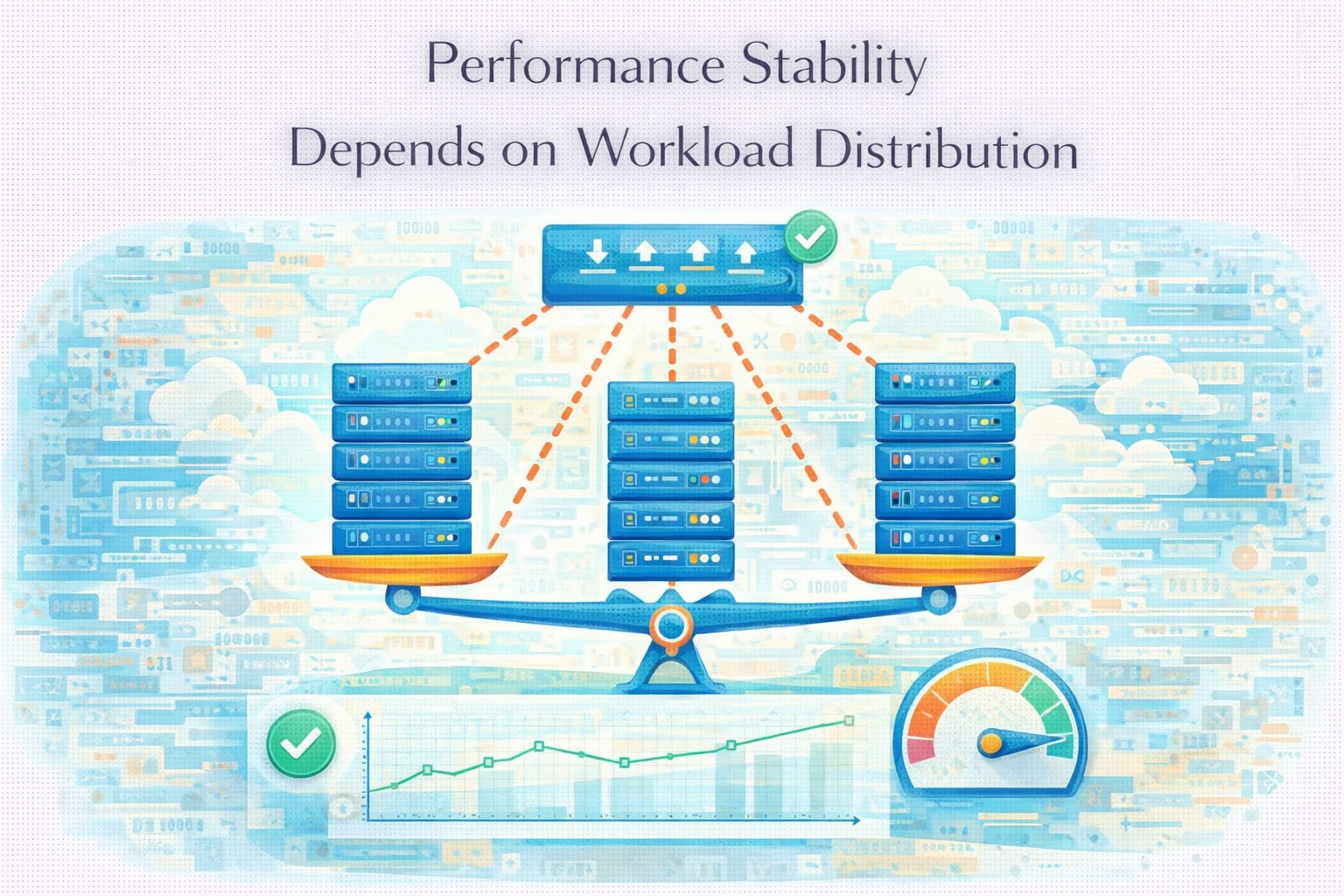
Performance stability depends on workload behavior.
Infrastructure resources such as CPU, memory, and storage provide capacity for application execution. However, capacity alone does not ensure stable performance. The way workloads are distributed across components strongly influences latency consistency and system reliability.
Uneven workload allocation creates instability.
At Wisegigs.eu, performance investigations frequently reveal systems with sufficient hardware resources but inconsistent response times. Despite adequate capacity, localized bottlenecks limit performance predictability.
Distribution patterns shape performance behavior.
Resource quantity alone does not define stability.
Performance Emerges From Workload Patterns
System performance reflects execution flow.
Requests travel through application layers, databases, caches, and external services. Each layer processes a portion of the workload, contributing to total response time.
When workloads are distributed evenly, resources operate efficiently.
When distribution becomes uneven, specific components experience higher demand.
Localized pressure produces latency variability.
Google’s performance documentation emphasizes identifying execution bottlenecks:
Performance reflects execution structure.
Uneven Distribution Creates Resource Bottlenecks
Bottlenecks occur when workload concentration increases.
If specific services receive disproportionate traffic, resource utilization becomes imbalanced. Even when total infrastructure capacity remains sufficient, concentrated demand creates delays.
Common bottleneck scenarios include:
- single database instances handling most queries
- background workers processing disproportionate tasks
- cache layers receiving uneven request patterns
- API endpoints experiencing uneven traffic volume
These imbalances reduce efficiency.
Performance stability requires balanced resource utilization.
Scaling Without Distribution Awareness Reduces Efficiency
Scaling increases resource availability.
However, adding servers does not automatically redistribute workload efficiently. Without structured distribution logic, new resources may remain underutilized while existing components continue experiencing high load.
Examples include:
- additional application servers without database scaling
- increased compute resources without query optimization
- expanded storage without improved access patterns
Scaling without distribution planning increases cost without proportional performance improvement.
Efficiency depends on workload allocation.
Load Balancing Influences System Stability
Load balancing distributes incoming traffic.
Balancers route requests across multiple application nodes, reducing pressure on individual servers. Effective load balancing improves resource utilization and reduces latency spikes.
However, load balancing configuration influences results.
Considerations include:
- session persistence configuration
- request routing algorithms
- health check frequency
- traffic weighting strategies
Improper balancing logic may still produce uneven load.
NGINX documentation describes how load balancing strategies affect traffic distribution:
https://www.nginx.com/resources/glossary/load-balancing/
Balanced routing improves response consistency.
Data Layer Distribution Affects Latency
Databases often represent performance constraints.
While application servers scale horizontally, data layers frequently require careful architecture adjustments. Query concentration on single nodes introduces latency spikes even when application layers remain underutilized.
Common distribution strategies include:
- read replicas for query separation
- caching frequently accessed queries
- partitioning high-volume datasets
- optimizing indexing structures
These approaches improve data access efficiency.
Database performance influences overall system responsiveness.
MariaDB documentation highlights query optimization importance:
https://mariadb.com/kb/en/optimization-and-tuning/
Efficient queries reduce latency variability.
Background Processes Compete for Resources
Scheduled tasks influence workload distribution.
Background jobs such as indexing, email processing, or cache rebuilding consume resources alongside user-facing operations. If scheduling overlaps with peak traffic periods, contention increases.
Typical background processes include:
- search indexing
- log processing
- scheduled synchronization tasks
- batch data imports
Uncoordinated scheduling introduces latency variability.
Workload timing influences performance stability.
Horizontal Scaling Introduces Coordination Overhead
Distributed systems require coordination.
Additional nodes communicate across networks, synchronize state, and manage shared resources. These coordination requirements introduce latency components independent of application logic.
Coordination overhead includes:
- cache synchronization
- session persistence management
- distributed locking mechanisms
- state replication processes
Distributed coordination affects response time predictability.
Scaling changes workload dynamics.
Cloud architecture documentation explains coordination trade-offs:
https://aws.amazon.com/architecture/
Distribution influences latency patterns.
Observability Reveals Distribution Imbalances
Monitoring exposes workload patterns.
Metrics reveal how requests distribute across services and infrastructure layers. Observability tools identify resource hotspots and uneven utilization patterns.
Useful indicators include:
- request distribution across nodes
- database query latency distribution
- cache hit ratio consistency
- background job execution timing
These signals reveal structural imbalances.
Visibility supports corrective adjustments.
At Wisegigs.eu, performance diagnostics prioritize identifying distribution bottlenecks before expanding infrastructure capacity.
Measurement informs optimization decisions.
What Reliable Scaling Strategies Prioritize
Stable performance requires distribution awareness.
Effective scaling strategies typically prioritize:
- balanced request routing
- query load distribution
- controlled background task scheduling
- caching strategies aligned with access patterns
- continuous monitoring of workload behavior
These practices improve resource utilization consistency.
At Wisegigs.eu, infrastructure scaling focuses on workload alignment rather than capacity expansion alone.
Balanced systems improve predictability.
Conclusion
Performance stability depends on workload structure.
Adding resources increases capacity.
However, distribution determines efficiency.
To recap:
- performance emerges from workload patterns
- uneven distribution creates bottlenecks
- scaling without distribution awareness reduces efficiency
- load balancing influences response consistency
- data layer distribution affects latency
- background processes compete for resources
- coordination overhead influences distributed systems
At Wisegigs.eu, reliable performance improvements result from balanced workload distribution, efficient resource utilization, and continuous observability.
If infrastructure scaling fails to stabilize performance, workload imbalance may be the underlying constraint.
Need help analyzing workload distribution or scaling infrastructure efficiently? Contact Wisegigs.eu