
Caching improves performance.
Applications reduce repeated computation by storing previously generated results. Databases handle fewer queries. Response times decrease. Consequently, caching is often implemented early in optimization efforts.
However, caching also changes system behavior.
At Wisegigs.eu, performance audits frequently reveal systems where aggressive caching improves speed temporarily but introduces reliability issues. Data becomes inconsistent. Updates fail to propagate. Debugging becomes significantly more complex.
These outcomes are predictable.
Caching trades computation cost for state management complexity.
Caching Is Often Treated as a Universal Solution
Performance problems trigger immediate responses.
When systems slow down, teams frequently introduce caching layers without fully diagnosing bottlenecks. Because caching produces visible improvements, it becomes a default optimization strategy.
However, caching does not eliminate underlying inefficiencies.
Slow queries remain slow.
Inefficient logic remains inefficient.
Instead, caching hides these problems temporarily.
Consequently, systems may appear fast while structural issues persist.
Caching Changes System Behavior
Caching introduces state.
Instead of computing results dynamically, systems return stored responses. This shift alters how data flows through the application.
Requests no longer reflect real-time data.
Responses depend on cache state, expiration rules, and invalidation logic. Therefore, application behavior becomes dependent on caching configuration rather than pure execution logic.
This transformation introduces new failure modes.
Stale Data Introduces Consistency Problems
Cached data may become outdated.
When underlying data changes, cached responses may not update immediately. As a result, users may see inconsistent information across requests.
Common scenarios include:
outdated product pricing
delayed content updates
inconsistent user session data
mismatched inventory status
These inconsistencies reduce system reliability.
Users expect accuracy, not just speed.
Cache Invalidation Becomes a Primary Risk
Cache invalidation determines correctness.
When data changes, the system must decide when and how to refresh cached values. Incorrect invalidation strategies lead to stale data or unnecessary recomputation.
This problem is widely recognized.
Cache invalidation is often described as one of the hardest problems in computer science.
Effective invalidation strategies require:
precise dependency tracking
event-driven cache updates
controlled expiration policies
clear data ownership boundaries
Without these mechanisms, caching introduces unpredictable behavior.
Redis documentation discusses cache consistency considerations:
Multiple Cache Layers Increase Complexity
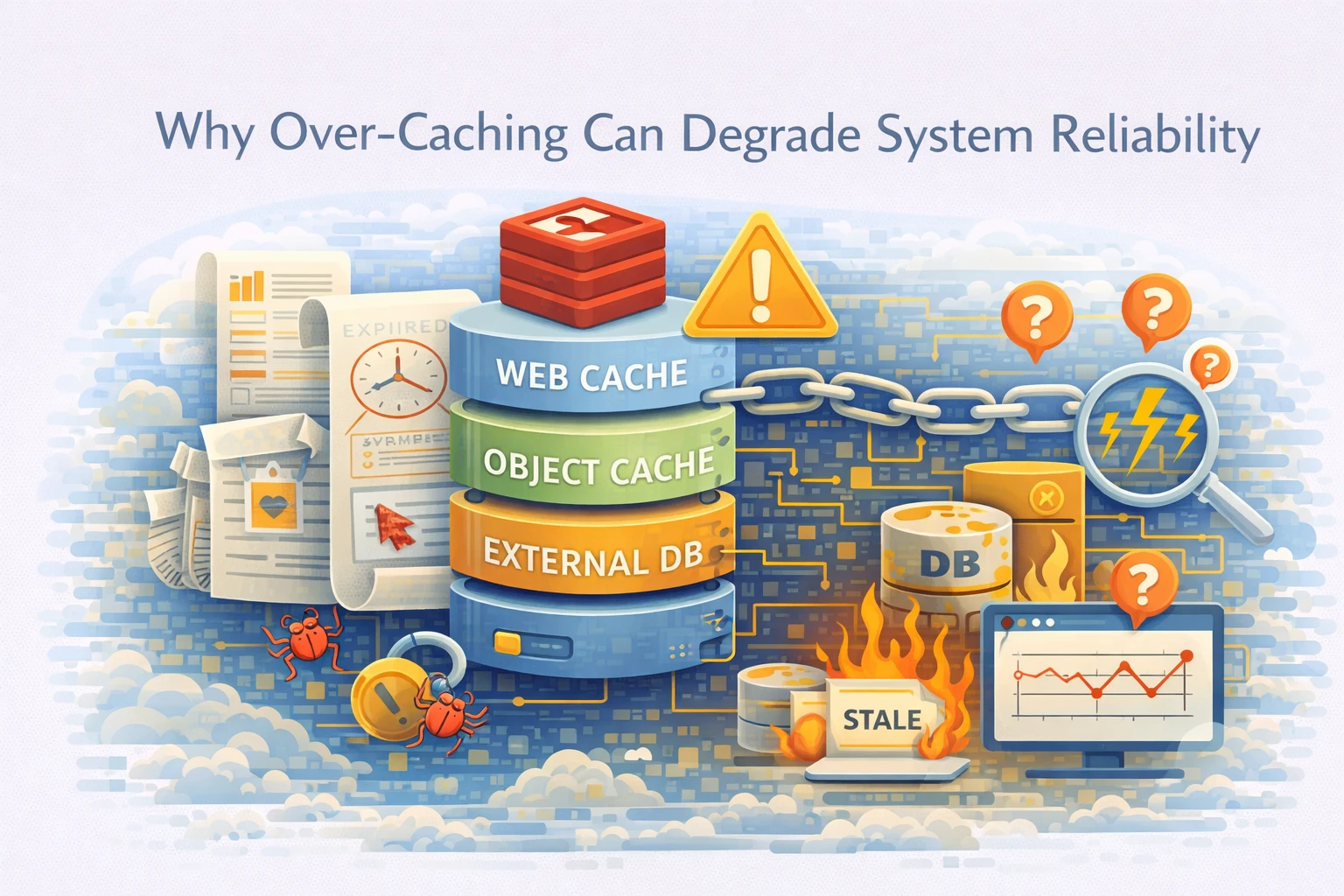
Modern systems often use multiple caching layers.
These may include:
application-level caching
object caching (Redis or Memcached)
full-page caching
CDN edge caching
Each layer operates independently.
Consequently, data may exist in multiple states simultaneously. Synchronizing these layers becomes complex.
For example:
CDN cache may serve outdated content
object cache may conflict with database state
application cache may override recent updates
This layered architecture increases coordination overhead.
Debugging Becomes More Difficult
Caching complicates debugging.
When issues arise, developers must determine whether problems originate from application logic or cache behavior. Reproducing bugs becomes difficult because cached responses may differ across environments.
Typical debugging challenges include:
inconsistent test results
difficulty reproducing stale data issues
hidden dependencies between cache layers
environment-specific behavior
These factors increase troubleshooting time.
Systems become harder to reason about.
Performance Gains Can Be Misleading
Caching improves perceived performance.
However, improvements may mask underlying inefficiencies. Systems appear fast under normal conditions but fail under specific scenarios.
For example:
cache misses trigger slow database queries
high traffic invalidates cache frequently
cache warm-up delays affect initial requests
In these cases, performance becomes inconsistent.
Average response time improves.
Worst-case latency remains problematic.
Therefore, caching may hide rather than solve performance issues.
Observability Is Required for Safe Caching
Caching requires visibility.
Without observability, teams cannot evaluate cache effectiveness or detect consistency issues. Monitoring systems must track both performance and correctness.
Key metrics include:
cache hit rate
cache miss latency
invalidation frequency
data freshness indicators
error rates related to stale data
These signals help identify whether caching improves or degrades system behavior.
At Wisegigs.eu, caching strategies always include monitoring and validation mechanisms.
Visibility ensures reliability.
What Reliable Caching Strategies Prioritize
Effective caching requires discipline.
Reliable systems typically prioritize:
identifying bottlenecks before caching
limiting caching scope to appropriate data
designing clear invalidation strategies
minimizing overlapping cache layers
monitoring cache behavior continuously
validating data consistency regularly
These practices balance performance improvements with system reliability.
Caching should support architecture, not replace it.
Conclusion
Caching improves performance.
However, excessive caching introduces complexity.
To recap:
caching does not remove underlying inefficiencies
it changes system behavior by introducing state
stale data creates consistency issues
invalidation becomes a critical challenge
multiple cache layers increase coordination complexity
debugging becomes more difficult
performance gains may hide deeper problems
observability is required for safe implementation
At Wisegigs.eu, reliable performance optimization begins with system analysis, controlled caching strategies, and continuous monitoring.
If your system feels fast but behaves inconsistently, over-caching may be the underlying cause.
Need help diagnosing caching or performance issues? Contact Wisegigs.eu