
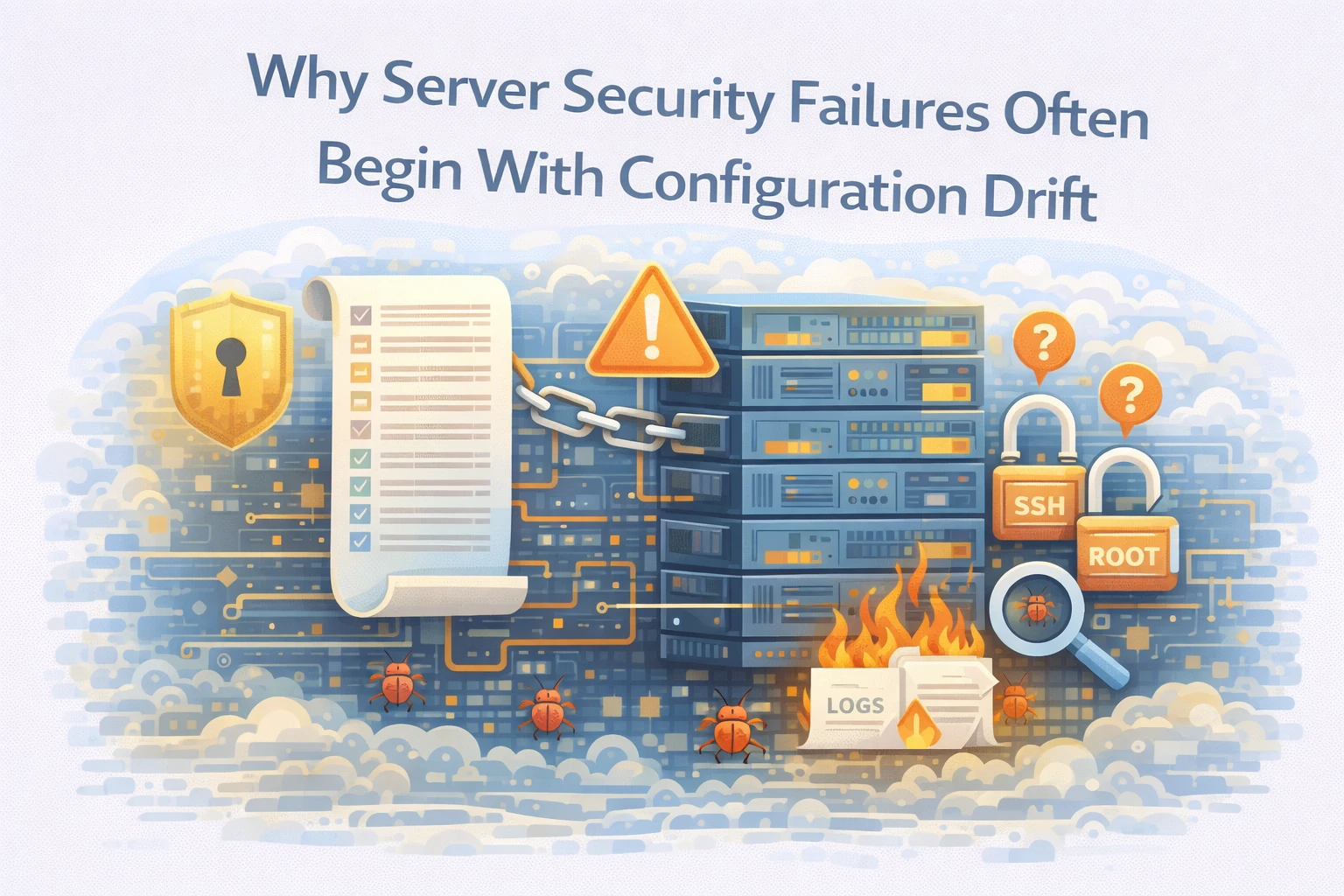
Server security failures rarely appear suddenly.
Most infrastructure breaches occur after gradual configuration changes weaken the original security baseline. Small operational adjustments accumulate over time, eventually creating gaps that attackers can exploit.
Because these changes happen incrementally, they often go unnoticed.
At Wisegigs.eu, infrastructure audits frequently reveal servers that were initially configured securely but slowly diverged from best practices. New services were added, permissions expanded, or temporary debugging access remained active.
Each modification appeared harmless.
However, together they created measurable security exposure.
Server Security Depends on Configuration Consistency
Secure server environments rely on predictable configuration states.
Firewall rules, user permissions, network policies, and service configurations must remain consistent to maintain a stable security posture. When these settings change frequently without documentation, visibility declines.
Configuration consistency allows teams to answer critical questions:
which services are exposed publicly
which users have administrative privileges
which ports remain accessible
which processes interact with sensitive data
Without consistent configurations, these answers become uncertain.
Security therefore depends on operational discipline.
Infrastructure Drift Gradually Weakens Security Posture
Configuration drift occurs when systems deviate from their intended configuration baseline.
This phenomenon often appears in environments managed manually. Administrators apply quick fixes, modify settings during troubleshooting, or install temporary tools without documenting changes.
Over time, these adjustments accumulate.
Examples include:
additional open ports left active
outdated packages remaining installed
temporary administrative users never removed
debug services exposed to public networks
Each deviation slightly increases the attack surface.
Collectively, they create significant vulnerability.
Default Configurations Rarely Remain Secure Over Time
Many servers begin with reasonable default settings.
Operating systems and hosting providers often include basic security protections such as firewalls, SSH restrictions, and secure package repositories. However, these defaults rarely remain sufficient as environments evolve.
New applications introduce additional requirements.
Services may require open ports. Monitoring tools may require additional access privileges. Third-party integrations may require API connectivity.
Without careful review, these changes weaken the original configuration baseline.
The Center for Internet Security (CIS) publishes widely adopted configuration benchmarks that illustrate this principle:
Regular configuration reviews therefore remain essential.
Patch Management Alone Does Not Guarantee Security
Many organizations focus heavily on software updates.
Keeping operating systems and applications patched is essential for security. However, patch management addresses only one dimension of infrastructure protection.
Configuration errors can still expose systems.
For example:
exposed administrative interfaces
weak authentication policies
excessive file permissions
public storage directories
Even fully patched systems remain vulnerable when configurations are mismanaged.
Security therefore requires both updates and configuration discipline.
Access Control Policies Often Degrade Over Time
User access control frequently changes during operational growth.
New developers join teams. Temporary contractors require access. Support engineers request elevated privileges to troubleshoot issues.
If access policies are not reviewed regularly, permissions accumulate.
Typical problems include:
unused accounts remaining active
shared administrative credentials
excessive root privileges
inconsistent SSH access policies
These issues expand the number of potential entry points.
Least privilege principles help reduce this exposure.
NIST security guidance emphasizes minimizing unnecessary access rights:
Monitoring and Logging Reveal Security Anomalies
Observability plays an important role in security.
Logs, authentication records, and network traffic analysis reveal unexpected behavior that may indicate configuration weaknesses or attempted intrusions.
Effective monitoring strategies include:
centralized log aggregation
authentication event tracking
anomaly detection for network traffic
audit trails for configuration changes
Without monitoring systems, early warning signals may go unnoticed.
Security incidents often remain invisible until damage occurs.
Compliance Frameworks Encourage Configuration Discipline
Security compliance frameworks promote structured configuration management.
Standards such as ISO 27001 or SOC 2 require organizations to document infrastructure settings, track configuration changes, and maintain access control policies.
These frameworks serve two purposes.
They reduce operational risk while improving auditability.
Although compliance does not guarantee perfect security, it introduces processes that prevent uncontrolled infrastructure drift.
Compliance guidelines also encourage consistent documentation and change tracking.
Infrastructure Automation Reduces Configuration Drift
Automation improves configuration consistency.
Infrastructure-as-Code (IaC) tools allow teams to define server configurations programmatically. Instead of modifying systems manually, engineers deploy standardized infrastructure templates.
Benefits include:
repeatable infrastructure environments
version-controlled configuration changes
automated deployment processes
simplified rollback procedures
These practices reduce the risk of undocumented configuration changes.
Tools such as Terraform and Ansible support this model:
Automation therefore strengthens long-term infrastructure security.
What Reliable Server Security Practices Prioritize
Stable hosting environments follow structured operational practices.
Effective infrastructure security strategies usually include:
documented configuration baselines
automated infrastructure provisioning
strict access control policies
centralized logging and monitoring
routine configuration audits
continuous patch management
At Wisegigs.eu, server security projects focus on maintaining configuration consistency rather than relying solely on reactive fixes.
Operational discipline prevents many security failures.
Conclusion
Server security failures rarely occur instantly.
Instead, they emerge gradually as configuration changes accumulate.
To recap:
consistent configuration states support security
infrastructure drift weakens protection over time
default settings rarely remain sufficient
patching alone does not guarantee safety
access control policies require regular review
monitoring reveals early warning signals
compliance frameworks encourage discipline
automation reduces configuration drift
At Wisegigs.eu, secure hosting environments emerge from disciplined infrastructure management, continuous monitoring, and automated configuration control.
If your server security posture feels uncertain, configuration drift may be the hidden cause.
Need help auditing or securing your hosting infrastructure? Contact Wisegigs.eu