
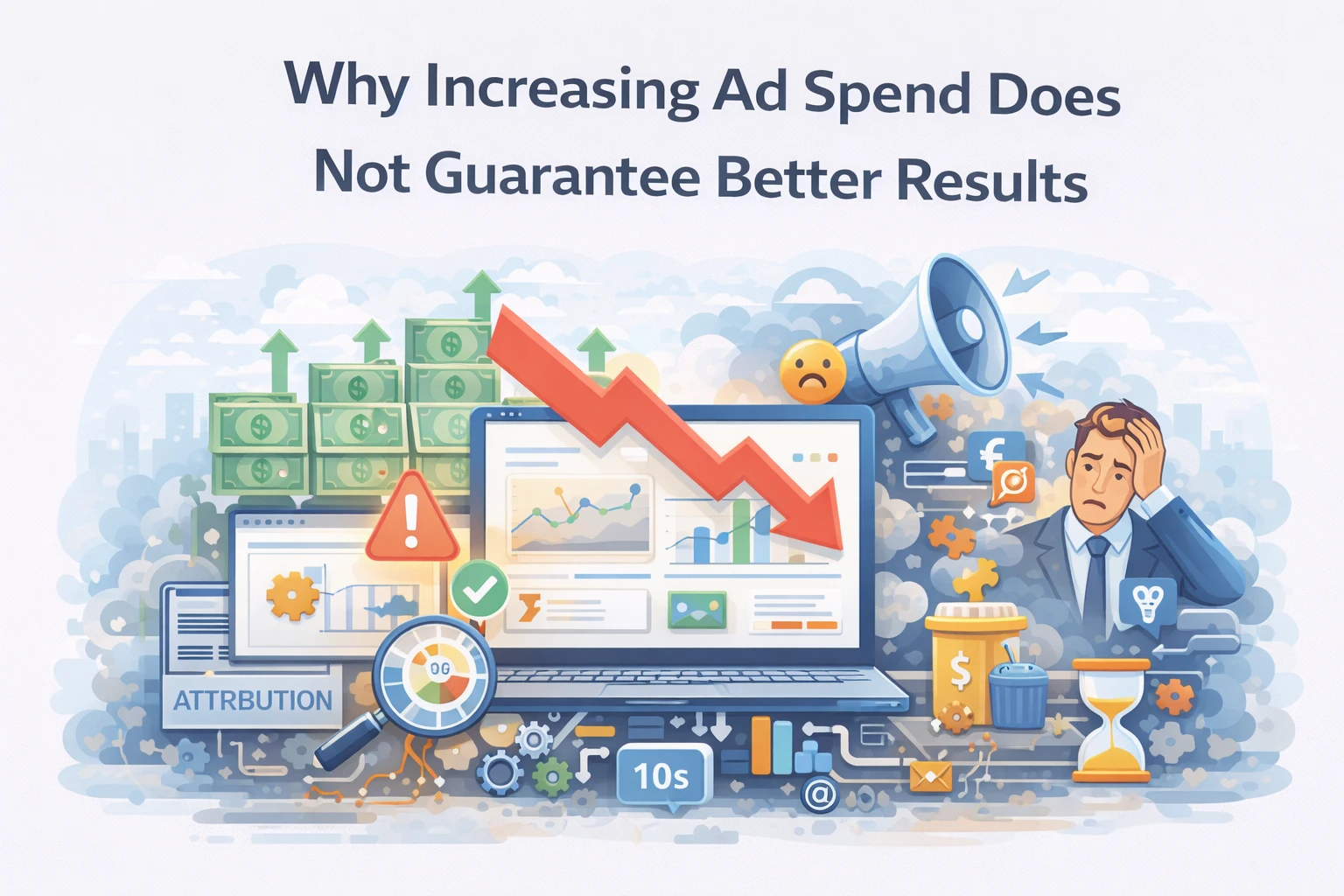
Paid media offers immediate traffic acquisition.
Advertising platforms allow marketers to expand reach quickly by increasing campaign budgets. Because the relationship between budget and impressions appears direct, many teams assume higher spending automatically produces better outcomes.
However, this assumption rarely holds.
At Wisegigs.eu, paid media audits frequently reveal campaigns where increased spending produces diminishing returns. Although impressions rise and traffic increases, conversions stagnate or decline.
This pattern is not unusual.
Paid media systems operate within market constraints.
Budget Expansion Is Often Treated as a Growth Strategy
Scaling budgets appears straightforward.
Advertisers increase daily limits, expand targeting ranges, or introduce additional campaigns. As a result, platforms deliver more impressions and traffic.
However, budget expansion alone does not improve campaign quality.
If targeting, messaging, or landing experiences remain unchanged, additional traffic simply repeats existing performance patterns.
Consequently, inefficiencies scale alongside spending.
Audience Saturation Limits Campaign Efficiency
Digital advertising relies on audience targeting.
Initially, campaigns reach the most relevant users within a defined segment. These individuals are more likely to engage or convert. As campaigns scale, platforms gradually expand delivery to less relevant users.
This process introduces diminishing efficiency.
High-intent users convert first.
Lower-intent users convert less frequently.
Eventually, additional budget primarily reaches audiences with weaker purchase intent.
Auction Dynamics Change as Spend Increases
Ad platforms operate through auctions.
Advertisers compete for impressions within specific audience segments. When campaigns increase bids or expand budgets, they often enter more competitive auctions.
Consequently, acquisition costs increase.
Higher bids attract additional impressions but may also increase cost-per-click or cost-per-thousand impressions. Therefore, budget expansion can raise costs without improving outcomes.
Google Ads documentation explains auction mechanics in detail:
https://support.google.com/google-ads/
Conversion Infrastructure Determines Paid Performance
Paid media performance depends heavily on post-click experience.
If landing pages fail to communicate value clearly or introduce friction during conversion, additional traffic will not improve results.
Common infrastructure issues include:
Slow landing page performance
Unclear value propositions
Complex form processes
Weak trust signals
Mobile usability problems
Under these conditions, scaling traffic amplifies conversion inefficiencies.
Google’s performance guidance consistently highlights landing experience importance:
Attribution Models Influence Budget Decisions
Campaign performance depends on attribution models.
Different models assign conversion credit differently. As a result, marketers may increase spending on channels that appear profitable but actually contribute less to the conversion journey.
For example:
Last-click attribution favors closing channels
First-touch attribution favors acquisition channels
Data-driven attribution distributes credit algorithmically
Each model produces different interpretations of campaign performance.
Therefore, inaccurate attribution can lead to misguided scaling decisions.
Google’s attribution model documentation provides detailed explanations:
https://support.google.com/google-ads/answer/6259715
Creative Fatigue Reduces Campaign Effectiveness
Advertising creatives influence engagement.
Over time, repeated exposure reduces user responsiveness. Audiences become familiar with messaging and ignore ads they have already seen.
This phenomenon is known as creative fatigue.
As campaigns scale, frequency often increases. Consequently, engagement rates decline and costs rise.
Creative rotation and testing become essential to maintain performance.
Scaling Amplifies Structural Weaknesses
Increasing budget magnifies existing system behavior.
If campaigns perform well structurally, scaling can produce predictable growth. However, if targeting, tracking, or landing experience contains weaknesses, increased spend amplifies those problems.
Examples include:
Misaligned audience targeting
Incomplete conversion tracking
Inefficient bidding strategies
Poor landing page relevance
Under these conditions, budget expansion accelerates inefficiency rather than growth.
Measurement Discipline Determines Optimization Quality
Reliable measurement enables effective optimization.
Without accurate tracking, campaign metrics become misleading. Marketers may attribute success to channels that generate traffic but not revenue.
Effective paid media measurement requires:
Validated conversion tracking
Consistent event definitions
Clear attribution modeling
Segment-level performance analysis
Cross-channel performance evaluation
Accurate data allows teams to adjust campaigns intelligently.
Without measurement discipline, budget increases become speculative.
What Reliable Paid Media Scaling Requires
Successful scaling depends on structural readiness.
Effective campaigns typically demonstrate:
Consistent conversion performance
Clear audience targeting
Stable landing page conversion rates
Reliable attribution models
Creative testing processes
Validated tracking infrastructure
Only when these foundations exist should budgets expand.
At Wisegigs.eu, paid media optimization focuses on performance architecture before scaling decisions.
Infrastructure determines campaign sustainability.
Conclusion
Increasing ad spend expands reach.
It does not guarantee improved results.
To recap:
Budget expansion alone does not improve campaign quality
Audience saturation reduces efficiency
Auction dynamics increase acquisition costs
Conversion infrastructure shapes outcomes
Attribution models influence scaling decisions
Creative fatigue reduces engagement
Scaling amplifies structural weaknesses
Measurement discipline enables optimization
At Wisegigs.eu, sustainable paid media growth emerges from strong measurement systems, optimized conversion infrastructure, and disciplined campaign analysis.
If increasing ad budgets fails to improve performance, the constraint likely exists within campaign structure rather than budget size.
Need help diagnosing paid media performance issues? Contact Wisegigs.eu