
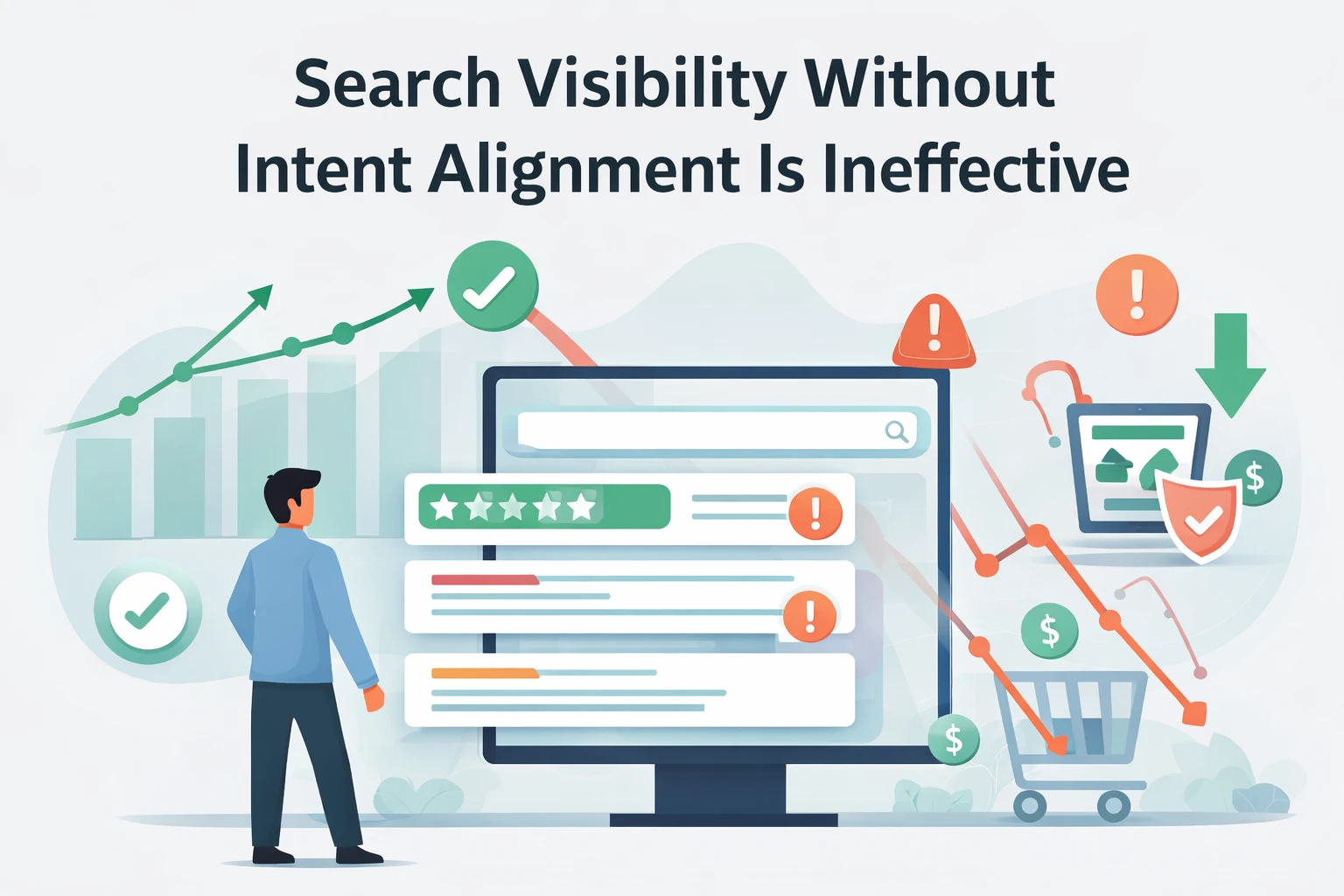
Search visibility is widely treated as success.
Higher rankings, stronger impressions, and traffic growth often become primary objectives in SEO initiatives. Because these metrics are easy to measure, they frequently dominate reporting and decision-making.
However, visibility alone does not produce business outcomes.
At Wisegigs.eu, SEO investigations repeatedly reveal websites with strong rankings yet weak performance indicators. Despite consistent traffic acquisition, engagement remains shallow, conversions stagnate, and revenue impact remains limited.
This outcome is not unusual.
Search engines optimize relevance.
Businesses depend on intent.
Visibility Metrics Frequently Create False Confidence
SEO dashboards emphasize exposure indicators.
Impressions rise. Click-through rates fluctuate. Positions improve. Consequently, these signals often suggest progress and reinforce existing strategies.
Yet exposure metrics describe opportunity rather than effectiveness.
Users arriving on a page do not guarantee users prepared to act.
Similarly, traffic growth does not ensure behavioral alignment.
Visibility measures reach.
Performance depends on motivation.
Google’s Search documentation consistently separates ranking from satisfaction:
https://developers.google.com/search
Rankings Do Not Define User Motivation
Search position influences discovery.
It does not determine intent.
Visitors arrive with different objectives. Some seek information. Others evaluate alternatives. Many validate decisions. Only a subset exhibits transactional readiness.
Therefore, identical keywords may represent entirely different expectations.
User behavior reflects underlying goals rather than SERP placement alone.
Intent Mismatch Produces Predictable Underperformance
Intent mismatch introduces structural friction.
Users searching for education encounter aggressive sales flows.
Conversely, users seeking solutions encounter generalized content.
Meanwhile, purchase-ready visitors encounter exploratory material.
Each misalignment increases abandonment probability.
Importantly, content quality may remain high while performance declines.
Relevance to intent, not polish, governs outcomes.
Traffic Quality Dominates Outcome Quality
Not all traffic carries equal value.
High volumes of low-intent visitors rarely produce sustainable gains. In contrast, smaller volumes of intent-aligned users frequently outperform larger audiences.
Consequently, engagement metrics require contextual interpretation.
Increased sessions may coexist with stagnant conversions.
Reduced sessions may accompany improved revenue efficiency.
Outcome quality reflects audience alignment rather than visit count.
Keyword Strategy Without Behavioral Context Fails
Keyword selection often prioritizes volume metrics.
While useful, these indicators do not describe user objectives. Popular queries frequently combine heterogeneous intent categories, which complicates interpretation.
Behavioral context therefore becomes critical.
What problem does the query represent?
Which decision stage does it reflect?
What expectation accompanies the click?
Without these considerations, keyword optimization becomes mechanically correct yet strategically ineffective.
Ahrefs’ research repeatedly emphasizes intent modeling:
Search Engines Optimize Relevance, Not Business Value
Search algorithms maximize perceived usefulness.
They do not optimize for revenue, leads, or conversions. Consequently, ranking success does not automatically translate into business success.
A page may satisfy informational queries efficiently while generating negligible commercial impact.
This divergence explains many SEO paradoxes.
Strong visibility.
Weak performance.
Conversion Friction Frequently Emerges Before Page Interaction
User expectations develop during search behavior.
Titles, snippets, and perceived relevance shape interpretation before any page loads. When the landing experience diverges from those expectations, friction appears immediately.
Importantly, this breakdown occurs prior to interface evaluation.
Consequently, conversion barriers often originate from expectation misalignment rather than visual or usability defects.
Why SEO Wins Fail to Translate Into Revenue
Ranking improvements frequently trigger optimism.
Traffic increases appear to validate strategy. However, revenue impact often lags or fails to materialize entirely.
Several structural causes repeatedly appear:
Informational traffic dominating commercial pages
Misaligned content hierarchy
Weak value proposition clarity
Decision-stage mismatch
Trust or credibility gaps
Therefore, SEO success metrics require business-context validation.
Moz’s SEO research frequently highlights this discrepancy:
What Intent-Aligned SEO & Content Prioritize
Effective SEO strategies incorporate behavioral alignment.
Clarify dominant user intents
Map queries to decision stages
Align content structure with expectations
Optimize for task completion rather than visits
Evaluate traffic quality, not volume alone
Continuously validate assumptions
At Wisegigs.eu, SEO decisions follow intent modeling rather than keyword metrics alone.
Relevance governs visibility.
Intent governs value.
Conclusion
Search visibility expands reach.
It does not guarantee effectiveness.
To recap:
Rankings do not define motivation
Intent mismatch produces abandonment
Traffic quality dominates outcomes
Keyword metrics lack behavioral context
Search engines optimize relevance, not revenue
Expectations shape engagement before landing
SEO wins may mask structural weaknesses
At Wisegigs.eu, sustainable SEO performance emerges from aligning visibility with user intent, decision psychology, and business objectives.
If rankings improved while results stagnated, the dominant constraint likely exists within intent alignment rather than search position.
Need help diagnosing SEO performance issues? Contact Wisegigs.eu