
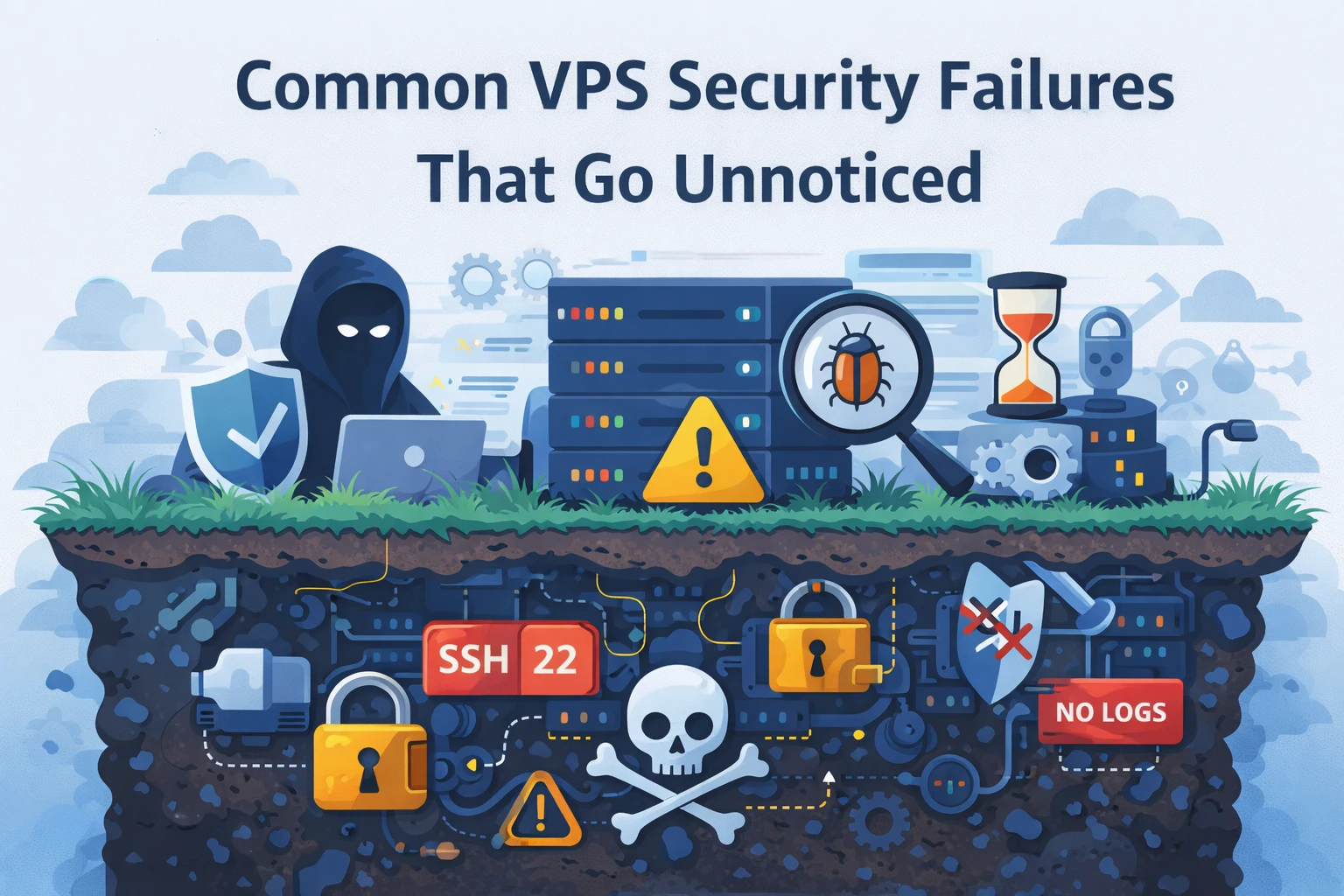
VPS deployments often project a false sense of safety.
Systems boot correctly. Services respond. Resource utilization appears normal. From an operational perspective, nothing seems wrong. Because no visible malfunction occurs, many environments are assumed secure by default.
However, security failures rarely manifest as obvious breakage.
At Wisegigs.eu, infrastructure audits routinely uncover VPS instances with critical exposure despite stable runtime behavior. Servers function exactly as configured while simultaneously presenting elevated compromise risk.
This outcome is structurally predictable.
Security weaknesses typically emerge from configuration decisions rather than catastrophic errors.
VPS Security Problems Rarely Announce Themselves
Compromised systems do not always fail loudly.
Unauthorized access, credential harvesting, or lateral movement may proceed without triggering immediate service disruption. Attackers frequently prefer persistence and stealth over destructive behavior.
Consequently, administrators may equate uptime with safety.
Operational stability does not imply defensive integrity.
Systems can remain responsive while actively vulnerable.
Security posture requires explicit verification.
Default Configurations Create Invisible Risk
Many VPS instances begin with minimal hardening.
Default OS images prioritize accessibility and compatibility. Security controls, by contrast, often require deliberate adjustment. Without intervention, baseline configurations expose predictable weaknesses.
Common examples include:
Unrestricted service exposure
Permissive firewall states
Enabled but unused services
Weak SSH policies
These conditions do not generate visible warnings.
They silently expand attack surface.
Ubuntu’s security documentation repeatedly emphasizes post-deployment hardening:
Defaults optimize convenience, not resilience.
Exposed Services Expand Attack Surface
Unnecessary listening services introduce avoidable risk.
Database ports, administrative panels, development endpoints, and debugging interfaces frequently remain publicly accessible. Each exposed service becomes a potential entry point.
Importantly, exposure does not require misbehavior.
A perfectly functioning service may still be exploitable.
Attack feasibility depends on visibility and accessibility.
Reducing surface area remains one of the most effective controls.
NGINX security guidance reflects this principle clearly:
https://nginx.org/en/security_advisories.html
Patch Gaps Accumulate Quietly
Unpatched systems degrade defensively over time.
Known vulnerabilities persist until remediation occurs. Because many exploits target documented weaknesses, patch delays directly increase compromise probability.
Patch gaps rarely produce immediate operational symptoms.
Services continue running.
Performance remains unaffected.
Risk silently compounds.
Vendor security advisories consistently highlight the importance of timely updates:
https://www.cisa.gov/known-exploited-vulnerabilities-catalog
Unpatched does not mean broken.
It means exposed.
Weak Authentication Remains a Dominant Failure
Credential security remains a primary breach vector.
Password reuse, weak keys, disabled multi-factor controls, and permissive login policies significantly lower attack cost. Automated scanning systems continuously probe for these weaknesses.
Successful intrusion often requires no exploit development.
Only credential compromise or brute-force success.
OpenSSH hardening guidance emphasizes restrictive policies and key management:
https://www.openssh.com/manual.html
Authentication failures are rarely dramatic.
They are simply effective.
Firewall Presence Does Not Equal Protection
Firewalls are widely deployed yet frequently misunderstood.
Rulesets may be overly permissive, inconsistently applied, or misaligned with service requirements. In some cases, administrators assume firewall existence alone guarantees safety.
Configuration quality determines effectiveness.
Improper rules may allow unnecessary access.
Overly broad allowances negate segmentation benefits.
Correctness matters more than presence.
Cloudflare’s security learning resources discuss layered defenses extensively:
https://www.cloudflare.com/learning/security/
Misplaced Trust in Provider-Level Security
Hosting providers secure infrastructure boundaries.
They do not secure guest operating systems or application configurations. Responsibility for instance-level security remains with operators.
This distinction is commonly overlooked.
Provider-managed hardware protections do not prevent:
Weak credentials
Service misconfiguration
Unpatched software
Application vulnerabilities
Shared responsibility models require explicit understanding.
AWS documentation articulates these boundaries clearly:
Assumptions create exposure.
Logging and Monitoring Are Commonly Neglected
Visibility defines detection capability.
Without adequate logs, anomaly detection, or alerting mechanisms, unauthorized activity may remain unnoticed indefinitely. Many VPS environments lack sufficient observability to identify compromise indicators.
Security failures often persist undetected because:
Logs are incomplete
Retention windows are short
Monitoring is absent
Alerts are misconfigured
Detection requires deliberate instrumentation.
Automation Changes Attack Dynamics
Modern attacks rely heavily on automation.
Bots continuously scan IP ranges, enumerate services, test credentials, and identify vulnerable targets. Exposure windows shrink dramatically under automated reconnaissance conditions.
Weak configurations are discovered rapidly.
Attackers no longer require manual probing.
Discovery is systematic and persistent.
This reality reshapes defensive requirements.
What Reliable VPS Security Practices Prioritize
Stable VPS security depends on disciplined configuration and verification.
Effective practices include:
Minimizing exposed services
Enforcing strong authentication controls
Maintaining patch hygiene
Designing restrictive firewall rules
Implementing logging and monitoring
Validating assumptions continuously
At Wisegigs.eu, VPS security is treated as an operational process rather than a static setup task.
Security posture evolves with system state.
Conclusion
VPS security failures are rarely exotic.
They are typically structural and preventable.
To recap:
Operational stability does not guarantee security
Default configurations introduce silent risk
Exposed services expand attack surface
Patch delays accumulate vulnerabilities
Weak authentication remains dangerous
Firewall correctness is critical
Provider security has defined limits
Visibility governs detection
At Wisegigs.eu, resilient hosting environments emerge from deliberate hardening, continuous validation, and realistic threat modeling.
If your VPS appears healthy yet has never undergone structured security review, unnoticed failures may already exist.