
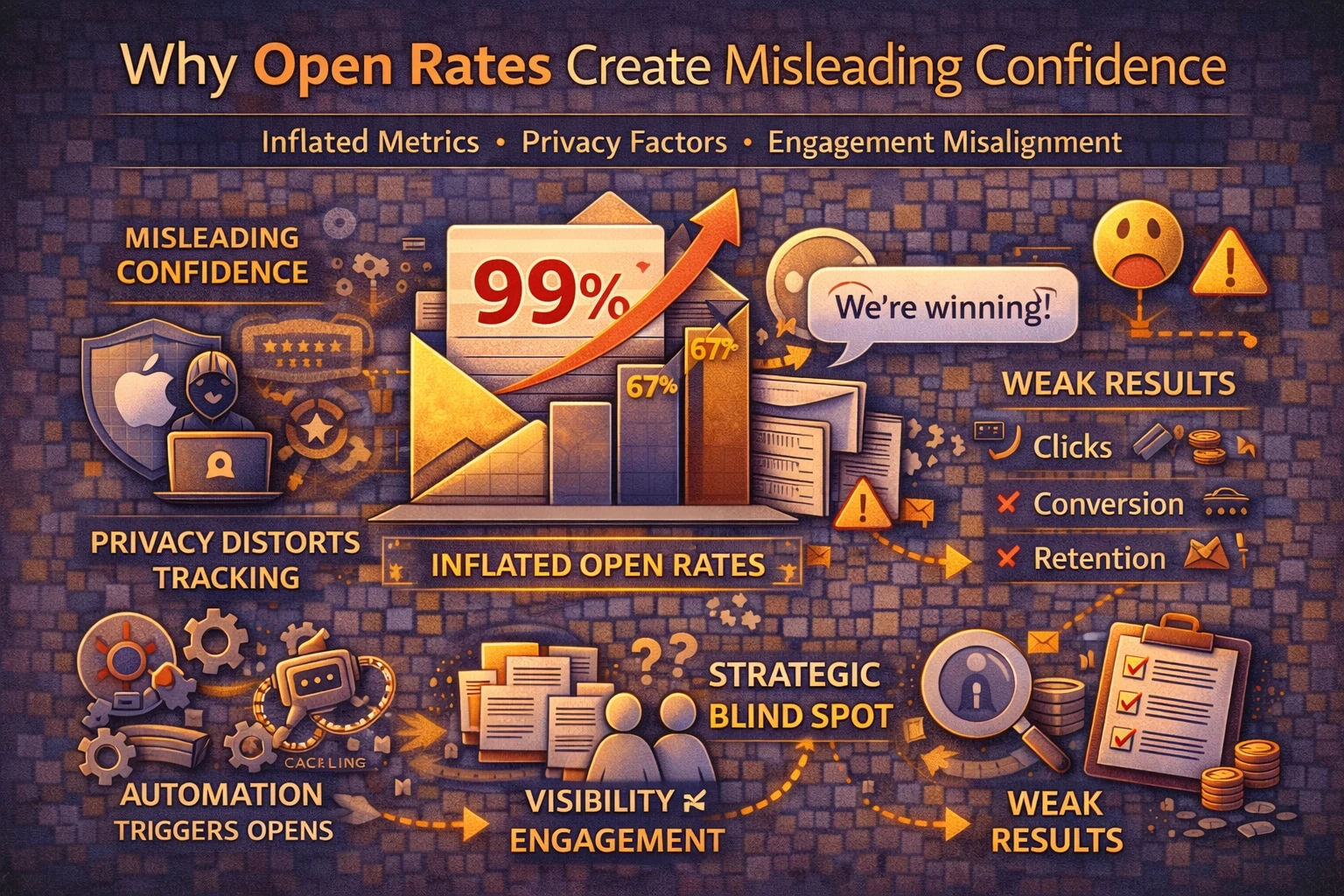
Open rates are among the most cited email metrics.
Because they are easy to understand and widely available across platforms, teams frequently treat them as reliable indicators of engagement. Higher open rates appear to signal improved subject lines, stronger audience interest, and successful campaign execution.
However, open rates rarely tell the full story.
At Wisegigs.eu, many email performance investigations reveal campaigns with impressive open percentages yet disappointing business outcomes. Despite strong visibility metrics, click behavior, conversions, and revenue impact often remain weak.
This mismatch is not accidental.
Open rates measure a technical event, not user intent.
An Open Does Not Represent a Decision
Email opens capture a binary signal.
A tracking pixel loads, which implies that the email client rendered the message. While this event confirms visibility, it does not confirm attention, comprehension, or meaningful engagement.
Users frequently open emails reflexively.
Notifications trigger curiosity. Previews load automatically. Messages are scanned briefly before dismissal. Consequently, the recorded open may not reflect genuine interest.
Visibility does not equal intent.
Modern Privacy Mechanisms Distort Measurement
Email ecosystems changed significantly.
Privacy protections implemented by major platforms now interfere with traditional tracking logic. For example, Apple’s Mail Privacy Protection preloads tracking pixels regardless of user behavior.
As a result, open metrics inflate artificially.
Campaigns may appear highly engaging even when recipients never actively view the content.
Apple’s documentation outlines this behavior clearly:
https://support.apple.com/
Measurement distortion is structural, not exceptional.
Inflated Opens Create Strategic Risk
Inaccurate metrics shape decisions.
When teams interpret inflated open rates as signals of success, optimization priorities shift incorrectly. Subject lines, send times, and segmentation strategies may be validated based on misleading data.
Consequently, performance models drift from reality.
False confidence emerges from corrupted signals.
Engagement Occurs After the Open
Meaningful interaction requires further action.
Clicks, replies, forwards, and conversions represent behavioral signals tied to user intent. Unlike opens, these events indicate deliberate engagement rather than passive visibility.
Optimization strategies anchored to open rates often ignore these deeper indicators.
Incomplete evaluation produces incomplete conclusions.
Audience Behavior Varies Widely
Different recipients interpret emails differently.
Some users open messages habitually. Others rely on previews. Many triage inboxes rapidly. Because behavioral diversity is high, open rates aggregate heterogeneous actions into a single misleading statistic.
Averages conceal variability.
Surface metrics obscure behavioral nuance.
Subject Line Optimization Can Backfire
Open-focused optimization incentivizes curiosity.
Subject lines designed to increase opens frequently prioritize intrigue over clarity. While this approach may improve visibility metrics, it often reduces downstream engagement when content fails to match expectations.
Higher opens may coexist with lower conversions.
Metric-driven incentives distort communication quality.
Automation and Preloading Introduce Noise
Email clients automate numerous behaviors.
Previews, caching mechanisms, spam filtering, and background processes may trigger tracking events without human interaction. Consequently, measurement noise accumulates invisibly.
Open rates become partially detached from user behavior.
Signal integrity degrades.
Why Open Rates Persist Despite Their Weaknesses
Open rates feel intuitive.
They provide immediate feedback, simple comparisons, and easy reporting. Because alternative engagement metrics require deeper instrumentation and interpretation, organizations often default to visibility-based indicators.
Convenience drives metric preference.
Accuracy is secondary.
What Reliable Email Measurement Prioritizes
Resilient email strategies emphasize behavioral signals.
Effective teams:
Evaluate click-through patterns
Measure conversion pathways
Analyze retention behavior
Validate segmentation quality
Correlate metrics with business outcomes
At Wisegigs.eu, email analytics focus on decision-oriented indicators rather than visibility artifacts.
Behavior defines effectiveness.
Conclusion
Open rates provide limited insight.
Although they capture message visibility, they do not reliably represent attention, intent, or value. Privacy mechanisms, automation layers, and behavioral diversity further weaken their interpretability.
To recap:
Opens measure technical events
Visibility does not equal engagement
Privacy protections distort tracking
Inflated metrics create risk
Meaningful signals occur after opens
Optimization incentives can mislead
At Wisegigs.eu, sustainable email performance depends on recognizing that metrics must reflect human behavior rather than client-side mechanics.
If your campaigns show strong open rates but weak outcomes, the problem may not be audience interest — but measurement interpretation.
Contact Wisegigs.eu