
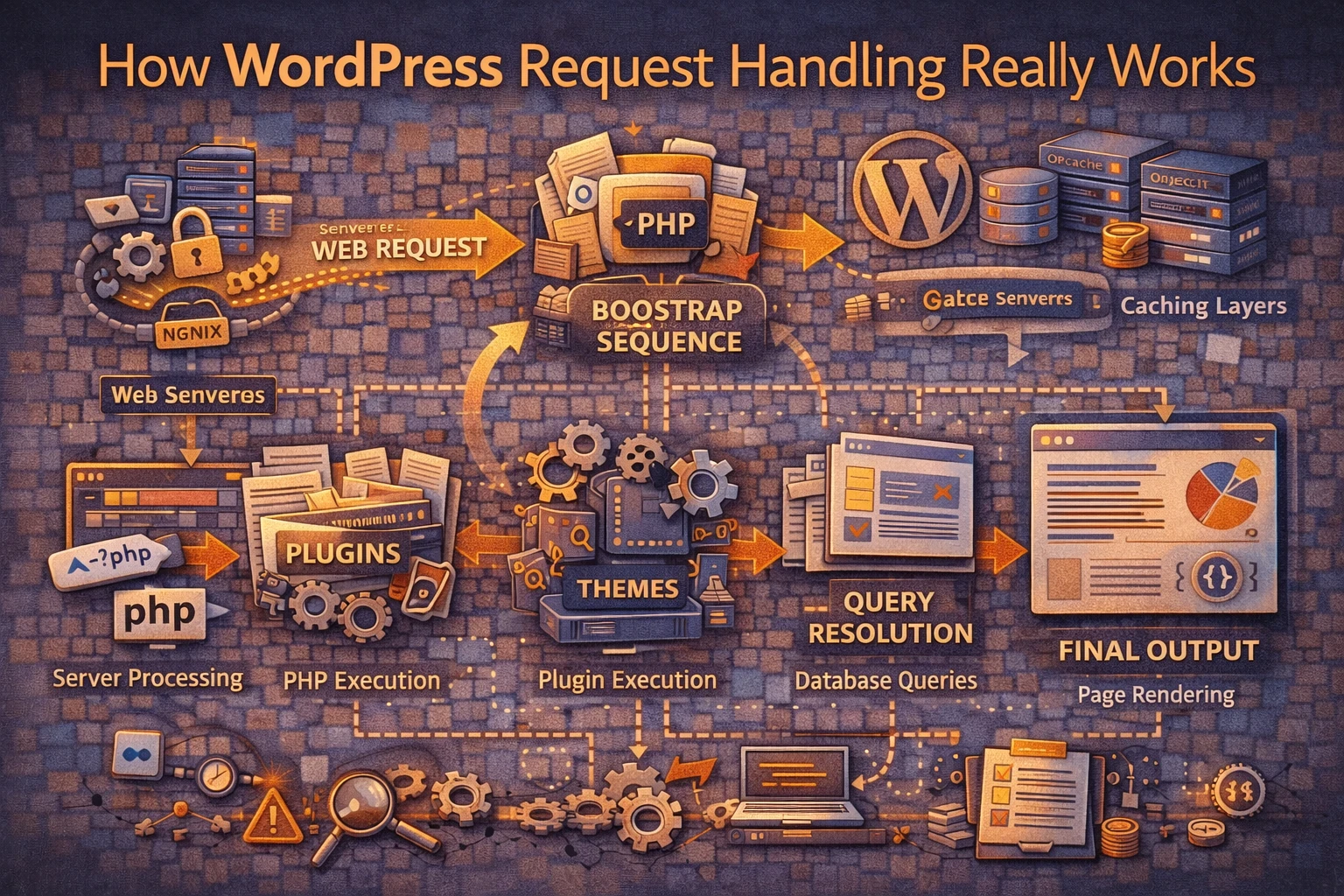
WordPress appears deceptively simple.
A visitor opens a URL, and a page loads. Because this interaction feels instantaneous, many developers treat request handling as a black box. As long as the output looks correct, deeper mechanics often remain unexplored.
However, WordPress request handling is highly dynamic.
At Wisegigs.eu, numerous performance anomalies, caching conflicts, and plugin incompatibilities can be traced back to misunderstandings about how WordPress processes incoming requests. Although the platform abstracts much of its internal logic, system behavior depends heavily on execution flow.
This article explains what actually happens during a WordPress request, why execution order matters, and how seemingly minor factors influence stability and performance.
Requests Begin Before WordPress Executes
Every page load starts at the server level.
Web servers such as NGINX or Apache receive the HTTP request, evaluate routing rules, and determine whether PHP execution is required. Static assets may be served immediately, while dynamic requests trigger further processing.
Consequently, WordPress is not the first component involved.
Server configuration directly shapes request behavior.
Authoritative NGINX documentation outlines this request lifecycle clearly:
https://nginx.org/en/docs/
PHP Initialization Defines the Runtime Environment
WordPress relies entirely on PHP execution.
Once the server delegates processing, PHP initializes the runtime, loads configuration values, and prepares the execution context. Memory limits, opcode caching, and environment variables influence subsequent behavior.
Importantly, runtime conditions vary across environments.
Differences at this stage frequently explain inconsistent system behavior.
Bootstrap Sequence Loads Core Components
WordPress does not process requests immediately.
Instead, it follows a structured bootstrap sequence. Core files load, constants are defined, database connections initialize, and essential subsystems prepare.
During this phase, WordPress establishes its operational state.
Execution order becomes critical.
The official WordPress developer resources describe this initialization model:
https://developer.wordpress.org/
Plugins Modify Execution Paths Early
Plugins are loaded before content resolution.
Each active plugin may register hooks, filters, and behavioral overrides. Consequently, request handling logic becomes context-dependent rather than purely deterministic.
Two identical requests may execute differently depending on plugin interactions.
This flexibility is powerful but introduces complexity.
Themes Influence Rendering, Not Request Logic
Themes primarily affect presentation.
However, many implementations blur architectural boundaries by embedding logic into theme layers. As a result, request outcomes may depend on visual components rather than structured application behavior.
This design pattern frequently complicates debugging and optimization.
Separation of concerns matters.
Query Resolution Determines Content Behavior
WordPress resolves requests through queries.
URL structures, rewrite rules, and routing logic determine which content objects should be retrieved. Database queries then fetch posts, pages, taxonomies, and metadata.
Inefficient queries at this stage create disproportionate performance impact.
Database behavior becomes a primary constraint.
MySQL performance considerations are extensively documented:
https://dev.mysql.com/doc/
Hooks and Filters Reshape System Flow Continuously
WordPress execution is event-driven.
Hooks and filters allow components to intercept, modify, or extend behavior at numerous stages. Consequently, request handling becomes a collaborative process across core, plugins, and themes.
While this model increases extensibility, it also multiplies interaction complexity.
Order and scope determine stability.
Output Generation Reflects Cumulative Decisions
Final output is not a single operation.
Instead, WordPress assembles responses through layered processing: query results, template resolution, plugin modifications, and rendering logic combine dynamically.
Unexpected behavior often reflects earlier execution decisions rather than template issues.
Symptoms rarely indicate root causes directly.
Caching Layers Alter Perceived Behavior
Caching mechanisms introduce additional abstraction.
Page caches, object caches, and opcode caches may intercept requests before full execution occurs. Consequently, observed behavior may not reflect real runtime processing.
Misconfigured caching frequently distorts troubleshooting efforts.
Performance analysis requires contextual awareness.
Google’s web performance guidance emphasizes real-user measurement:
https://web.dev/
Why Execution Order Creates Hidden Complexity
WordPress request handling is sequential yet dynamic.
Small changes in hook priority, plugin loading order, or conditional logic can alter system behavior significantly. Because execution paths depend on context, reproducibility becomes challenging.
Stable systems demand disciplined structure.
What Reliable WordPress Systems Prioritize
Resilient WordPress environments emphasize predictability.
Effective teams:
Understand bootstrap dependencies
Control plugin interactions carefully
Separate logic from presentation
Monitor query behavior
Validate caching effects
Minimize unnecessary execution paths
At Wisegigs.eu, WordPress performance and stability investigations consistently reveal that architectural discipline outweighs isolated optimizations.
System behavior emerges from flow design.
Conclusion
WordPress request handling is not a black box.
It is a structured yet highly dynamic execution process influenced by server configuration, PHP runtime conditions, plugins, queries, and caching layers.
To recap:
Requests begin at the server level
PHP defines runtime constraints
Bootstrap sequence establishes state
Plugins reshape execution paths
Query resolution drives content logic
Hooks alter system flow
Output reflects cumulative decisions
Caching modifies perception
At Wisegigs.eu, stable WordPress systems are built by recognizing that reliability depends on understanding execution flow rather than reacting to surface-level symptoms.
If your WordPress site behaves inconsistently, the underlying cause may lie in request handling dynamics.
Contact Wisegigs.eu