
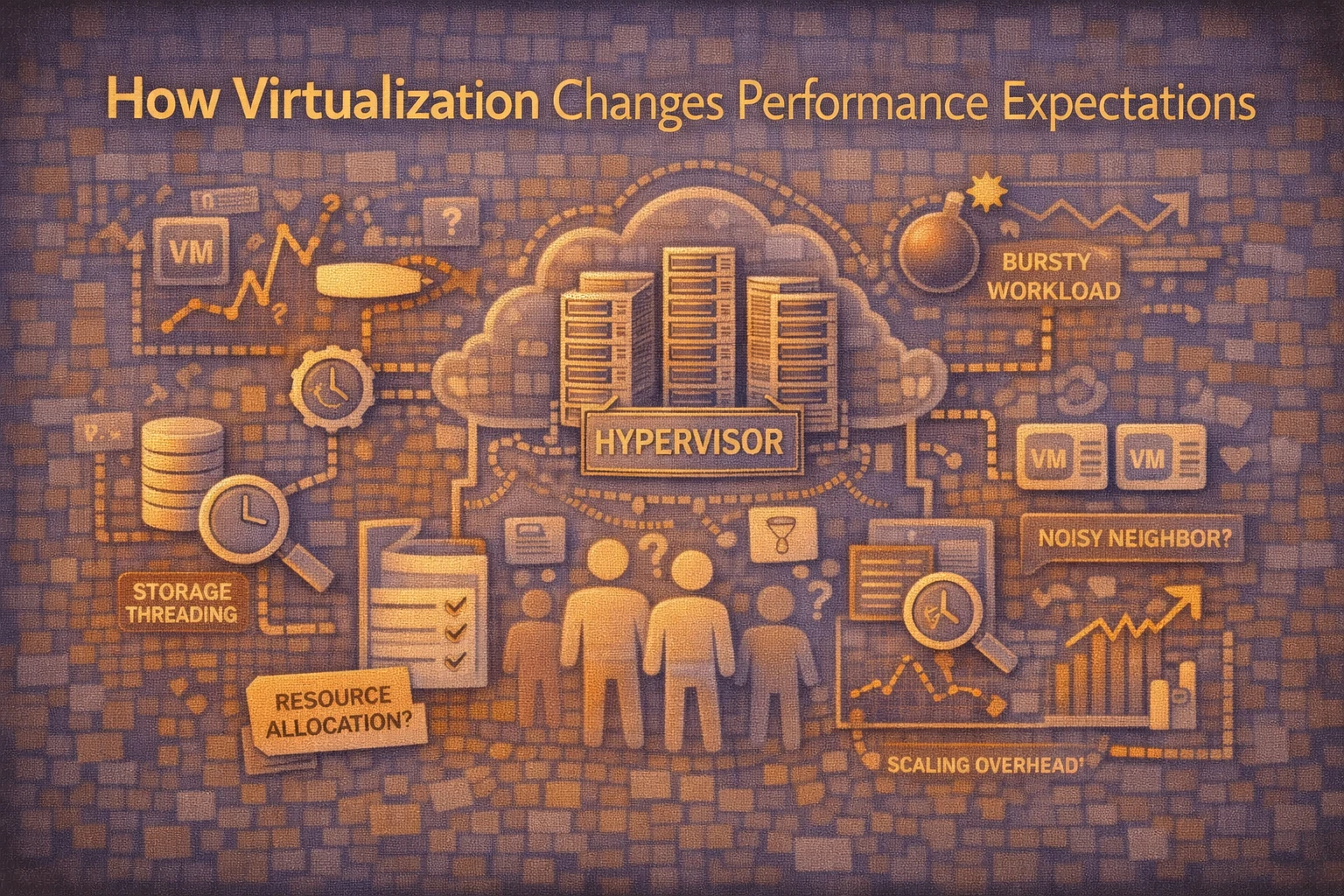
Virtualization transformed modern hosting.
Instead of relying on dedicated hardware, workloads now operate within abstracted environments that dynamically allocate resources. Because this model increases flexibility and efficiency, many teams assume performance behavior remains predictable as long as nominal specifications appear sufficient.
In reality, virtualization fundamentally alters performance dynamics.
At Wisegigs.eu, infrastructure investigations frequently reveal mismatches between expected and observed behavior in VPS and cloud environments. Systems that appear adequately provisioned may still exhibit latency variability, inconsistent throughput, or unexplained resource contention.
This article explains why virtualization reshapes performance expectations, how abstraction layers introduce new constraints, and why traditional capacity assumptions often fail.
Dedicated Hardware Assumptions No Longer Apply
Traditional performance models were simpler.
Dedicated servers offered stable relationships between workloads and physical resources. CPU cycles, memory access, and storage behavior remained largely deterministic because isolation occurred at the hardware level.
Virtualized environments operate differently.
Multiple instances share underlying infrastructure, while hypervisors coordinate resource allocation. Consequently, workloads no longer interact directly with hardware in predictable ways.
Performance becomes contextual rather than absolute.
Resource Allocation Is Dynamic, Not Static
Virtual machines rely on scheduling mechanisms.
CPU time, memory access, and I/O operations are mediated by virtualization layers that balance competing workloads. As a result, nominal resource assignments do not guarantee uninterrupted availability.
Under variable load conditions, scheduling decisions influence performance behavior.
Therefore, identical VPS specifications may produce different outcomes across time or environments.
This variability often surprises teams expecting hardware-like consistency.
Latency Variability Is Structurally Normal
Performance fluctuations are not necessarily anomalies.
Shared infrastructure introduces contention scenarios that manifest as transient latency shifts. Network queues, storage access delays, and CPU scheduling effects all contribute to variability independent of application logic.
Cloud providers explicitly document these dynamics.
For example, AWS describes how instance performance depends on underlying host conditions:
https://docs.aws.amazon.com/
Virtualization inherently introduces probabilistic behavior.
Noisy Neighbor Effects Persist
Isolation mechanisms reduce interference.
They do not eliminate it entirely.
Competing workloads on shared hosts may generate bursty resource demand. Consequently, neighboring activity can influence performance even when direct misconfiguration is absent.
This phenomenon explains why systems sometimes degrade without visible internal changes.
External context influences internal experience.
Storage Behavior Changes Significantly
Virtualized storage systems abstract physical devices.
Disk operations, caching layers, and network-attached storage introduce additional latency components. Therefore, I/O behavior becomes dependent on broader infrastructure conditions rather than local hardware characteristics.
As a result, storage-intensive workloads often display unpredictable performance patterns.
Traditional disk assumptions become unreliable.
Benchmarking Results Can Be Misleading
Synthetic benchmarks offer limited insight.
Short-duration tests frequently fail to capture scheduling variability, contention effects, and workload interactions. Consequently, systems that perform well during controlled testing may behave differently under sustained production load.
Meaningful performance evaluation requires observing real workload behavior over time.
Instantaneous metrics rarely tell the full story.
Scaling Behavior Differs From Physical Systems
Scaling virtualized workloads introduces coordination complexity.
Additional instances interact through networks, shared services, and distributed state mechanisms. Consequently, scaling does not simply multiply capacity.
Instead, it reshapes performance characteristics.
Latency, synchronization overhead, and dependency interactions influence outcomes more than raw resource counts.
Monitoring Becomes More Critical
Visibility defines reliability.
Without detailed metrics, tracing, and system-level observability, diagnosing virtualization-induced variability becomes extremely difficult.
Performance analysis in virtualized environments requires continuous measurement rather than episodic testing.
Stable operations depend on persistent awareness.
Why Misaligned Expectations Create Operational Risk
Incorrect assumptions drive incorrect decisions.
When teams interpret virtualization performance through dedicated hardware mental models, troubleshooting paths become distorted. Capacity upgrades may fail to resolve issues rooted in scheduling or contention dynamics.
As a result, optimization efforts often target symptoms instead of causes.
Understanding virtualization constraints reduces misdiagnosis.
What Reliable VPS and Cloud Performance Evaluation Looks Like
Resilient teams adjust expectations deliberately.
Effective approaches include:
Measuring long-term workload behavior
Monitoring latency distribution, not averages
Evaluating contention patterns
Validating scaling assumptions
Designing for variability tolerance
At Wisegigs.eu, virtualization performance is treated as a systems behavior problem rather than a static specification exercise.
Abstraction changes everything.
Conclusion
Virtualization did not merely improve resource utilization.
It fundamentally changed how performance behaves, how variability emerges, and how reliability must be evaluated.
To recap:
Dedicated hardware assumptions no longer apply
Resource allocation is dynamic
Latency variability is normal
Noisy neighbors still influence workloads
Storage behavior differs significantly
Benchmarks can mislead
Scaling reshapes performance dynamics
Monitoring becomes essential
At Wisegigs.eu, stable VPS and cloud systems are built by aligning performance expectations with virtualization realities rather than relying on nominal specifications alone.
If your VPS behaves inconsistently despite adequate resources, the issue may not be capacity — but expectation mismatch.
Contact Wisegigs.eu