
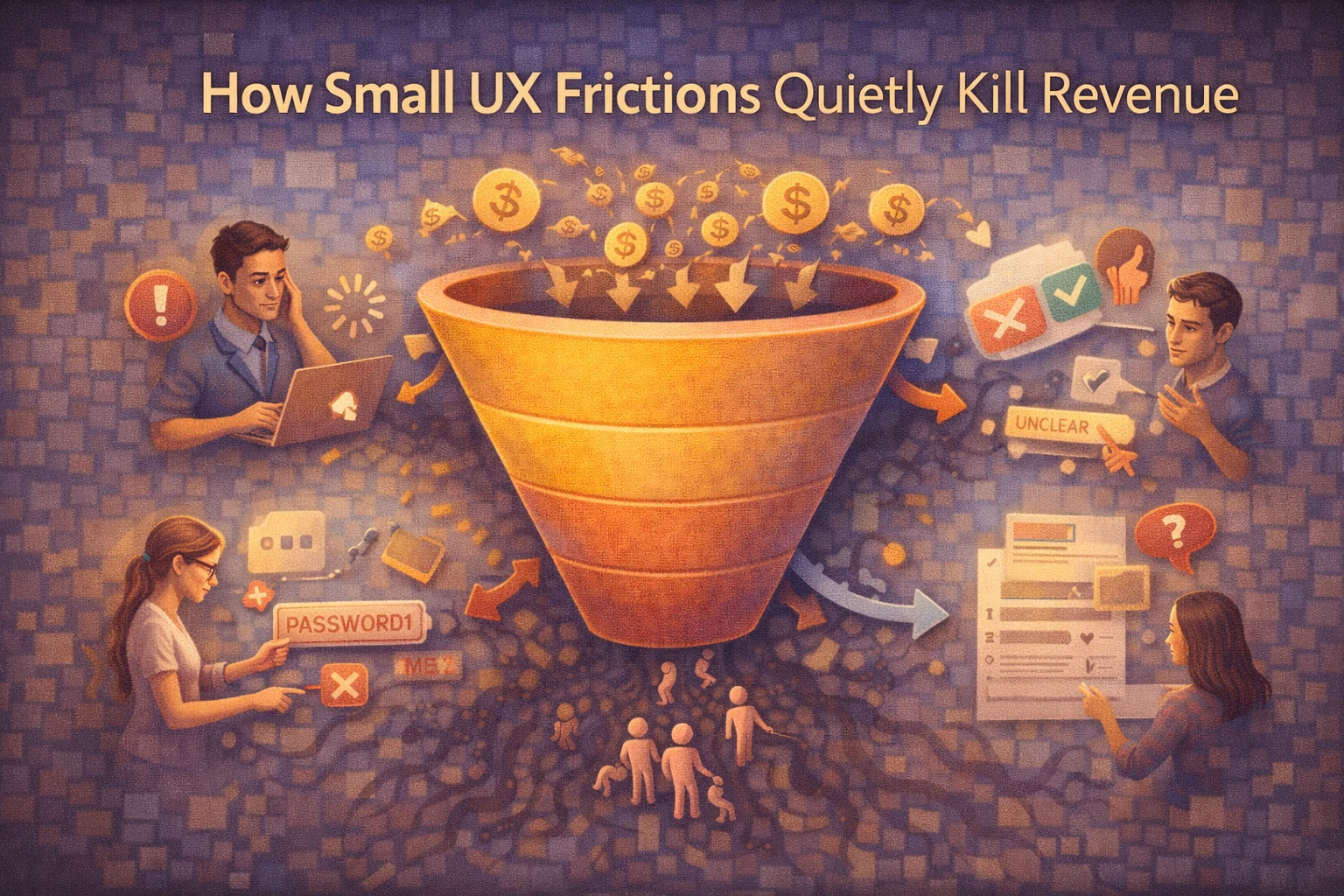
Most conversion problems do not originate from dramatic failures.
Pages load, buttons function, and checkout flows technically work. Because nothing appears broken, performance is often considered acceptable.
However, user experience rarely fails loudly.
At Wisegigs.eu, many revenue and conversion investigations reveal a consistent pattern: the system operates correctly, yet subtle UX frictions quietly suppress results. These frictions rarely trigger alarms. Instead, they degrade performance gradually while remaining difficult to detect.
This article explains how minor UX issues accumulate, why they are frequently overlooked, and how small inefficiencies produce disproportionately large business consequences.
Friction Does Not Require Failure
Users abandon experiences without encountering errors.
Even when pages render properly, hesitation, confusion, or cognitive overload can interrupt decision-making. Consequently, conversion loss often occurs without any visible malfunction.
In practice, the absence of technical failure masks behavioral resistance.
Nielsen Norman Group’s UX research consistently highlights how small usability obstacles affect user behavior:
https://www.nngroup.com/articles/
Stable interfaces can still produce unstable outcomes.
Cognitive Load Silently Reduces Conversions
Every interaction demands mental effort.
Unclear labels, inconsistent layouts, excessive choices, or ambiguous messaging increase cognitive load. As a result, users delay decisions or disengage entirely.
Importantly, this effect does not require obvious confusion.
Even subtle friction slows processing and reduces completion rates. Over time, these micro-delays compound into measurable revenue impact.
Users Interpret Interfaces Differently Than Designers
Design intent does not guarantee user interpretation.
Elements that appear obvious internally may introduce uncertainty externally. For example, visual hierarchy, wording choices, and interaction patterns often carry unintended signals.
Therefore, minor mismatches between expectation and presentation frequently disrupt flows.
Google’s UX and conversion guidance emphasizes aligning design with user mental models:
https://web.dev/learn/design/
Perceived clarity is not universal clarity.
Small Delays Create Disproportionate Impact
Milliseconds influence behavior.
Slight rendering delays, layout shifts, or interaction latency increase abandonment probability. While individual delays appear negligible, their behavioral effects are significant.
Consequently, performance and UX cannot be separated cleanly.
Google’s Web Performance research documents how latency affects engagement:
https://web.dev/vitals/
Speed problems often manifest as UX problems.
Friction Compounds Across the Funnel
Conversion paths involve multiple steps.
Each additional interaction introduces potential resistance. When friction exists at several points, cumulative impact becomes substantial.
Users rarely articulate these barriers.
Instead, they exit quietly, leaving analytics to reflect declining completion rates without obvious explanation.
Funnels degrade gradually, not abruptly.
Visual Polish Can Conceal Structural Issues
Attractive interfaces feel trustworthy.
However, visual refinement does not eliminate interaction friction. In many cases, polished design masks deeper usability issues by creating a false sense of effectiveness.
As a result, teams may attribute poor performance to traffic quality rather than interface behavior.
Aesthetics influence perception. They do not guarantee efficiency.
Metrics Often Hide UX Problems
Analytics surfaces outcomes, not causes.
Declining conversions, reduced engagement, or abnormal exit rates indicate symptoms rather than root problems. Without behavioral analysis, interpretation becomes speculative.
Consequently, UX friction frequently survives optimization cycles.
Effective diagnosis requires connecting quantitative data with user behavior patterns.
Why Friction Persists Undetected
Small UX problems rarely trigger urgency.
No errors occur. No crashes happen. Systems continue operating. Because friction produces gradual rather than catastrophic loss, detection is delayed.
Eventually, revenue decline becomes visible.
By that stage, identifying the source becomes more complex.
Quiet degradation is more dangerous than visible failure.
What Reliable Conversion Optimization Looks Like
Stable systems treat UX as an operational variable.
Effective teams:
Measure behavioral signals continuously
Evaluate flows under real conditions
Minimize unnecessary decisions
Test assumptions rigorously
Treat anomalies as diagnostic inputs
At Wisegigs.eu, conversion optimization focuses on reducing friction rather than merely refining visuals.
This approach produces durable improvements.
Conclusion
Small UX frictions rarely attract attention.
Nevertheless, their cumulative impact can quietly suppress revenue, distort analytics, and mislead decision-making.
To recap:
Friction does not require failure
Cognitive load reduces conversions
User interpretation varies
Small delays influence behavior
Funnels amplify minor inefficiencies
Visual polish can mislead
Metrics hide underlying causes
At Wisegigs.eu, sustainable growth depends on recognizing that conversion loss often originates from subtle experience-level resistance rather than obvious defects.
If your pages work yet conversions stagnate, invisible UX friction may be limiting performance.
Contact Wisegigs.eu