
Speed is one of the most misunderstood topics in web development.
Many teams evaluate performance based on perception. If pages load quickly during casual browsing, the site is considered fast. Consequently, deeper analysis is often skipped.
However, perceived speed and measured performance are not the same thing.
At Wisegigs.eu, numerous performance investigations begin with the same statement:
“The site feels fast.”
Shortly afterward, analytics, conversion data, or real-world usage contradicts that assumption.
This article explains why perceived speed is unreliable, how misleading signals distort decision-making, and what meaningful performance evaluation actually requires.
Perception Is Inherently Inconsistent
Human perception is variable by nature.
A page may feel fast on one device yet appear slow on another. Network quality, CPU performance, background processes, and caching states all influence the experience.
Because conditions constantly change, perception cannot function as a stable measurement model. As a result, teams relying on subjective impressions often misdiagnose performance.
Measured systems, in contrast, eliminate this ambiguity.
Google’s Web Performance guidance stresses objective measurement rather than intuition:
https://web.dev/measure/
Local Testing Rarely Reflects Real Usage
Developers frequently evaluate performance in ideal conditions.
Modern laptops, stable connections, and warm caches create a best-case scenario. Under those circumstances, most websites appear responsive.
Real users operate under different constraints.
Older devices, mobile networks, CPU throttling, and cold cache states produce entirely different results. Therefore, a site that feels fast internally may perform poorly in production.
Without representative testing, perception becomes misleading.
Caching Distorts the Experience
Caching improves perceived speed dramatically.
Returning visitors often experience near-instant loads because assets already exist locally. While this behavior is beneficial, it creates a false sense of consistency.
First-time visitors do not benefit from those cached resources.
As a result, perceived speed for internal teams diverges from actual speed for new users, paid traffic, or geographically distant audiences.
Performance evaluation must consider cold-state behavior, not only repeat visits.
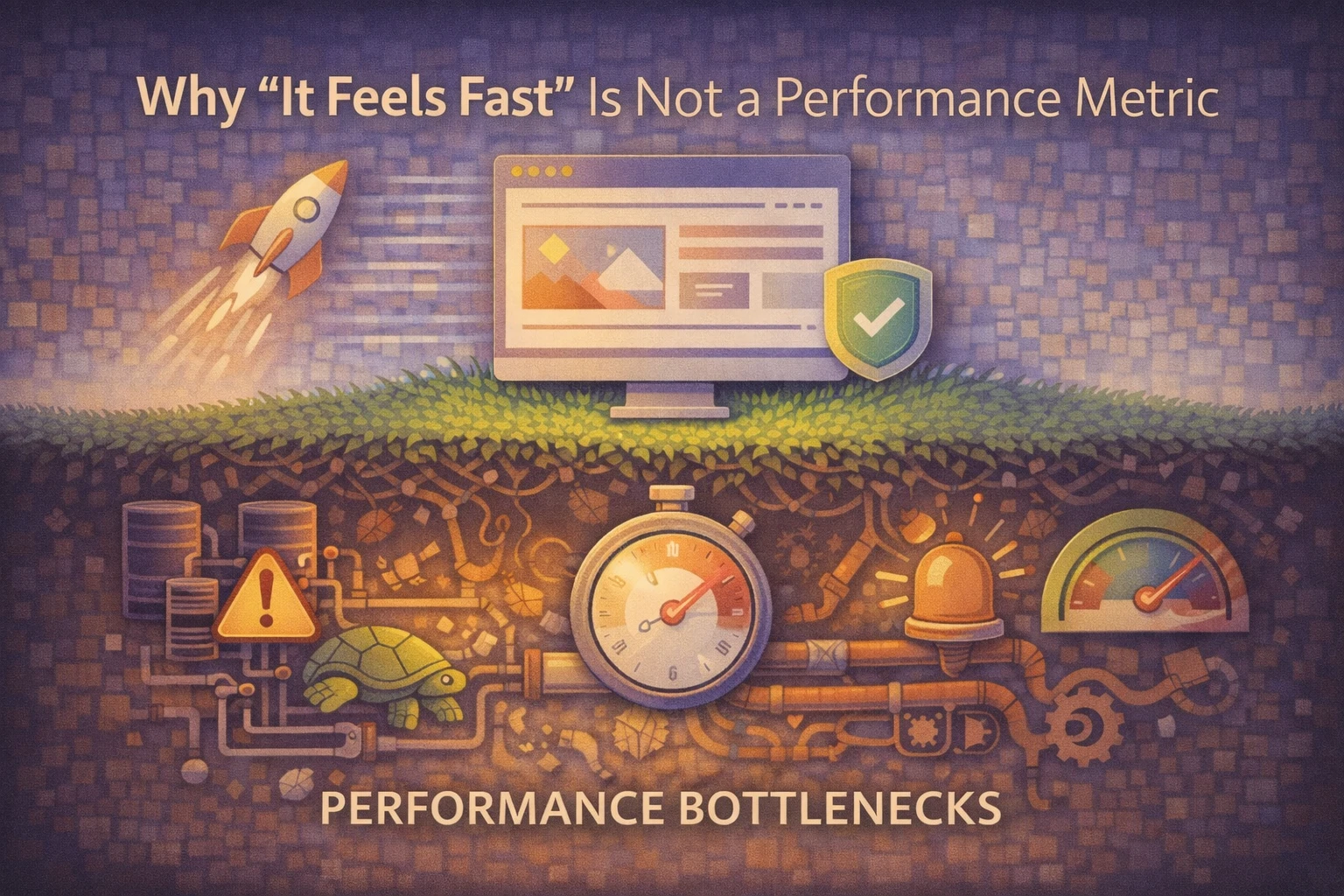
Visual Speed Masks Backend Delays
Fast visual rendering does not guarantee fast systems.
Pages may display content quickly while background operations continue executing. API calls, database queries, analytics scripts, and third-party resources often load after visible elements appear.
Consequently, the interface feels responsive even when the system remains under strain.
Meaningful performance analysis requires measuring full execution time, not just visual completion.
Performance Problems Often Scale Non-Linearly
Performance rarely degrades in a linear fashion.
A site that feels fast at low traffic may slow down abruptly under load. Database contention, uncached operations, and resource competition emerge only when usage increases.
Because perception occurs under limited conditions, scaling behavior remains invisible until failure occurs.
Objective measurement, however, reveals these patterns early.
Metrics Reveal What Perception Cannot
Reliable performance assessment depends on measurement.
Key indicators include:
Time to First Byte (TTFB)
Largest Contentful Paint (LCP)
Cumulative Layout Shift (CLS)
Interaction latency
Query execution patterns
These metrics expose bottlenecks that perception cannot detect.
Google’s Core Web Vitals framework defines standardized performance signals tied to real user experience:
https://web.dev/vitals/
Without metrics, performance discussions become speculative.
Perception Encourages False Confidence
Subjective evaluation often reinforces incorrect conclusions.
If stakeholders perceive the site as fast, deeper investigation feels unnecessary. Over time, unresolved inefficiencies accumulate silently.
Eventually, failures surface during campaigns, traffic spikes, or infrastructure changes.
Perception delayed detection. Measurement would have prevented surprise.
What Meaningful Performance Evaluation Looks Like
Stable systems rely on structured analysis.
Effective teams:
Measure real-world performance continuously
Test cold and warm scenarios
Evaluate under representative load
Correlate metrics with user outcomes
Revisit assumptions regularly
In this model, performance becomes observable rather than assumed.
At Wisegigs.eu, optimization always follows measurement, never perception.
Conclusion
Perceived speed is not a performance metric.
It is a subjective impression shaped by context, hardware, caching, and conditions.
To recap:
Perception varies across environments
Local testing rarely reflects production
Caching distorts experiences
Visual speed hides backend delays
Scaling issues remain invisible
Metrics expose real bottlenecks
At Wisegigs.eu, reliable performance decisions rely on measurement, not intuition.
If your website feels fast but behaves unpredictably under load, perception may be hiding the real problem.
Contact Wisegigs.eu