
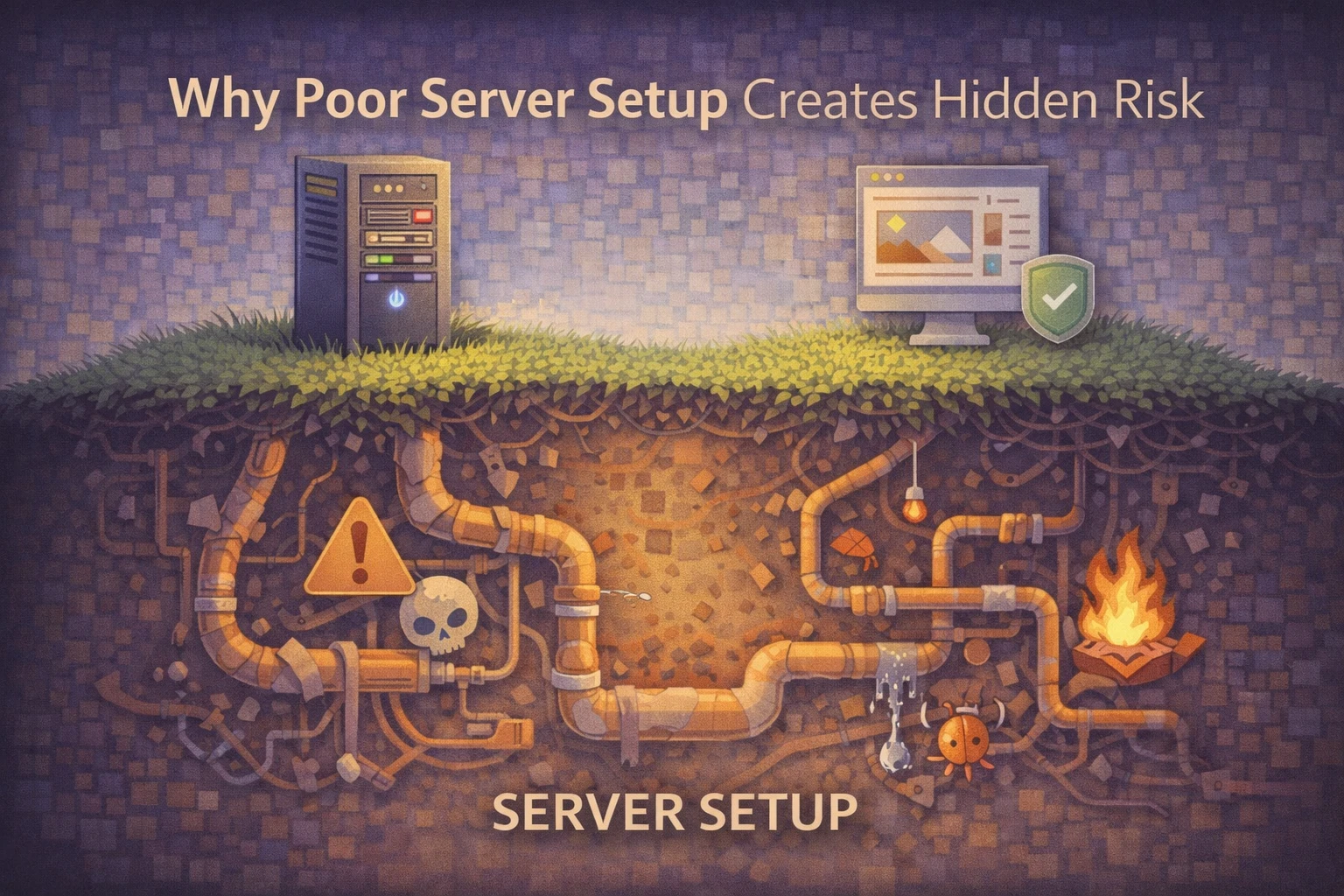
Most servers appear healthy at first.
They boot successfully, services run, and applications respond as expected. Because of this, server setup is often considered “done” once everything works.
However, a server that works is not the same as a server that is stable.
At Wisegigs.eu, many outages and performance incidents trace back to poor server setup decisions made early and never revisited. These decisions rarely cause immediate failures. Instead, they introduce hidden risk that surfaces later under load, during updates, or at the worst possible time.
This article explains how poor server setup creates hidden risk, why control panels often mask these issues, and what reliable environments do differently.
A Working Server Only Proves the Present
A server that boots and responds proves one thing:
It works right now.
Unfortunately, this snapshot view ignores how systems behave over time. Traffic grows, software updates, configurations drift, and usage patterns change.
When setup decisions optimize only for quick success, long-term stability suffers. As a result, systems quietly accumulate fragility while appearing healthy on the surface.
This is why many server failures feel sudden, even though their causes existed for months.
Default Configurations Are Not Neutral
Default server configurations are designed for general use.
They prioritize compatibility over resilience. While defaults help servers start quickly, they rarely match real workloads.
For example, default limits, logging behavior, and background task handling often remain untouched. Over time, these defaults interact poorly with production traffic.
Linux server documentation consistently emphasizes the importance of tuning systems for their intended workload:
https://www.kernel.org/doc/html/latest/admin-guide/
When defaults remain unexamined, hidden risk becomes inevitable.
Control Panels Can Hide Structural Problems
Server panels make infrastructure approachable.
They simplify common tasks, centralize management, and reduce friction. However, panels also abstract critical details.
As a result:
Configuration changes happen implicitly
Resource limits are assumed, not verified
Background services grow unnoticed
Responsibility becomes unclear
When problems appear, teams struggle to understand what the panel changed behind the scenes.
This abstraction is useful, but it becomes dangerous when it replaces understanding.
Resource Limits Are Often Assumed, Not Enforced
Many servers fail because limits were never explicit.
CPU, memory, disk I/O, and process limits are frequently assumed rather than enforced. Under light usage, this seems harmless.
Later, when traffic spikes or background jobs overlap, resources compete silently. Performance degrades, services restart, and failures cascade.
The Linux control group documentation explains why explicit limits matter in multi-process environments:
https://www.kernel.org/doc/html/latest/admin-guide/cgroup-v2.html
Without enforced boundaries, servers behave unpredictably under stress.
Logging and Monitoring Are Added Too Late
Poor server setup often treats monitoring as optional.
Logs may be incomplete, rotated incorrectly, or never reviewed. Metrics may not exist at all.
Because of this, early warning signs go unnoticed. By the time alerts fire, damage is already done.
Google’s Site Reliability Engineering principles emphasize that observability must exist before failure, not after:
https://sre.google/sre-book/monitoring-distributed-systems/
Servers without visibility do not fail gracefully. They fail silently, then catastrophically.
Updates Expose Weak Foundations
Updates rarely cause problems on their own.
Instead, updates expose weak assumptions made during setup. Dependencies change, services restart, and timing shifts.
On poorly set up servers:
Updates feel risky
Rollbacks are unclear
Downtime becomes likely
As a result, teams delay updates, which increases security and stability risk even further.
A stable server tolerates change. A fragile one fears it.
Updates Expose Weak Foundations
Updates rarely cause problems on their own.
Instead, updates expose weak assumptions made during setup. Dependencies change, services restart, and timing shifts.
On poorly set up servers:
Updates feel risky
Rollbacks are unclear
Downtime becomes likely
As a result, teams delay updates, which increases security and stability risk even further.
A stable server tolerates change. A fragile one fears it.
Hidden Risk Compounds Over Time
The most dangerous aspect of poor server setup is compounding risk.
Each small workaround, exception, or manual fix adds complexity. Eventually, the system becomes difficult to reason about.
At that point:
Changes are avoided
Knowledge becomes siloed
Recovery depends on individuals
The server still works, but no one trusts it.
What Reliable Server Setup Looks Like
Reliable server environments are intentional.
They:
Make limits explicit
Separate responsibilities clearly
Treat panels as tools, not foundations
Add monitoring from day one
Expect change and test for it
At Wisegigs, server setup is treated as an engineering decision, not a checklist. Stability is designed upfront, not patched later.
This mindset reduces risk long before incidents occur.
Conclusion
Poor server setup rarely causes immediate failure.
Instead, it creates hidden risk that surfaces later under pressure.
To recap:
Working servers only prove the present
Defaults hide important assumptions
Panels can mask structural issues
Missing limits cause unpredictable behavior
Lack of monitoring delays detection
Updates expose weak foundations
At Wisegigs.eu, stable hosting environments are built by treating server setup as a long-term commitment, not a one-time task.
If your server works today but feels risky to touch, the problem is not traffic or software.
It is hidden risk in the setup.
Contact Wisegigs.eu