
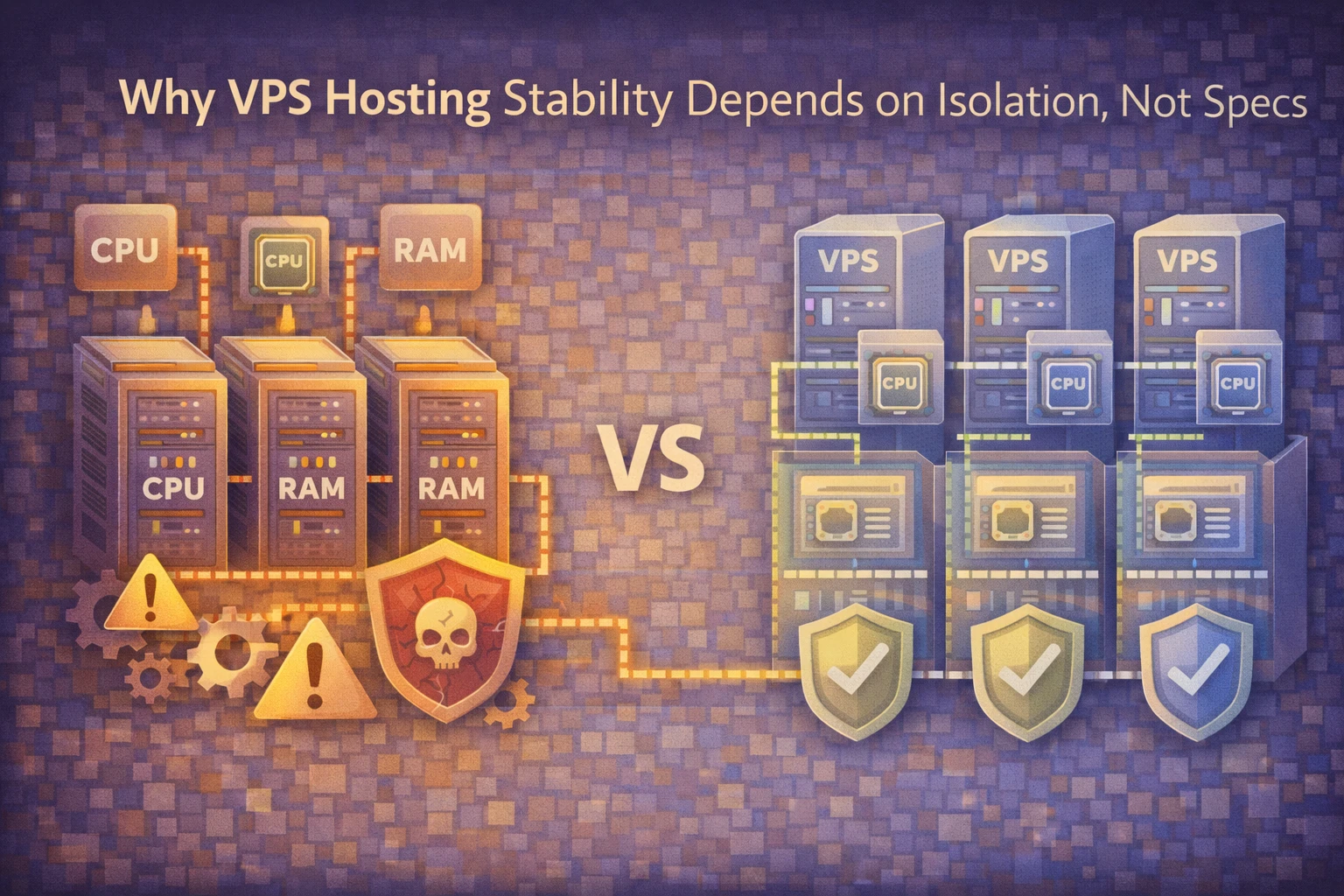
VPS hosting is usually sold with numbers.
CPU cores, RAM size, disk space, and bandwidth dominate comparison tables. Because of this, many teams assume that higher specifications automatically lead to better stability.
In reality, VPS stability depends far less on raw specifications and far more on resource isolation.
At Wisegigs.eu, many VPS incidents we investigate occur on servers with more than enough CPU and memory. The underlying issue is rarely capacity. Instead, it is weak isolation between workloads.
This article explains why VPS hosting stability depends on isolation rather than specs, how poor isolation creates unpredictable behavior, and what reliable VPS environments do differently.
Specs Describe Capacity, Not Behavior
Server specifications describe what could be available.
They do not describe how resources behave under contention.
For example, two VPS instances may both advertise four CPU cores and eight gigabytes of RAM. However, their real-world behavior can differ dramatically depending on how strictly the host enforces limits.
Without strong isolation, resources become shared in practice even when they appear dedicated on paper.
Virtualization fundamentals emphasize that isolation defines workload behavior, not raw capacity:
https://www.redhat.com/en/topics/virtualization/what-is-a-virtual-machine
Specs tell you how much exists. Isolation determines how reliably you can use it.
The “Noisy Neighbor” Problem Is Structural
One of the most common VPS complaints involves inconsistent performance.
This inconsistency often comes from the noisy neighbor problem. When another VPS on the same host consumes excessive CPU, memory, or disk I/O, neighboring instances suffer.
Importantly, this happens even when your own VPS stays within its advertised limits.
Strong isolation prevents this scenario by enforcing strict boundaries. Weak isolation allows one workload to impact others silently. Without isolation, VPS hosting behaves like shared hosting with better marketing.
CPU Isolation Protects Response Time
CPU isolation determines how processing time is distributed.
When CPU scheduling is loose, a busy VPS can monopolize processing time. As a result, other servers experience latency spikes and slower response times.
With proper isolation, each VPS receives a guaranteed share of CPU time. Even during traffic spikes, response times remain predictable.
Linux scheduling and control groups play a key role in enforcing CPU fairness:
https://docs.kernel.org/scheduler/
Predictable CPU behavior matters more than having extra cores that cannot be reliably accessed.
CPU Isolation Protects Response Time
CPU isolation determines how processing time is distributed.
When CPU scheduling is loose, a busy VPS can monopolize processing time. As a result, other servers experience latency spikes and slower response times.
With proper isolation, each VPS receives a guaranteed share of CPU time. Even during traffic spikes, response times remain predictable.
Linux scheduling and control groups play a key role in enforcing CPU fairness:
https://docs.kernel.org/scheduler/
Predictable CPU behavior matters more than having extra cores that cannot be reliably accessed.
Disk and I/O Isolation Matter More Than Speed
Disk performance rarely appears in VPS marketing.
However, disk I/O contention causes many real-world performance problems. Backups, logging, database writes, or file uploads can saturate shared storage.
Without I/O isolation, unrelated applications slow down during these operations. Over time, performance feels random and unreliable.
Proper isolation limits the impact of heavy disk usage. As a result, live traffic remains responsive even during maintenance tasks.
Disk and I/O Isolation Matter More Than Speed
Disk performance rarely appears in VPS marketing.
However, disk I/O contention causes many real-world performance problems. Backups, logging, database writes, or file uploads can saturate shared storage.
Without I/O isolation, unrelated applications slow down during these operations. Over time, performance feels random and unreliable.
Proper isolation limits the impact of heavy disk usage. As a result, live traffic remains responsive even during maintenance tasks.
Network Isolation Affects Reliability Under Load
Network resources are also shared in VPS environments.
When network isolation is weak, traffic bursts from one VPS can introduce latency or packet loss for others. This becomes especially visible during campaigns, launches, or API spikes.
Strong isolation enforces bandwidth limits and traffic shaping. Consequently, network behavior stays predictable as usage grows.
For modern applications, network stability is as important as raw throughput.
What Reliable VPS Hosting Does Differently
Reliable VPS platforms design for isolation first.
They enforce CPU, memory, disk, and network limits intentionally. They also monitor contention continuously and validate behavior under load.
At Wisegigs, VPS environments are designed to behave predictably even during spikes. Isolation is treated as a core requirement, not an optional feature.
This approach ensures that scaling remains controlled instead of chaotic.
Conclusion
VPS hosting stability is not about impressive specifications.
It is about how reliably resources behave under pressure.
To recap:
Specs describe capacity, not guarantees
Weak isolation creates noisy neighbor problems
CPU and memory isolation protect stability
Disk and network isolation prevent hidden bottlenecks
Upgrading specs rarely fixes structural issues
At Wisegigs.eu, we build VPS and cloud environments where isolation is intentional, measurable, and enforced.
If your VPS has strong specs but unpredictable performance, isolation — not capacity — is likely the missing piece.
Contact Wisegigs.eu