
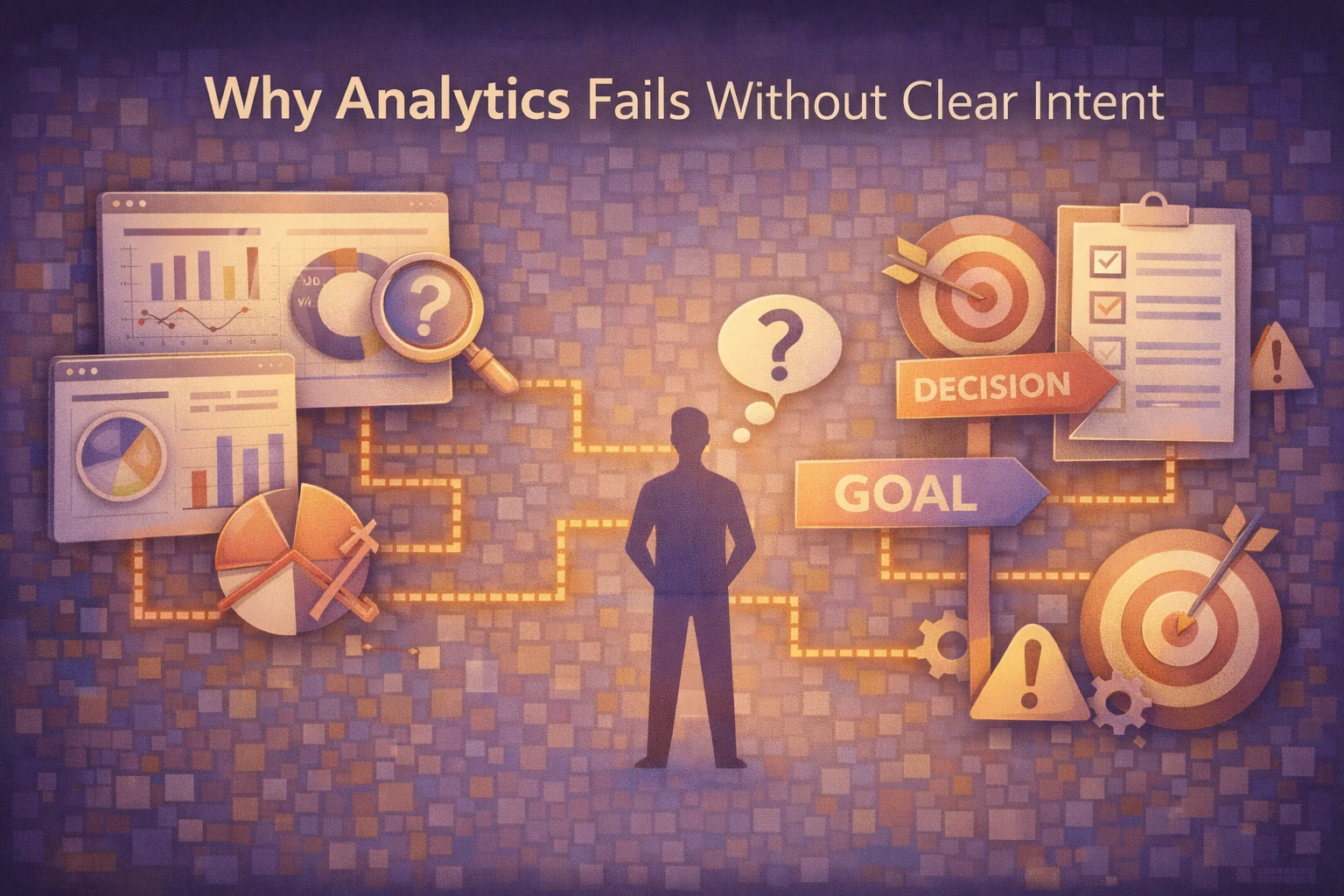
Modern websites collect a lot of data.
Pageviews, events, funnels, heatmaps, recordings, and dashboards are everywhere. As a result, teams often assume that better analytics automatically leads to better decisions.
In practice, that assumption rarely holds.
At Wisegigs, many analytics problems we see do not come from missing tools or broken tracking. Instead, they come from unclear intent. When teams do not agree on what they are trying to learn, analytics quietly fails.
This article explains why analytics without intent produces confusion, how teams misuse data without realizing it, and what effective analytics strategies do differently.
Data Collection Is Not the Same as Insight
Most analytics setups focus on collecting data.
Teams track:
Page views
Clicks
Scroll depth
Conversions
Events
While this information is useful, it does not explain anything on its own.
Without a clear question, data becomes noise. Dashboards fill up, reports grow longer, and confidence increases — even when understanding does not.
Analytics only becomes valuable when it answers a specific question. Without intent, tracking simply records activity.
Analytics Tools Do Exactly What You Ask Them To
Analytics tools are not smart on their own.
They measure what they are told to measure. If tracking is configured without a clear goal, the resulting data reflects that ambiguity.
Common examples include:
Tracking everything “just in case”
Measuring vanity metrics instead of outcomes
Treating dashboards as performance indicators
Interpreting trends without context
As a result, teams draw conclusions that feel data-driven but rest on weak assumptions.
Google’s analytics documentation emphasizes that measurement should start with defined objectives, not tools:
https://support.google.com/analytics/answer/9327974
Without Intent, Metrics Replace Questions
Healthy analytics starts with questions.
For example:
Why are users dropping off here?
What blocks users from completing this action?
Which step causes confusion?
What behavior indicates success?
When intent is missing, teams flip the process. They look at metrics first and then invent explanations afterward.
This leads to:
Confirmation bias
Overconfidence in dashboards
Decisions driven by correlation, not causation
Analytics should guide inquiry, not replace it.
Tracking Often Reflects Internal Assumptions
Many analytics setups mirror how teams think, not how users behave.
Internal assumptions shape:
Funnel definitions
Conversion goals
Event naming
Success criteria
When those assumptions are wrong, analytics reinforces the wrong story.
For example, a funnel may assume linear behavior when users explore non-linearly. As a result, drop-offs appear as failures instead of normal behavior.
UX research consistently shows that user behavior rarely matches internal mental models:
https://www.nngroup.com/articles/mental-models/
Without intent, analytics amplifies these mismatches.
More Data Makes the Problem Worse
When analytics feels unclear, teams often respond by adding more tracking.
Unfortunately, this usually increases confusion.
More events create:
More dashboards
More reports
More alerts
More interpretations
However, without a guiding question, none of this leads to clarity.
Instead of insight, teams experience analysis paralysis. Decisions slow down while confidence falsely increases.
Good analytics reduces uncertainty. Poor analytics multiplies it.
Intent Aligns Analytics With Business Outcomes
Clear intent connects analytics to real outcomes.
Before tracking anything, effective teams answer:
What decision will this data support?
What behavior matters most right now?
What change are we evaluating?
What would success look like?
With intent defined, analytics becomes focused.
Metrics become signals instead of distractions. Dashboards shrink. Conversations improve. Decisions become easier to justify.
At Wisegigs, analytics strategy always starts with intent before tools.
What Intent-Driven Analytics Looks Like
Analytics works best when teams follow a simple discipline:
Define the question first
Track only what supports that question
Review data in context
Combine quantitative data with observation
Revisit assumptions regularly
In this model, analytics supports learning rather than validation.
Tools matter far less than clarity.
Conclusion
Analytics rarely fails because of missing data.
It fails because teams do not define what they want to learn.
Without clear intent:
Metrics replace questions
Dashboards create false confidence
Assumptions go unchallenged
Decisions drift away from reality
With intent, analytics becomes a powerful tool for understanding behavior and improving outcomes.
At Wisegigs.eu, we help teams design analytics strategies that start with intent and end with actionable insight.
If your analytics setup produces more reports than answers, the issue may not be tracking at all.
Contact Wisegigs.eu