
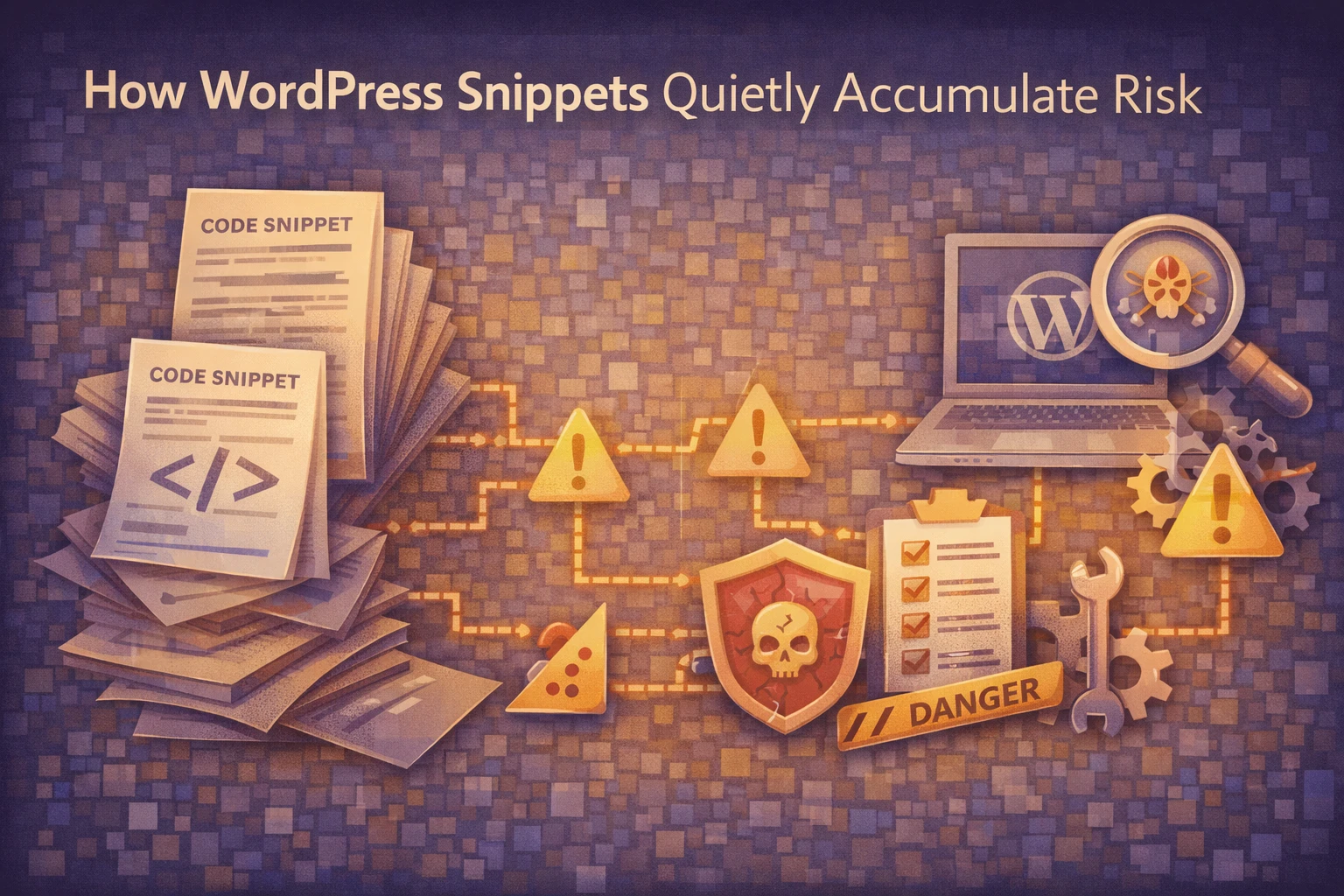
Most WordPress sites eventually rely on custom snippets.
In the early stages, teams usually see these snippets as harmless additions. A small tweak fixes a problem, or a quick adjustment adds missing functionality. Because the site continues to work, the change rarely triggers concern.
Over time, however, those small fixes stop behaving like temporary solutions. Instead, they quietly become permanent parts of the system.
At Wisegigs, many WordPress stability issues originate from snippets rather than large architectural choices. In most cases, the risk does not appear immediately. Instead, it grows slowly as the site evolves.
This article explains how WordPress snippets accumulate risk over time, why that risk is easy to overlook, and how disciplined teams keep it under control.
Snippets Usually Enter Without a Clear Plan
In many projects, developers add snippets reactively.
For example, a feature may be missing, a bug may appear, or a client may request a small change. As a result, developers introduce a snippet to solve the immediate issue.
While the solution works, teams rarely document the decision. Later, when requirements change, no one remembers why the snippet exists or which assumptions it relies on.
Because of this pattern, snippets accumulate without intent instead of being added deliberately.
“It Works” Becomes the Only Validation
After adding a snippet, teams rarely review it again.
As long as the site loads correctly, everyone assumes the snippet is safe. Unfortunately, working code does not automatically mean reliable code.
In practice, many snippets:
Depend on execution order
Assume specific plugin behavior
Modify global state
Bypass stable WordPress APIs
WordPress core documentation consistently recommends using stable APIs to reduce fragility:
https://developer.wordpress.org/apis/
When snippets ignore those APIs, hidden risk increases over time.
Snippets Hide Technical Debt Extremely Well
Unlike plugins, snippets do not advertise their presence.
They do not show update notices.
They do not publish changelogs.
They do not warn about incompatibilities.
Because everything appears to work, technical debt remains invisible.
Eventually, that debt surfaces as risky updates, unexplained bugs, or performance regressions. At that point, teams often hesitate to change anything.
Martin Fowler explains how unmanaged design decisions create long-term cost in software systems:
https://martinfowler.com/articles/designDead.html
Even small snippets can compound into significant debt.
Execution Context Is Commonly Misunderstood
WordPress executes code in many different contexts.
For instance, snippets may run during frontend requests, admin screens, AJAX calls, REST API requests, or background tasks.
Many developers assume a snippet runs in only one context. In reality, it often executes far more frequently than expected.
As a result, snippets may slow down unrelated requests, trigger side effects, or introduce bugs that are difficult to reproduce.
The WordPress Plugin Handbook stresses the importance of context-aware logic:
https://developer.wordpress.org/plugins/
Ignoring execution context increases unpredictability across the site.
Snippets Often Lose Ownership Over Time
As WordPress projects evolve, teams change.
The original author may leave, documentation may disappear, and priorities may shift. At that stage, teams often treat existing snippets as untouchable.
Because no one clearly owns the code, developers avoid removing or refactoring logic they do not fully understand. Over time, confidence drops and fear replaces clarity.
This loss of ownership is one of the main reasons WordPress sites become fragile as they age.
Updates Expose Hidden Assumptions
WordPress updates are not inherently risky.
However, unmanaged snippets often rely on undocumented behavior or outdated assumptions. When core, plugins, or themes evolve, those assumptions break.
As a result, updates feel dangerous even though the platform itself remains stable.
WordPress maintains strong backward compatibility, but it cannot protect custom code built on unsafe foundations:
https://wordpress.org/support/article/hardening-wordpress/
Updates simply reveal problems that already existed.
How Disciplined Teams Manage Snippets Safely
Stable WordPress sites do not avoid snippets.
Instead, teams manage them intentionally.
Disciplined teams:
Treat snippets as long-lived code
Document why each snippet exists
Review snippets during updates
Remove unused logic
Isolate behavior instead of scattering fixes
At Wisegigs, teams treat snippets as production software rather than disposable helpers. Because of this approach, long-term risk stays manageable.
Conclusion
WordPress snippets rarely cause immediate failures.
Instead, they introduce slow and accumulating risk.
The problem is not the snippet itself. The real issue is the lack of strategy, ownership, and review around it.
To recap:
Snippets often enter without intent
“It works” hides fragility
Technical debt accumulates quietly
Execution context is frequently ignored
Ownership fades over time
Updates expose hidden assumptions
At Wisegigs.eu, the most stable WordPress sites are not the ones with the fewest snippets. They are the ones where every snippet exists for a clear reason and receives the same care as production code.
If your WordPress site has grown through years of small fixes, now is the right time to review which snippets help — and which quietly add risk.
Contact Wisegigs.eu