
VPS hosting is often promoted as a straightforward upgrade from shared hosting.
At first glance, the benefits appear obvious. You get more CPU, more memory, and greater control over your server environment. Because of this, many teams assume that performance problems disappear automatically after moving to a VPS.
In reality, performance and stability depend far more on resource isolation than on raw capacity.
At Wisegigs.eu, many VPS-related issues we diagnose are caused by weak isolation rather than insufficient resources. Over time, these weaknesses create unpredictable behavior that becomes difficult to trace and expensive to fix.
This article explains what resource isolation really means, why it matters in VPS environments, and how proper isolation supports long-term reliability.
What Resource Isolation Really Means
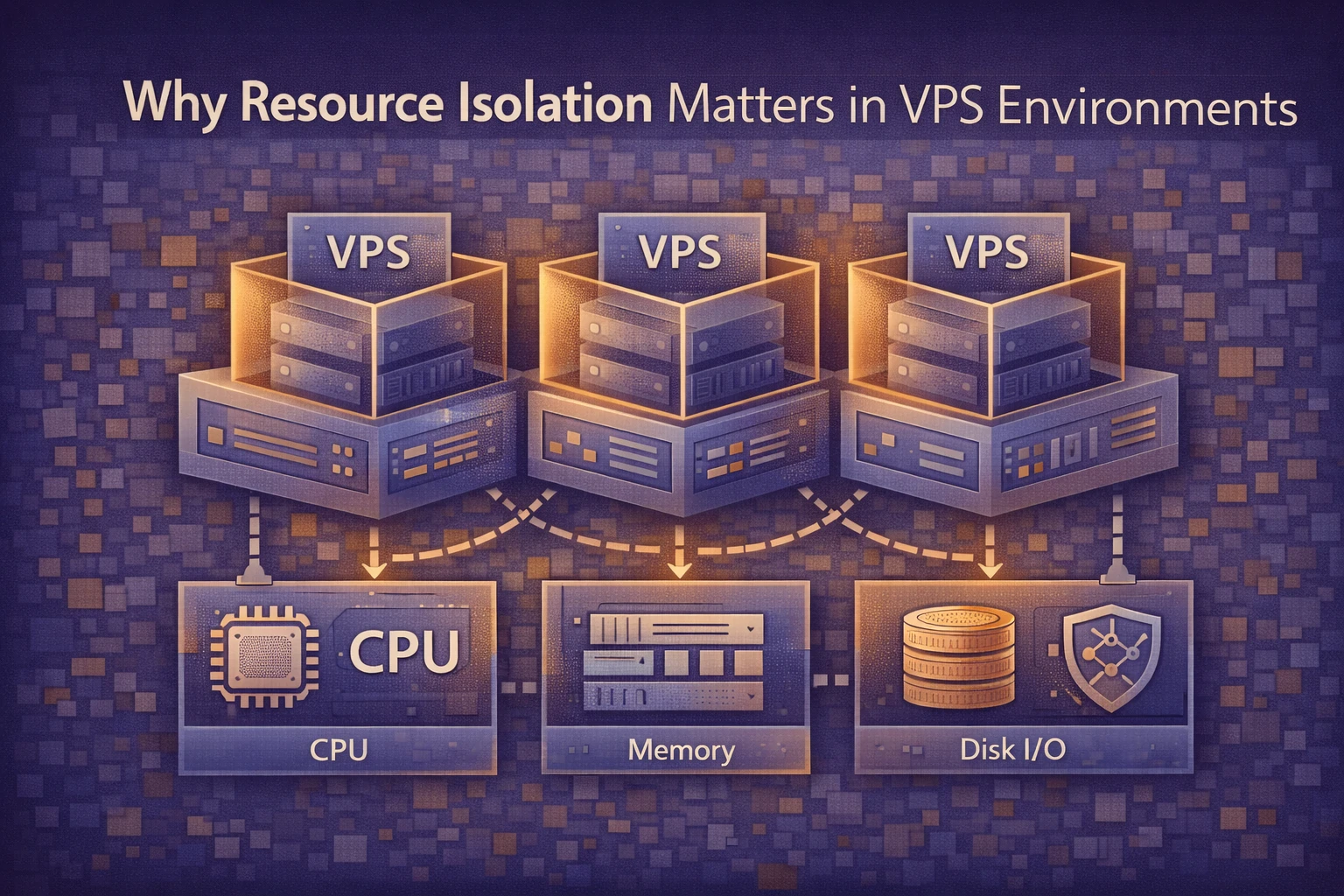
In a VPS environment, multiple virtual servers share the same physical machine.
However, sharing hardware does not mean sharing behavior.
Resource isolation defines how strictly each VPS is separated from others running on the same host. When isolation is properly enforced, one VPS cannot interfere with another.
Specifically, isolation applies to CPU usage, memory limits, disk input/output, and network throughput. When these boundaries are clear, performance remains predictable even under load.
Virtualization platforms rely on these boundaries to deliver consistent behavior across tenants:
https://www.redhat.com/en/topics/virtualization/what-is-a-virtual-machine
Without proper isolation, VPS hosting behaves much like shared hosting with better branding.
Why “Noisy Neighbors” Are a Structural Problem
One of the most common VPS complaints is inconsistent performance.
In many cases, this inconsistency is caused by a “noisy neighbor.” This happens when another VPS on the same host consumes excessive resources.
For example, a traffic spike, a backup job, or a poorly optimized application can overload shared hardware. As a result, other VPS instances slow down even though their own workloads have not changed.
Strong resource isolation prevents this behavior by enforcing strict limits. Therefore, predictable performance depends more on isolation than on advertised specifications.
CPU Isolation Protects Response Time
CPU isolation controls how processing time is distributed across VPS instances.
Without clear CPU limits, one virtual server can monopolize processing power. Consequently, response times increase and latency becomes unpredictable.
With proper CPU isolation in place, each VPS receives a defined share of processing time. Even during traffic spikes, applications continue to respond consistently.
Linux scheduling and cgroups are commonly used to enforce CPU fairness in virtualized systems:
https://docs.kernel.org/scheduler/
For performance-sensitive workloads, predictable CPU behavior is essential.
Memory Isolation Prevents System Instability
Memory is another critical isolation layer.
When memory limits are not enforced correctly, a single VPS can exhaust available RAM on the host. As this happens, swapping increases or processes are terminated unexpectedly.
Because of this, system stability suffers across all VPS instances.
Proper memory isolation ensures that each VPS operates within defined limits. As a result, failures remain contained instead of cascading across the host.
Linux control groups are widely used to enforce memory boundaries in VPS environments:
https://www.kernel.org/doc/html/latest/admin-guide/cgroup-v2.html
Disk and I/O Isolation Are Often Overlooked
Disk performance is frequently overlooked in VPS environments.
However, disk input/output is one of the most common bottlenecks under real workloads. Heavy database writes, backups, or logging processes can saturate shared storage.
Without I/O isolation, these operations slow down unrelated applications. Over time, this leads to erratic performance that is difficult to diagnose.
With proper disk isolation, intensive operations are constrained. Therefore, live traffic remains responsive even during maintenance tasks.
Network Isolation Improves Predictability
Network resources are also shared in VPS environments.
When network isolation is weak, high traffic from one VPS can affect others. This may cause packet loss, latency spikes, or throttling during peak usage.
Strong isolation enforces bandwidth limits and traffic shaping. As a result, network behavior remains predictable even when demand increases.
For APIs and real-time services, this consistency is critical.
Why Isolation Matters More as Traffic Grows
Under low traffic, weak isolation is easy to ignore.
As usage increases, however, hidden coupling becomes visible. Performance fluctuates, errors appear under load, and scaling feels unreliable.
At this stage, adding more resources rarely fixes the problem. Instead, the lack of isolation becomes the limiting factor.
Well-designed VPS environments are built to behave consistently as traffic grows.
What Reliable VPS Hosting Does Differently
Reliable VPS platforms prioritize isolation by design.
They enforce CPU, memory, disk, and network limits intentionally. In addition, they monitor resource behavior continuously to detect contention early.
At Wisegigs, VPS hosting is treated as shared infrastructure that must behave like dedicated systems. Because of this, isolation is validated under real workloads rather than assumed.
Conclusion
VPS hosting delivers value because it enforces boundaries, not because it offers larger numbers.
Resource isolation:
Prevents noisy neighbor issues
Improves performance predictability
Protects stability under load
Makes scaling safer
Without proper isolation, VPS environments inherit the same risks as shared hosting.
At Wisegigs.eu, we design VPS and cloud environments where isolation is intentional, measurable, and reliable.
If your VPS performance feels inconsistent despite adequate resources, isolation may be the missing piece.
Contact Wisegigs.eu