
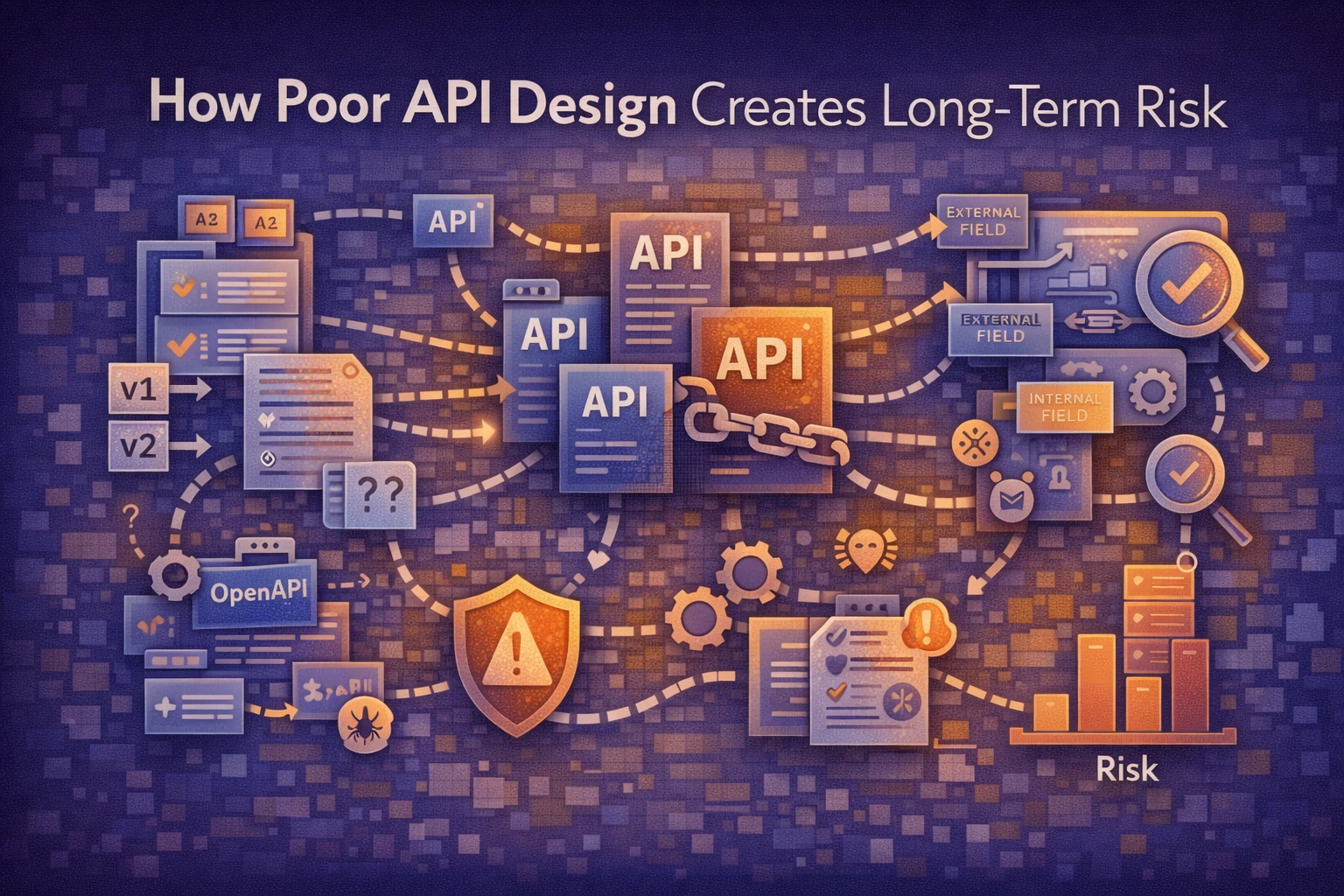
APIs are often introduced to simplify system integration.
In practice, they connect services, enable data exchange, and help teams move faster. Initially, these benefits are clear and measurable.
However, as systems grow and more consumers rely on the API, early design decisions begin to matter far more than expected.
At Wisegigs.eu, many long-term operational issues can be traced back to APIs that were designed quickly and never treated as long-lived systems. The risk rarely appears immediately. Instead, it accumulates quietly over time.
This article explains how poor API design creates long-term risk, why that risk is difficult to reverse, and what disciplined teams do differently.
APIs Become Contracts Whether You Plan for It or Not
Once an API is used, it effectively becomes a contract.
Even undocumented behavior quickly turns into an expectation. Because of this, consumers begin to rely on specific response structures, field names, defaults, and side effects.
As a result, any change becomes risky when expectations are implicit rather than explicit.
According to the OpenAPI Initiative, clearly defined contracts are essential for reducing integration risk and preventing unintended breakage:
https://www.openapis.org/
Without explicit contracts, teams often discover breaking changes only after consumers fail in production.
Poor Versioning Locks Systems in Place
Many APIs begin without versioning.
At first, this feels reasonable. There may be only one consumer, and the API is often considered internal.
Over time, however, additional integrations appear. As a result, backward compatibility becomes an assumption rather than a choice.
Eventually, teams are forced into difficult trade-offs:
Breaking existing integrations
Freezing the API permanently
Adding conditional logic everywhere
Consequently, technical debt becomes structural.
Although versioning is challenging, avoiding it makes future change far more expensive.
Ambiguous Error Handling Hides Failure
APIs fail in many different ways.
For example, failures can result from invalid input, network issues, rate limits, or downstream service problems.
Unfortunately, poorly designed APIs often return generic errors, inconsistent status codes, or incomplete failure details. Because of this, consumers are forced to guess how to respond.
REST API design guidelines emphasize that clear and consistent error semantics are critical for reliable integrations:
https://restfulapi.net/
When errors are ambiguous, failures propagate silently and become harder to diagnose.
Inconsistent Data Models Increase Coupling
In many systems, APIs expose internal data structures directly.
Although this may seem efficient, it tightly couples consumers to implementation details. Over time, this coupling limits flexibility.
Problems often appear when internal models change, fields gain new meaning, or optional values become required. As a result, even small refactors can break multiple integrations.
Well-designed APIs protect consumers from internal change by maintaining stable and intentional data contracts.
Without that discipline, systems lose the ability to evolve independently.
Poor API Design Scales Risk, Not Just Traffic
As usage increases, poor design multiplies risk.
Under low traffic, design flaws remain invisible. Under real load, however, issues such as chatty request patterns, synchronous dependencies, and tight coupling begin to surface.
According to Google’s Site Reliability Engineering guidance, tightly coupled systems dramatically increase blast radius during failures:
https://sre.google/books/
In other words, APIs should reduce dependency rather than amplify it.
Ownership Gaps Turn APIs Into Orphans
APIs often outlive their original creators.
Without clear ownership, documentation becomes outdated, changes lack review, and consumers rely on assumptions instead of guarantees. Over time, teams become afraid to modify the API.
This fear is not technical. Instead, it is organizational.
Long-lived APIs require explicit ownership, clear review processes, and defined maintenance expectations.
What Disciplined API Design Looks Like
Teams that avoid long-term API risk treat APIs as products.
Specifically, they:
Define explicit contracts
Version intentionally
Document behavior and errors
Protect consumers from internal change
Monitor usage and failures
Assign clear ownership
Design for evolution
As a result, APIs remain reliable as systems grow and requirements change.
At Wisegigs.eu, API design is treated as infrastructure rather than glue code.
Conclusion
Poor API design rarely causes immediate failure.
Instead, it introduces delayed fragility.
Implicit contracts, missing versioning, unclear errors, and weak ownership slowly turn APIs into barriers instead of enablers. By the time problems surface, change feels risky and expensive.
Sustainable systems treat APIs as long-lived commitments rather than short-term shortcuts.
At Wisegigs.eu, we help teams design and refactor APIs that remain reliable, evolvable, and safe to change over time.
If your system relies on APIs that feel risky to modify, the issue is not growth.
Contact Wisegigs.eu