
Reliable hosting is often misunderstood.
Many teams focus on uptime percentages, server specs, or monitoring dashboards. As long as services are running, the system is considered healthy.
Site Reliability Engineering (SRE) challenges this thinking.
At Wisegigs.eu, we see that the most reliable hosting environments are not the ones with the most metrics, but the ones designed to fail safely, recover quickly, and behave predictably under stress.
This article explains what SRE teaches us about reliable hosting, why uptime alone is misleading, and how SRE principles improve long-term infrastructure stability.
1. Reliability Is a User Experience Problem
SRE defines reliability from the user’s perspective.
A system is reliable when:
Requests succeed consistently
Performance is predictable
Failures are rare and brief
Recovery is fast and controlled
A server can be “up” while users experience timeouts, errors, or degraded performance.
This is why SRE shifts focus from raw uptime to service reliability.
Google’s SRE principles emphasize that reliability must be measured by user-visible outcomes, not internal system status:
https://sre.google/books/
2. Uptime Metrics Hide Real Failure Modes
Uptime is binary.
Either the service is reachable or it isn’t.
Real failures are rarely binary.
Common examples include:
Slow responses under load
Partial outages affecting specific features
Database contention
Cache failures
Background job backlogs
These issues often occur while uptime metrics remain green.
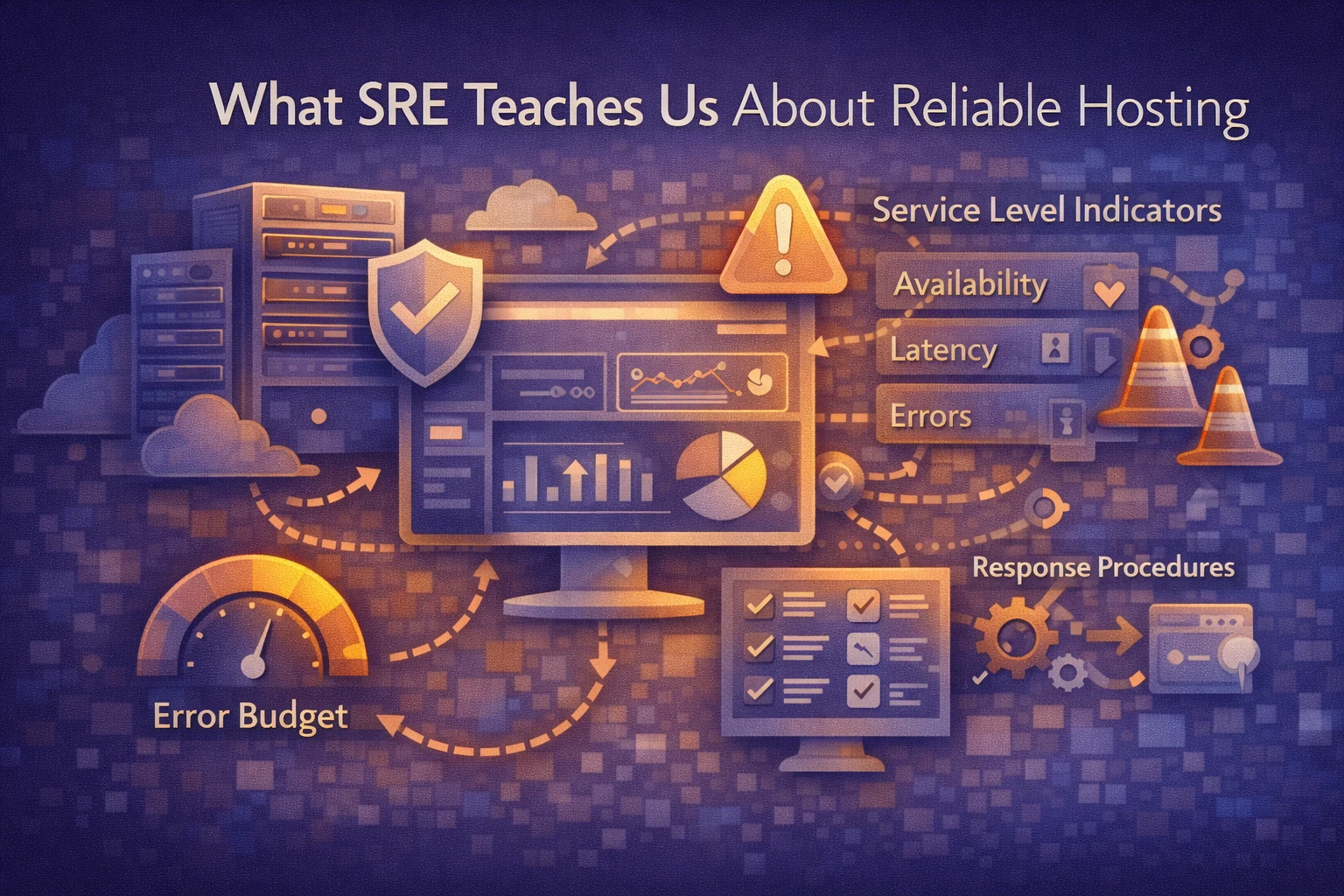
SRE replaces simple uptime tracking with Service Level Indicators (SLIs) that measure latency, error rates, and availability from the user’s perspective.
3. Monitoring Without Context Creates Noise
Many hosting environments collect vast amounts of metrics.
CPU usage.
Memory consumption.
Disk space.
Network throughput.
Yet incidents still catch teams by surprise.
SRE teaches that monitoring must answer clear questions:
Is the service healthy for users?
Are we approaching failure thresholds?
Is behavior changing unexpectedly?
Without context, metrics generate alerts without insight.
Effective monitoring reduces noise and highlights meaningful signals.
4. Alerting Must Be Actionable
One of the most important SRE lessons is that alerts should require action.
Poor alerting practices include:
Alerting on every metric spike
Alerting without clear ownership
Alerting without defined response steps
This leads to alert fatigue, where teams begin ignoring warnings.
5. Error Budgets Change How Hosting Is Managed
SRE introduces the concept of error budgets.
An error budget defines how much failure is acceptable within a given period.
Instead of chasing 100% uptime, teams:
Allow controlled failure
Balance reliability with change velocity
Pause risky changes when reliability degrades
This approach prevents over-engineering while maintaining user trust.
Error budgets encourage disciplined decision-making rather than reactive firefighting.
6. Reliability Requires Designing for Failure
SRE assumes that failures will happen.
Servers crash.
Networks fail.
Deployments go wrong.
Reliable hosting environments are designed to:
Isolate failures
Recover automatically
Minimize blast radius
Restore service quickly
This mindset differs sharply from traditional hosting setups that assume stability until something breaks.
Designing for failure reduces downtime severity and recovery time.
7. What SRE-Driven Hosting Looks Like in Practice
Hosting environments influenced by SRE principles share common traits:
User-focused reliability metrics
Meaningful monitoring and alerting
Clear incident ownership
Documented response procedures
Regular incident reviews
Continuous improvement after failures
These systems improve over time because failures are treated as learning opportunities, not surprises.
At Wisegigs, we apply SRE thinking even to small and mid-scale hosting environments — because reliability problems scale faster than infrastructure.
Conclusion
Reliable hosting is not achieved by hardware alone.
It is built through:
Clear reliability goals
User-focused measurement
Thoughtful monitoring
Actionable alerting
Prepared recovery processes
SRE teaches us that reliability is a system property, not a metric.
At Wisegigs.eu, we help teams apply SRE principles to hosting environments so systems remain stable, predictable, and resilient as they grow.
If your hosting looks healthy but failures still surprise you, it may be time to rethink how reliability is measured and managed.
Contact Wisegigs.eu