
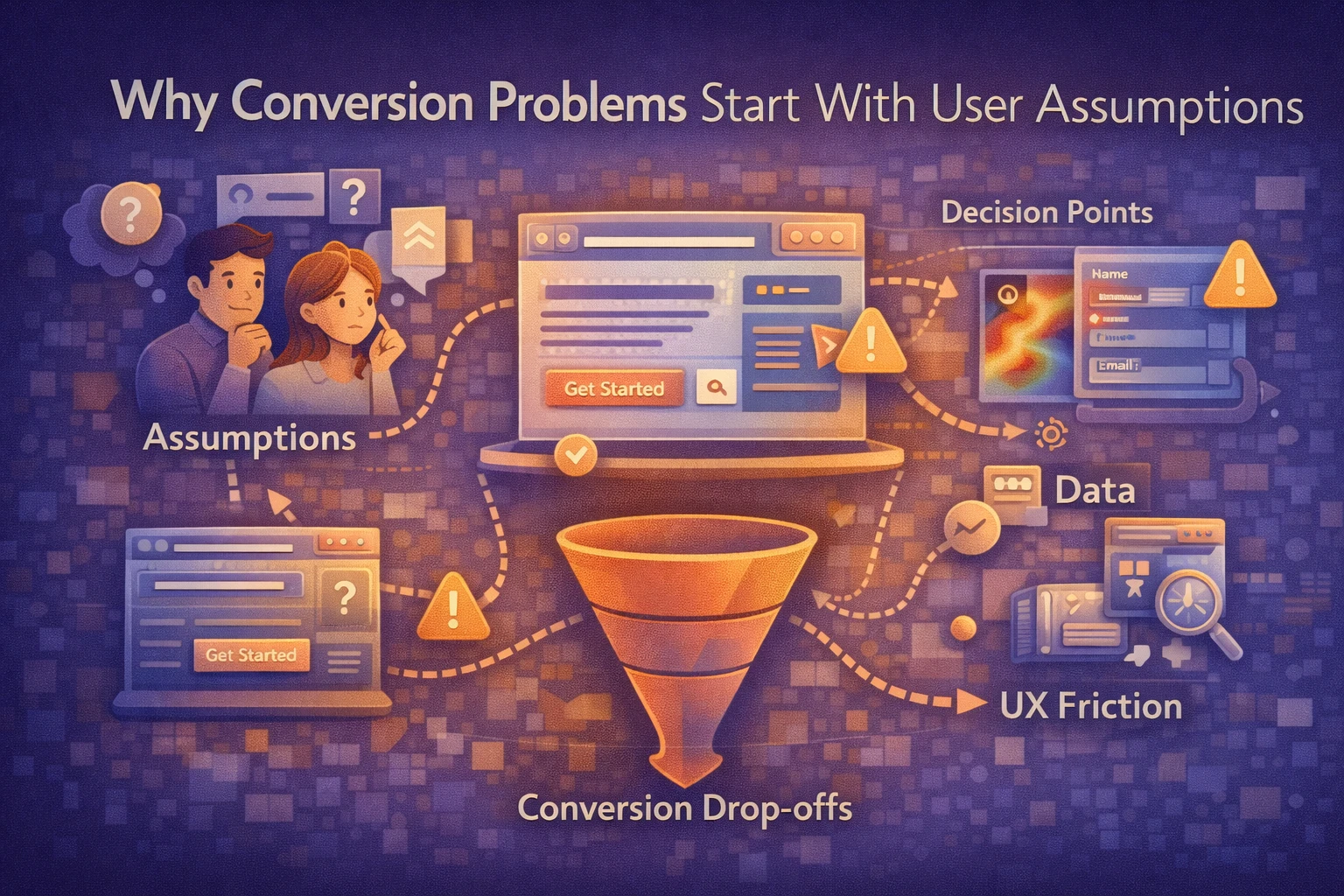
When conversions drop, teams usually look for tactical fixes.
Change the button color.
Rewrite the headline.
Add urgency.
Run another A/B test.
Sometimes results improve. Often they don’t.
At Wisegigs, many conversion problems we diagnose do not originate from design flaws or technical errors. They originate from incorrect assumptions about users — how they think, what they need, and how they make decisions.
This article explains why user assumptions quietly undermine conversion rates, how those assumptions form, and what successful CRO and UX strategies do differently.
1. Assumptions Replace Evidence Too Easily
Most websites are built around assumptions.
Common ones include:
Users will read the page carefully
Users understand industry terminology
Users are ready to decide immediately
Users know what to do next
These assumptions feel reasonable — but they are rarely tested.
When decisions are based on internal beliefs rather than observed behavior, conversion problems are inevitable.
UX research consistently shows that users behave differently than designers and stakeholders expect:
https://www.nngroup.com/articles/ux-prototype-hi-lo-fidelity/
2. Teams Design for Themselves, Not for Users
Many UX and CRO decisions are made by people deeply familiar with the product.
This creates blind spots.
What feels obvious to insiders is often confusing to first-time visitors.
Common examples include:
Vague value propositions
Overloaded feature lists
Jargon-heavy explanations
Missing context for decisions
Users arrive without background knowledge. When a site assumes understanding, friction increases silently.
This gap between internal knowledge and external perception is one of the most common causes of conversion failure.
3. Assumed Intent Rarely Matches Real Intent
Conversion paths often assume a single user mindset.
For example:
“Visitors are ready to buy”
“Users want all the details upfront”
“Speed matters more than clarity”
In reality, user intent varies.
Some users are researching.
Others are comparing.
Some need reassurance.
Others need simplicity.
Analytics platforms show what users do, but they rarely explain why.
Google’s UX research emphasizes aligning content and flow with real user intent rather than assumed readiness:
https://web.dev/articles/user-centric-performance-metrics
When intent is misjudged, conversion paths fail even with good traffic.
4. Small UX Friction Is Often Invisible Internally
Minor UX issues often go unnoticed by internal teams.
Examples include:
Unclear calls to action
Ambiguous form labels
Unexpected navigation behavior
Overloaded pages
Inconsistent messaging
These issues feel small individually.
Together, they create hesitation.
Users rarely complain. They simply leave.
This is why usability testing often reveals problems teams never anticipated.
5. CRO Becomes Cosmetic When Assumptions Remain
When assumptions go unchallenged, CRO efforts focus on surface changes.
This leads to:
Button color tests
Microcopy tweaks
Layout rearrangements
These changes may produce temporary improvements, but they do not address structural issues.
Effective CRO challenges assumptions first:
Why is this page needed?
What decision is the user trying to make?
What information reduces uncertainty?
What happens if they hesitate?
Without these questions, optimization becomes guesswork.
6. Data Without Interpretation Reinforces Assumptions
Data does not eliminate assumptions automatically.
Teams often interpret analytics through existing beliefs:
“Users didn’t scroll because the content is fine”
“Bounce rate is high because traffic quality is bad”
“Conversions dropped because of seasonality”
Without qualitative insight, data can reinforce incorrect narratives.
UX research methods such as session recordings, usability testing, and user interviews exist specifically to challenge assumptions:
https://www.interaction-design.org/literature/topics/user-research
CRO improves when data and observation work together.
7. What High-Converting Sites Do Differently
Websites with strong conversion performance share common behaviors:
They validate assumptions with real user data
They test understanding, not just visuals
They design for clarity before persuasion
They reduce cognitive load
They align UX with different stages of intent
Conversion success comes from reducing uncertainty, not forcing action.
At Wisegigs, CRO is treated as a behavioral problem before it is a design problem.
Conclusion
Conversion problems rarely begin with design mistakes.
They begin with assumptions.
When websites assume too much — about intent, understanding, motivation, or behavior — friction grows quietly and conversions suffer.
Successful CRO and UX strategies replace assumptions with evidence, clarity, and empathy for real users.
At Wisegigs.eu, we help teams identify and remove the hidden assumptions that undermine conversion performance.
If your website has traffic but struggles to convert, the issue may not be the design.
Contact Wisegigs.eu