
When deployment pipelines break, the first instinct is usually to blame the tools.
The CI system is unreliable.
The deployment service is buggy.
The automation platform is limited.
So teams replace tools, migrate platforms, or add more automation — only to encounter the same problems again.
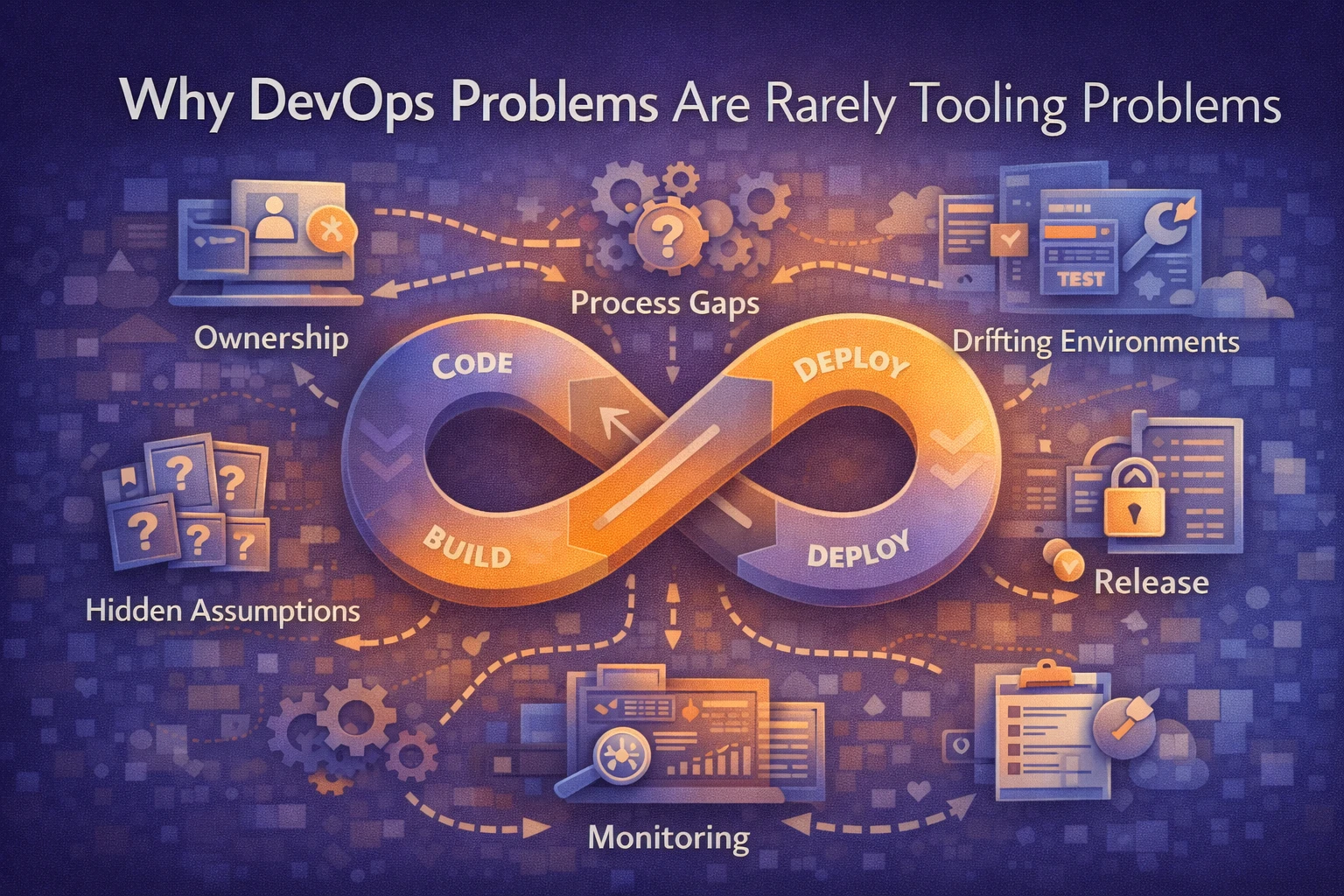
At Wisegigs, most DevOps failures we encounter are not caused by tooling limitations. They are caused by process gaps, unclear ownership, and unsafe assumptions that no tool can fix.
This article explains why DevOps problems are rarely tooling problems, what actually causes CI/CD pipelines to fail, and how mature teams approach deployment reliability.
1. Tools Automate What Already Exists
DevOps tools do not create good processes.
They automate existing ones.
If a deployment process is:
Fragile
Inconsistent
Poorly understood
Dependent on tribal knowledge
Automation simply makes those problems faster and more repeatable.
CI/CD tools execute instructions exactly as defined — even when those instructions encode risky behavior.
This is why broken pipelines often reflect broken processes, not broken software.
2. Lack of Ownership Is a Common Root Cause
Many DevOps issues stem from unclear responsibility.
Questions often go unanswered:
Who owns the deployment pipeline?
Who approves production releases?
Who rolls back failed deployments?
Who updates pipeline logic when requirements change?
Without ownership, pipelines degrade over time.
Small changes accumulate.
Exceptions are added.
Workarounds become permanent.
Google’s Site Reliability Engineering practices emphasize clear ownership and accountability as core requirements for reliable systems:
https://sre.google/books/
Tools cannot replace responsibility.
3. CI/CD Pipelines Encode Risky Assumptions
Pipelines often assume ideal conditions.
Examples include:
Tests always pass reliably
Deployments are reversible
Environments behave identically
Dependencies update safely
Rollbacks are rarely needed
These assumptions hold — until they don’t.
When assumptions break, pipelines fail in unpredictable ways.
This is why mature DevOps practices emphasize designing for failure, not just success:
https://martinfowler.com/articles/continuousIntegration.html
A good pipeline expects things to go wrong.
4. Environment Drift Breaks Automation
Many DevOps problems originate from environment inconsistency.
Common issues include:
Differences between staging and production
Manual hotfixes applied directly to live systems
Configuration changes not tracked in version control
Secrets managed outside the pipeline
Automation relies on predictability.
When environments drift, pipelines become unreliable regardless of tooling quality.
Infrastructure-as-code practices exist specifically to address this problem, not to introduce new tools:
https://www.hashicorp.com/resources/what-is-infrastructure-as-code
5. Tool Switching Often Masks Deeper Issues
Switching CI/CD platforms is tempting.
New tools promise:
Faster builds
Better UI
More integrations
Fewer failures
But without addressing process flaws, teams often recreate the same problems on a new platform.
Symptoms return as:
Flaky builds
Manual overrides
Emergency deploys
Fear of releases
Tool churn increases complexity without improving reliability.
DevOps maturity comes from discipline, not features.
6. Reliable Pipelines Favor Safety Over Speed
High-performing teams optimize for safety first.
This includes:
Small, incremental deployments
Clear rollback paths
Automated verification
Explicit approval gates when needed
Post-deployment monitoring
Speed emerges naturally when systems are predictable.
The DevOps Research and Assessment (DORA) findings show that reliable deployment practices correlate more strongly with performance than specific tools:
https://cloud.google.com/devops
Process quality drives outcomes.
7. What Mature DevOps Teams Do Differently
Teams with stable CI/CD systems share common traits:
Clear ownership of pipelines
Documented deployment workflows
Version-controlled configuration
Consistent environments
Automated testing with known limits
Monitoring tied to deployments
Tools support these practices — they do not replace them.
DevOps success is organizational before it is technical.
Conclusion
DevOps problems rarely start with tools.
They start with:
Unclear ownership
Fragile processes
Hidden assumptions
Environment drift
Lack of operational discipline
Replacing tools without addressing these issues only resets the clock.
Effective DevOps treats deployment as a critical system — not a convenience feature.
At Wisegigs.eu, we help teams design CI/CD pipelines that prioritize safety, clarity, and reliability before automation.
If your deployments feel risky despite modern tooling, the issue may not be the tools.
Contact Wisegigs.eu