
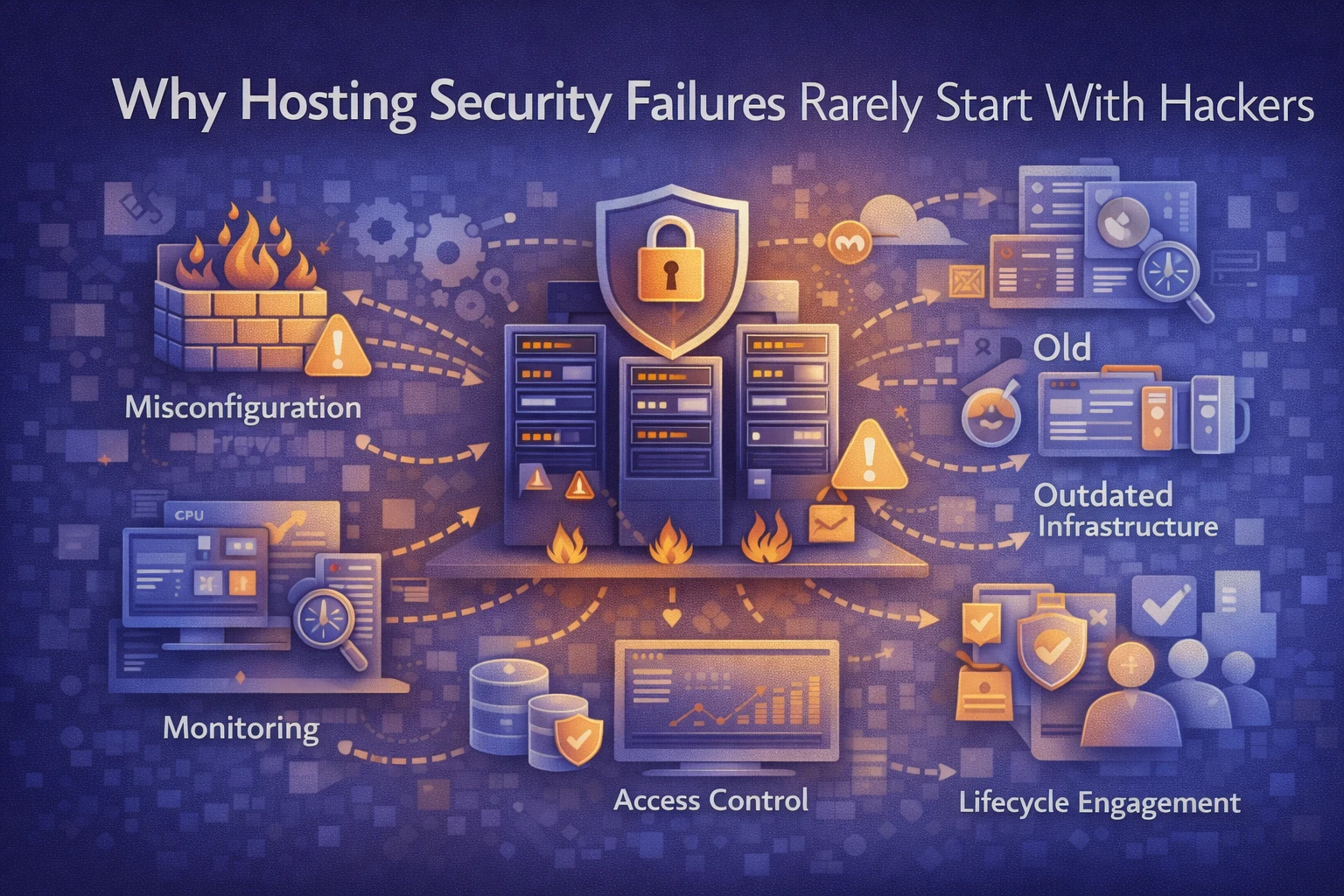
When businesses think about hosting security, they usually imagine external attackers.
Malware injections.
Brute-force login attempts.
Distributed denial-of-service attacks.
These threats are real. However, most hosting security failures do not begin with attackers. They begin with internal weaknesses that attackers later exploit.
At Wisegigs, security incidents rarely originate from advanced hacking techniques. Instead, they typically result from misconfiguration, outdated infrastructure, weak operational controls, or incomplete compliance planning.
This article explains why hosting security failures usually start long before an attacker appears, which structural risks create vulnerabilities, and how secure infrastructure prevents operational disasters.
1. Most Security Failures Begin With Misconfiguration
Hosting environments are complex systems composed of:
Web servers
Databases
File storage
Networking layers
Access control systems
Monitoring infrastructure
Security failures often occur when one or more of these layers are incorrectly configured.
Common misconfigurations include:
Publicly exposed services
Improper file permissions
Open administrative ports
Weak authentication enforcement
Default credentials left unchanged
The Open Web Application Security Project identifies security misconfiguration as one of the most common causes of real-world breaches:
https://owasp.org/www-project-top-ten/
Attackers typically exploit these weaknesses rather than creating new vulnerabilities.
2. Outdated Infrastructure Creates Silent Risk
Many hosting environments run outdated components.
This includes:
Server operating systems
Database engines
PHP or runtime environments
Control panels
Third-party integrations
Outdated software increases risk because known vulnerabilities become publicly documented. Once disclosed, automated tools begin scanning the internet for systems that have not been patched.
Cybersecurity frameworks consistently emphasize patch management as one of the most effective defensive measures:
https://www.cisa.gov/cybersecurity-best-practices
Failures to maintain infrastructure updates create predictable attack opportunities.
3. Compliance Often Focuses on Documentation, Not Behavior
Compliance frameworks help organizations maintain security standards. However, compliance does not automatically guarantee real protection.
Many environments pass compliance audits while still exposing operational weaknesses such as:
Weak monitoring practices
Poor incident response procedures
Incomplete logging systems
Misaligned access control policies
The National Institute of Standards and Technology explains that cybersecurity frameworks must be continuously applied rather than treated as static checklists:
https://www.nist.gov/cyberframework
Compliance supports security, but it cannot replace operational discipline.
4. Weak Access Control Is a Major Risk Multiplier
Hosting security depends heavily on identity and access management.
Common access control risks include:
Shared administrative credentials
Excessive user privileges
Lack of multi-factor authentication
Poor credential rotation policies
When attackers obtain credentials, they bypass many traditional security layers.
Cloud security guidelines consistently emphasize identity protection as a critical defense mechanism:
https://cloud.google.com/security/best-practices
Strong authentication and least-privilege access significantly reduce breach impact.
5. Monitoring Failures Allow Small Incidents to Grow
Security incidents rarely escalate instantly.
They often begin as:
Suspicious login attempts
Abnormal resource usage
Unexpected configuration changes
Unusual outbound traffic
Without monitoring and alerting, these signals go unnoticed.
Modern infrastructure security strategies prioritize observability because early detection dramatically reduces recovery time and damage severity.
Logging and monitoring are essential components of compliance and operational resilience.
6. Backup and Recovery Weaknesses Turn Breaches Into Disasters
Security is not only about prevention. It is also about recovery.
Many hosting environments rely on backups that:
Are not tested regularly
Lack proper retention policies
Are stored on the same infrastructure
Cannot be restored quickly
Backup failures convert minor security incidents into major business disruptions.
Disaster recovery planning is widely recognized as a core component of secure infrastructure design.
7. What Secure Hosting Infrastructure Does Differently
Hosting environments with strong security share consistent characteristics:
Layered security controls
Regular patch management
Strong access control policies
Continuous monitoring and logging
Verified backup and recovery procedures
Clear incident response planning
Secure infrastructure assumes incidents will occur and prepares to contain them safely.
Security maturity reduces operational uncertainty and improves long-term stability.
Conclusion
Hosting security failures rarely begin with hackers.
They begin with:
Misconfiguration
Outdated infrastructure
Weak access control
Incomplete monitoring
Poor recovery planning
Attackers simply exploit weaknesses that already exist.
Secure hosting requires intentional planning, continuous monitoring, and disciplined infrastructure management.
At Wisegigs.eu, we help businesses design hosting environments that reduce security risk through proactive compliance, hardening, and operational security strategies.
If your hosting environment appears secure but lacks structured protection and monitoring, it may be time for a deeper security review.
Contact Wisegigs.eu