
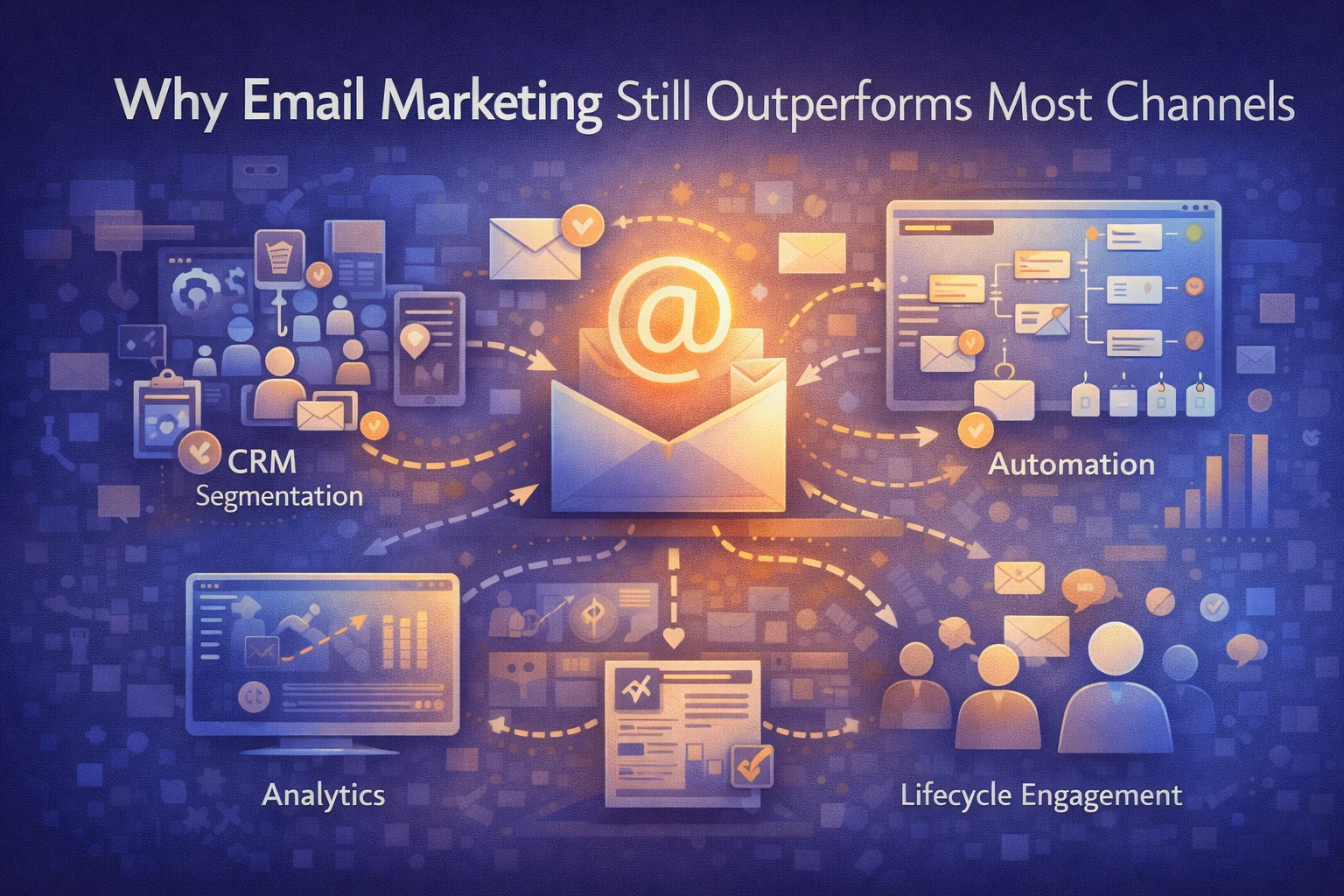
Marketing channels change constantly.
Social platforms rise and fall.
Paid advertising costs fluctuate.
Search algorithms evolve.
Despite these changes, email marketing continues to deliver consistent performance across industries.
At Wisegigs, we regularly see businesses invest heavily in social media and paid traffic while overlooking email — even though email remains one of the most reliable and profitable marketing channels available.
This article explains why email marketing continues to outperform other channels, what makes it structurally different, and why businesses that ignore email often struggle with long-term growth.
1. Email Marketing Owns the Audience Relationship
Most digital marketing channels operate on rented platforms.
Businesses depend on:
Social media algorithms
Advertising platform policies
Search engine ranking changes
Email marketing works differently.
When someone subscribes, the business owns a direct communication channel that is not controlled by third-party algorithms.
This ownership creates stability. Even when platform policies change or advertising costs increase, email communication remains accessible.
2. Email Consistently Delivers High ROI
Email marketing repeatedly ranks among the highest-return marketing channels.
This happens because email:
Targets existing or interested audiences
Requires lower ongoing acquisition costs
Supports automated lifecycle communication
Encourages repeat engagement
Studies from marketing analytics organizations show that email campaigns consistently outperform many paid and social campaigns in return on investment:
https://www.litmus.com/resources/email-marketing-roi/
Unlike paid traffic, where each visit has a cost, email allows businesses to communicate repeatedly without paying for every interaction.
3. Email Supports the Entire Customer Lifecycle
Many marketing channels focus on acquisition.
Email supports:
Lead nurturing
Customer onboarding
Retention campaigns
Re-engagement campaigns
Post-purchase communication
This makes email structurally valuable.
It strengthens relationships over time instead of focusing only on first contact.
Customer relationship management strategies emphasize lifecycle communication as a major driver of long-term revenue growth:
https://www.salesforce.com/marketing/email/
Email is uniquely positioned to support that lifecycle.
4. Segmentation Makes Email Highly Targeted
Email marketing allows detailed audience segmentation based on:
Behavior
Purchase history
Engagement patterns
Demographics
Customer lifecycle stage
This precision allows businesses to send relevant messages instead of broad campaigns.
Segmentation improves engagement while reducing unsubscribes and spam complaints.
CRM platforms emphasize segmentation as one of the most important factors in effective customer communication strategies.
5. Automation Creates Scalable Personalization
Email automation allows businesses to deliver personalized communication at scale.
Automated workflows can respond to:
User behavior
Purchase events
Abandoned carts
Content engagement
Subscription milestones
Automation transforms email from manual campaigns into a continuous engagement system.
Marketing automation studies show that triggered emails often outperform scheduled campaigns because they match real user behavior:
https://www.hubspot.com/marketing-statistics
Automation increases efficiency while improving customer experience.
6. Email Provides Clear and Reliable Measurement
Email marketing offers measurable performance indicators such as:
Open rates
Click-through rates
Conversion rates
Engagement patterns
Retention impact
Unlike social media metrics, which can be heavily influenced by platform algorithms, email performance is directly tied to audience response.
This transparency helps businesses evaluate campaign effectiveness more accurately.
Reliable measurement supports long-term optimization.
7. Email Builds Long-Term Brand Trust
Frequent, valuable communication builds familiarity.
Email allows businesses to:
Educate customers
Provide ongoing value
Share updates and insights
Maintain brand presence
Trust develops through consistency.
Channels focused solely on acquisition often struggle to build this level of relationship depth.
Email supports both marketing and customer relationship strategy simultaneously.
Conclusion
Marketing channels evolve constantly, but email continues to outperform most alternatives because of its structural advantages.
Email marketing works because it:
Builds owned communication channels
Delivers strong return on investment
Supports the entire customer lifecycle
Enables segmentation and automation
Provides reliable measurement
Strengthens long-term customer relationships
Businesses that rely only on acquisition channels often struggle with retention and engagement. Email marketing fills that gap.
At Wisegigs.eu, we help businesses design email and CRM systems that support long-term growth, not just short-term campaigns.
If your marketing focuses heavily on acquisition but lacks customer lifecycle strategy, email may be the missing piece.
Contact Wisegigs.eu