
Security incidents rarely begin with an attack.
They begin with assumptions.
Systems appear stable. Updates work. Backups exist. Monitoring shows normal activity. Because nothing is visibly broken, security is often treated as a checklist rather than a strategy.
At Wisegigs, most security issues we investigate are not caused by sophisticated attackers. They are caused by gaps in planning that quietly accumulate operational risk over time.
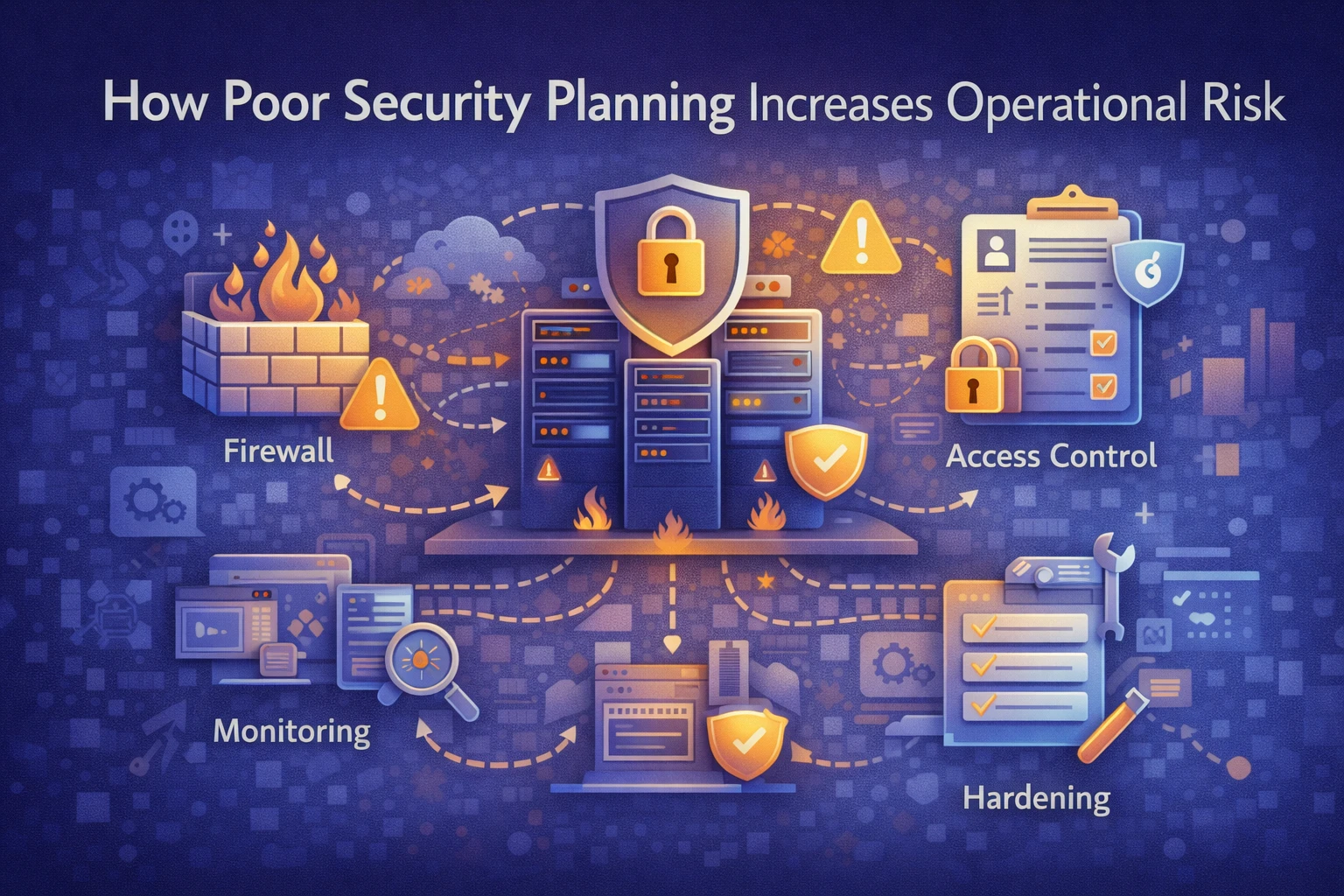
This article explains how poor security planning increases operational risk, why reactive security measures fail, and how stable systems approach security differently.
1. Security Planning Determines How Systems Fail
Every system eventually experiences stress.
Updates introduce changes.
Traffic patterns shift.
Dependencies evolve.
Human errors occur.
Without security planning, failures tend to cascade.
Instead of isolated incidents, teams face:
Extended downtime
Data exposure risks
Recovery delays
Unpredictable system behavior
Security planning is not about preventing every attack.
It is about limiting damage when something goes wrong.
Industry security frameworks emphasize resilience as a core component of cybersecurity design:
https://www.nist.gov/cyberframework
2. Reactive Security Creates Hidden Risk
Many websites rely heavily on reactive security tools.
These include:
Firewall plugins
Malware scanners
Automated threat blocking
Emergency patching
While these tools are useful, they are defensive layers, not strategic solutions.
Reactive security often results in:
Overlapping protections
False confidence
Poor visibility into system behavior
Delayed response to emerging threats
Security should shape infrastructure design, not just respond to incidents.
3. Operational Risk Often Comes From Internal Complexity
Security failures frequently originate from system complexity rather than external threats.
Examples include:
Misconfigured permissions
Outdated dependencies
Conflicting plugins or modules
Weak environment separation
Untracked configuration changes
Complex systems increase the likelihood of human error, which remains one of the leading causes of security incidents.
OWASP highlights misconfiguration and outdated components as major contributors to real-world vulnerabilities:
https://owasp.org/www-project-top-ten/
Poor planning allows complexity to grow unchecked, increasing operational risk with every update.
4. Security Failures Rarely Appear Immediately
Security weaknesses often remain invisible until conditions change.
They surface when:
Software updates modify behavior
Traffic increases expose vulnerabilities
New integrations introduce attack surfaces
Backup and recovery procedures are tested during emergencies
Because these weaknesses develop slowly, teams often underestimate their impact until recovery becomes difficult.
This is why security hardening must be treated as an ongoing process rather than a one-time implementation.
5. Lack of Visibility Increases Incident Severity
Operational risk increases dramatically when systems lack observability.
Without monitoring and logging, teams cannot:
Detect abnormal behavior
Trace security incidents
Validate system integrity
Identify root causes
Security without visibility creates blind spots.
Modern infrastructure guidelines stress that logging, monitoring, and alerting are foundational components of secure system design:
https://ubuntu.com/security
Observability reduces recovery time and prevents small incidents from becoming major outages.
6. Security Planning Requires Environment Awareness
Many operational risks originate from environments behaving differently than expected.
Common issues include:
Development changes reaching production
Staging environments lacking security controls
Testing performed on live systems
Shared credentials across environments
Proper security planning enforces environment separation, reducing the risk of accidental exposure or configuration drift.
Environment discipline is widely recommended in secure software architecture standards.
7. What Mature Security Planning Looks Like
Systems with strong security planning share common traits:
Defined access control policies
Clear update and patch management processes
Controlled plugin and dependency management
Structured monitoring and logging
Regular security reviews
Documented incident recovery procedures
These systems assume incidents will occur — and are prepared to respond safely.
Security maturity reduces operational uncertainty.
Conclusion
Security failures rarely begin with attackers.
They begin with missing structure.
Poor security planning increases operational risk by allowing complexity, assumptions, and visibility gaps to grow unchecked. Over time, these risks transform routine updates or minor incidents into major disruptions.
Effective security is not reactive. It is intentional, structured, and continuous.
At Wisegigs.eu, we help teams design WordPress and web platforms that reduce operational risk through proactive security planning and long-term hardening strategies.
If your website feels secure but difficult to maintain safely, it may be time to review your security planning. Contact Wisegigs.eu