
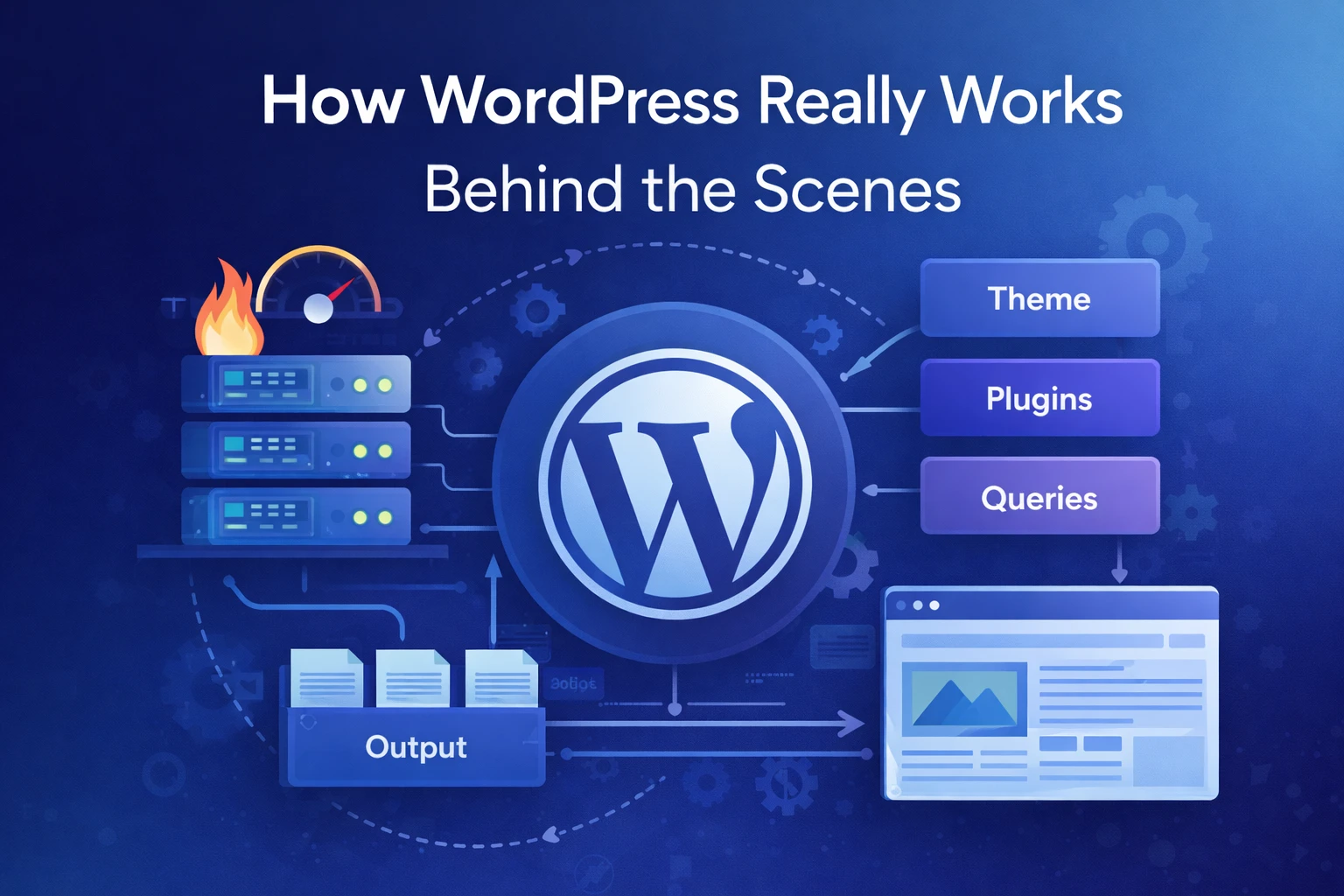
WordPress looks simple on the surface.
Pages load. Content publishes. Plugins install. Everything appears to work.
Because of this, most people never think about what actually happens behind the scenes.
However, that simplicity hides a complex system.
At Wisegigs, we often work with WordPress sites that function correctly but are structurally fragile. They work today, but they struggle to scale, break during updates, or become difficult to maintain.
This article explains how WordPress really works, why problems appear over time, and what separates stable websites from fragile ones.
WordPress Is a System, Not a Website Builder
WordPress is often treated as a visual tool.
In reality, it is a full software system built on:
PHP execution
A database-driven content model
A plugin and hook system
A theme rendering layer
Every page request passes through all of these components before anything is displayed to the user.
Because of this, WordPress behavior depends heavily on how it is structured and maintained.
What Happens When a Page Loads
When someone visits a WordPress site, several steps happen in sequence:
The server receives the request
WordPress core loads
Active plugins are initialized
The theme is executed
Database queries are processed
The final page is generated
This happens on every uncached request.
The more logic added to each step, the more work the server must do.
WordPress documentation explains this execution flow in detail:
https://developer.wordpress.org/plugins/hooks/
Why Many WordPress Sites Seem Fine at First
Most WordPress problems do not appear immediately.
Instead, they build up slowly through:
Extra plugins added over time
Custom code added without review
Quick fixes that remain permanently
Features added without performance testing
Because the site still loads, these issues go unnoticed.
Over time, however, the system becomes harder to maintain and more likely to fail.
“Working” Does Not Mean “Healthy”
A WordPress site can function while still being unstable.
Common warning signs include:
Slow admin dashboard
Updates that feel risky
Plugins conflicting with each other
Unexpected behavior after changes
These problems are rarely caused by WordPress itself.
They are usually caused by structural decisions that were never revisited.
Where Most WordPress Implementations Go Wrong
Lack of structure
Themes often contain logic that should live elsewhere. Plugins overlap responsibilities. Custom code is added without long-term planning.
No performance awareness
If traffic is low, performance issues remain hidden. When traffic grows, problems appear suddenly.
Implicit behavior
Many sites rely on default behavior without understanding how or when it runs.
No ownership
When no one owns the system, quality slowly degrades.
Why Updates Reveal Hidden Problems
WordPress maintains strong backward compatibility.
When updates break a site, it usually means the site depends on:
Undocumented behavior
Assumptions about execution order
Unsafe overrides
Poorly isolated custom logic
Updates do not cause these issues.
They expose them.
Performance Problems Appear Late
Performance issues rarely show up at launch.
They usually appear when:
Content grows
Traffic increases
Plugins accumulate
Hosting limits are reached
By that time, the underlying architecture is difficult to change.
Google recommends measuring real-world performance rather than assumptions:
https://web.dev/measure/
What a Healthy WordPress System Looks Like
Stable WordPress sites share a few important traits:
Clear separation between logic and presentation
Minimal and intentional plugin usage
Predictable execution flow
Documented decisions
Clear technical ownership
These systems are designed to grow without breaking.
Conclusion
WordPress does not fail because it is weak.
It fails when it is treated casually.
A site can “work” and still be fragile. Real stability comes from understanding how WordPress behaves, making intentional decisions, and treating the platform as production software.
At Wisegigs.eu, we build WordPress systems designed to remain stable, maintainable, and scalable over time.
If your WordPress site works today but feels risky to change, it’s time to take a closer look.
Contact Wisegigs.eu