
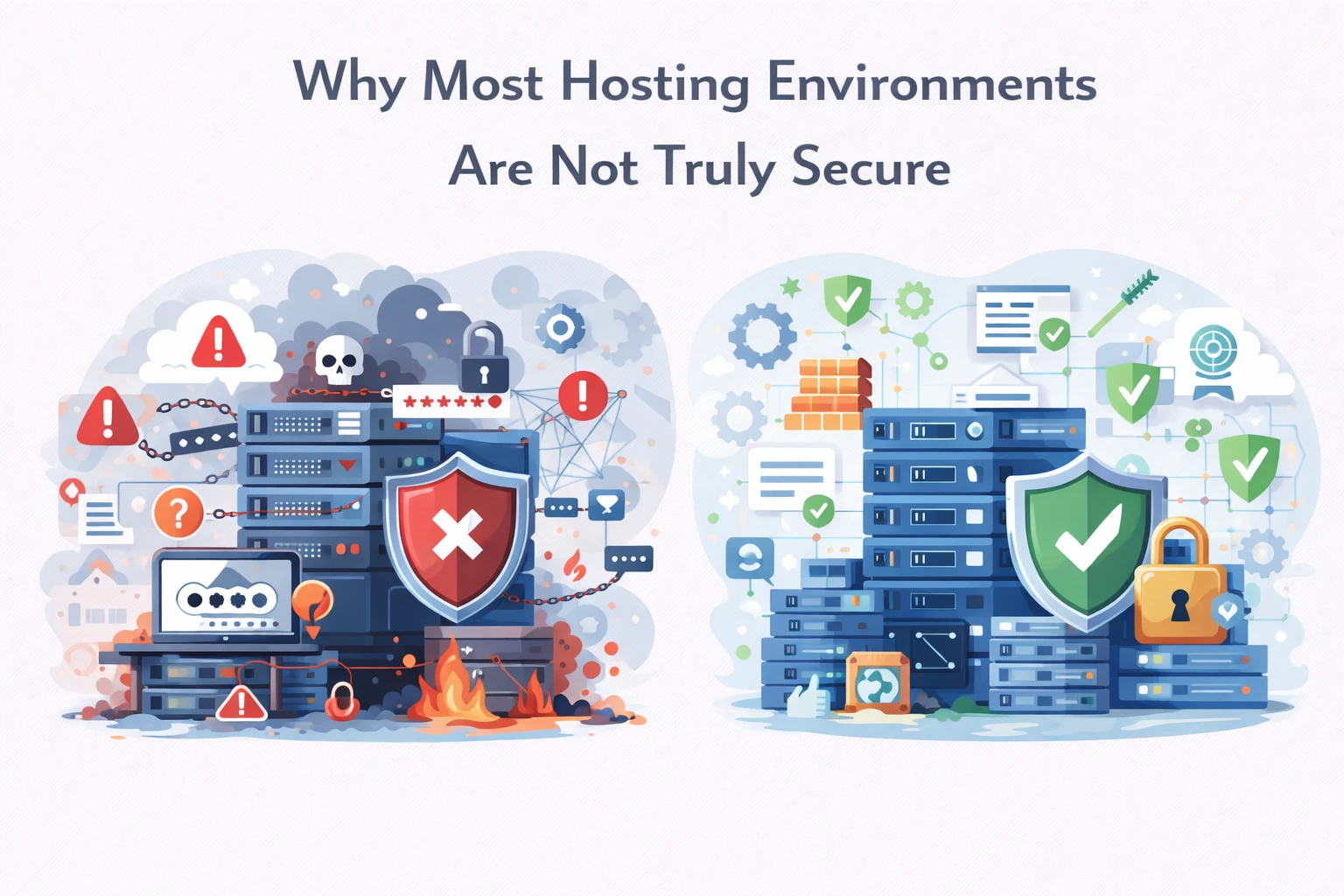
Hosting security compliance is one of the main reasons why most hosting environments are not truly secure. Many website owners assume that using a hosting provider automatically guarantees security. However, most hosting environments contain hidden risks caused by weak configuration, missing controls, and lack of compliance awareness.
Because of this, security issues rarely appear suddenly. Instead, they build up over time. As a result, problems often go unnoticed until downtime, data exposure, or penalties occur.
At Wisegigs.eu, we regularly audit hosting setups that appear stable but fail basic security and compliance checks. In most cases, these issues exist long before anyone notices them.
Hosting Security Compliance Is Often Overlooked
Many businesses believe their hosting provider handles security by default. However, this assumption creates risk.
In reality, most hosting providers only secure:
Physical infrastructure
Network availability
Base operating system
Meanwhile, they do not secure:
Application configuration
User access controls
File permissions
Patch management
Compliance requirements
Because of this gap, responsibility for hosting security compliance always remains with the site owner.
Google confirms that most compromised websites result from configuration issues rather than platform vulnerabilities:
https://developers.google.com/search/docs/advanced/security
Why Most Hosting Environments Are Insecure by Default
Security problems often begin at setup.
For example:
Default server settings remain unchanged
Unused services stay active
Access rules stay too permissive
Software updates are delayed
Because everything still works, these issues seem harmless. However, over time, they create serious security risks.
As a result, hosting environments slowly become vulnerable without any visible warning signs.
Compliance Plays a Direct Role in Hosting Security
Hosting security compliance is not optional. Instead, it directly affects how systems operate.
For example, compliance controls:
Define how data is handled
Limit who can access systems
Enforce logging and monitoring
Require incident response procedures
Therefore, even small websites must follow basic compliance rules, especially when handling user data.
Cloudflare explains how security and compliance work together in modern hosting environments:
https://www.cloudflare.com/learning/security/what-is-web-security/
Shared Hosting Introduces Additional Risk
Shared hosting increases exposure because multiple sites share the same resources.
As a result:
Isolation becomes limited
Server-level hardening is restricted
Updates depend on the provider
One compromised site can affect others
For this reason, shared hosting rarely meets modern hosting security compliance standards.
Lack of Monitoring Makes Threats Invisible
Many hosting environments operate without active monitoring.
Without monitoring:
File changes go undetected
Unauthorized access remains unnoticed
Malware continues running
Performance issues stay hidden
Because of this, security incidents often last longer than expected.
Google’s Site Reliability Engineering guide explains why monitoring is essential for secure systems:
https://sre.google/sre-book/monitoring-distributed-systems/
Firewalls Alone Do Not Secure Hosting
Although firewalls help, they do not provide complete protection.
Effective hosting security compliance also requires:
Least-privilege access
Strong authentication
Regular patching
Audit logs
Configuration management
Most breaches happen inside the system, not at the network edge.
What Secure Hosting Actually Looks Like
A secure hosting environment includes:
Hardened server configuration
Isolated services
Controlled user access
Continuous monitoring
Regular security audits
Documented compliance practices
At Wisegigs.eu, we treat hosting security as an ongoing process rather than a one-time setup.
Why Security Must Be Built Into Hosting
Security works best when teams build it into the system from the beginning.
When teams add security later:
Risks remain hidden
Costs increase
Complexity grows
Stability suffers
However, when security is part of the architecture, systems remain reliable and compliant as they scale.
Final Thoughts
Most hosting environments are not truly secure because hosting security compliance often receives little attention.
To summarize:
Hosting providers do not secure applications
Misconfiguration causes most breaches
Compliance is often ignored
Monitoring is frequently missing
Firewalls alone are not enough
Secure hosting requires structure, visibility, and continuous improvement.
If your hosting environment has never been reviewed for security or compliance, Wisegigs can help you identify risks and build a secure, scalable setup. Contact Wisegigs.eu