
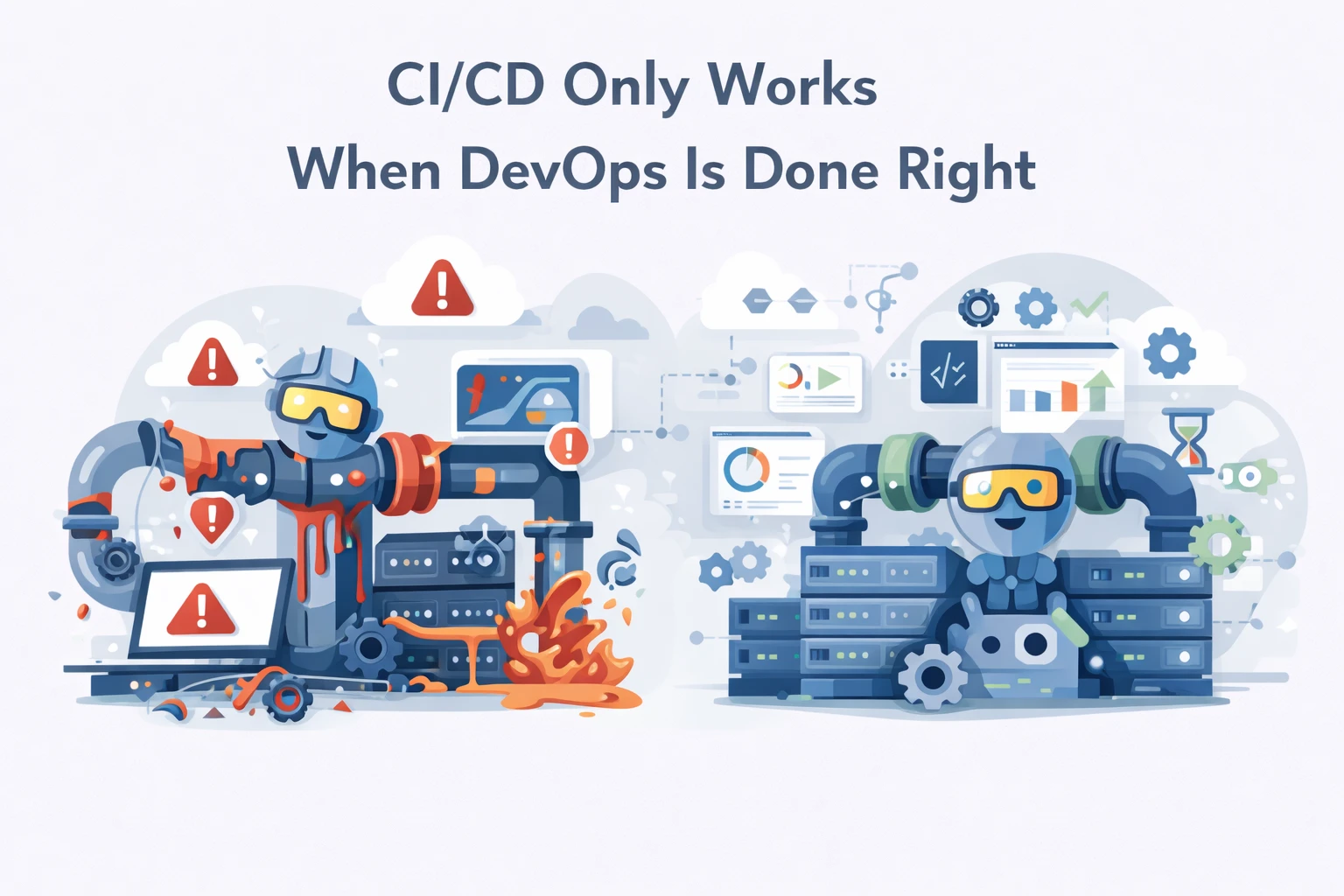
CI/CD only works when DevOps is done right. Many teams adopt pipelines, automation tools, and deployment workflows expecting faster releases and better stability. Instead, they often encounter broken builds, unstable deployments, and growing technical debt.
The problem is not CI/CD itself.
The problem is how it is implemented.
At Wisegigs.eu, we regularly see teams invest heavily in automation while skipping the fundamentals of DevOps. As a result, pipelines become fragile, releases slow down, and confidence in deployments disappears.
This article explains why CI/CD fails, where most teams go wrong, and what effective DevOps actually looks like in practice.
CI/CD Is Not a Tool — It’s a Process
CI/CD is often treated as a toolset instead of a workflow.
Teams install:
GitHub Actions
GitLab CI
Jenkins
Bitbucket Pipelines
Then they expect stability and speed to improve automatically.
However, CI/CD only works when it reflects a well-designed development process. Without that foundation, automation simply accelerates problems.
According to Google’s DevOps research, high-performing teams succeed because of process maturity, not tooling:
https://cloud.google.com/devops
Why Most CI/CD Pipelines Fail
CI/CD failures rarely come from one big issue. Instead, they result from several small problems working together.
1. No Clear Deployment Strategy
Many teams cannot answer basic questions:
What triggers a deployment?
What environments exist?
How are rollbacks handled?
Who approves production changes?
Without clear rules, pipelines become unpredictable.
2. Poor Environment Separation
A common mistake is treating all environments the same.
Typical problems include:
Shared databases between staging and production
Missing environment variables
Inconsistent configuration files
Manual overrides
When environments differ, bugs appear only in production.
3. CI Pipelines That Only Test Builds
CI often focuses on whether code builds, not whether it works.
Missing checks include:
Integration tests
Security scans
Performance validation
Dependency verification
As a result, broken code passes CI but fails after deployment.
Automation Does Not Fix Broken Processes
Automation amplifies whatever process already exists.
If your workflow is:
Unclear
Manual
Inconsistent
Then CI/CD will simply make those problems happen faster.
This is why many teams experience:
Frequent rollbacks
Failed deployments
Long recovery times
Developer frustration
DevOps requires process alignment before automation.
Why CI/CD Breaks Under Team Growth
CI/CD pipelines that work for small teams often fail as teams grow.
Common scaling issues include:
Long build times
Conflicting deployments
Merge conflicts
Environment contention
Lack of ownership
Without clear responsibility and isolation, pipelines become bottlenecks.
Google’s SRE practices emphasize that scaling requires reliability and ownership, not just automation:
https://sre.google/sre-book/release-engineering/
What Proper DevOps Actually Looks Like
Effective DevOps focuses on stability, visibility, and control.
Key principles include:
Clear deployment stages
Automated testing at every step
Reproducible environments
Version-controlled infrastructure
Rollback capability
Monitoring after deployment
CI/CD becomes reliable only when these foundations exist.
At Wisegigs.eu, we design pipelines around these principles to avoid failures before they happen.
CI/CD and Monitoring Must Work Together
Deploying code without monitoring is risky.
A proper setup includes:
Application monitoring
Error tracking
Deployment logging
Performance alerts
This ensures issues are detected immediately after release.
Without monitoring, CI/CD becomes a blind process.
Why DevOps Is About Reliability, Not Speed
Many teams believe DevOps exists to ship faster.
In reality, DevOps exists to:
Reduce risk
Improve consistency
Increase visibility
Shorten recovery time
Speed is a result of reliability, not the goal.
When pipelines are stable, teams move faster naturally.
What to Focus on Instead of Tools
Instead of adding more tools, focus on:
Process clarity
Environment consistency
Deployment confidence
Observability
Failure recovery
CI/CD succeeds when systems are predictable.
Final Thoughts
CI/CD only works when DevOps is done right.
To summarize:
Automation cannot fix broken processes
CI/CD needs structure before speed
Poor pipelines cause instability
Monitoring is essential
DevOps is a mindset, not a tool
When DevOps is implemented correctly, CI/CD becomes a competitive advantage instead of a liability.
If your deployment process feels fragile or unpredictable, the problem is not your tools.
It is your DevOps foundation.
If your CI/CD pipeline feels fragile, slow, or unreliable, Wisegigs can help you design a stable DevOps workflow that scales with your team and infrastructure. Contact Wisegigs.eu