
The VPS vs cloud debate usually starts with the wrong question.
Instead of examining how systems are designed and operated, teams compare pricing models, scalability claims, and provider features. As a result, one option is labeled “modern” while the other is dismissed as “old school.” Because of this framing, teams often make decisions quickly and rely on perception rather than operational reality.
At Wisegigs.eu, we consistently see a different pattern. Performance issues, outages, and instability rarely come from choosing VPS or cloud. Instead, these problems appear when teams compare the wrong factors and ignore how systems actually behave in production.
In this article, we explain why VPS vs cloud is the wrong comparison. More importantly, we show what teams should evaluate instead and how better framing leads to reliable hosting decisions.
1. VPS and Cloud Solve the Same Core Problem
At a fundamental level, VPS and cloud platforms solve the same problem.
Both provide:
Compute resources
Storage
Networking
Isolation
However, the difference lies in how those resources are provisioned and managed, not in what they are.
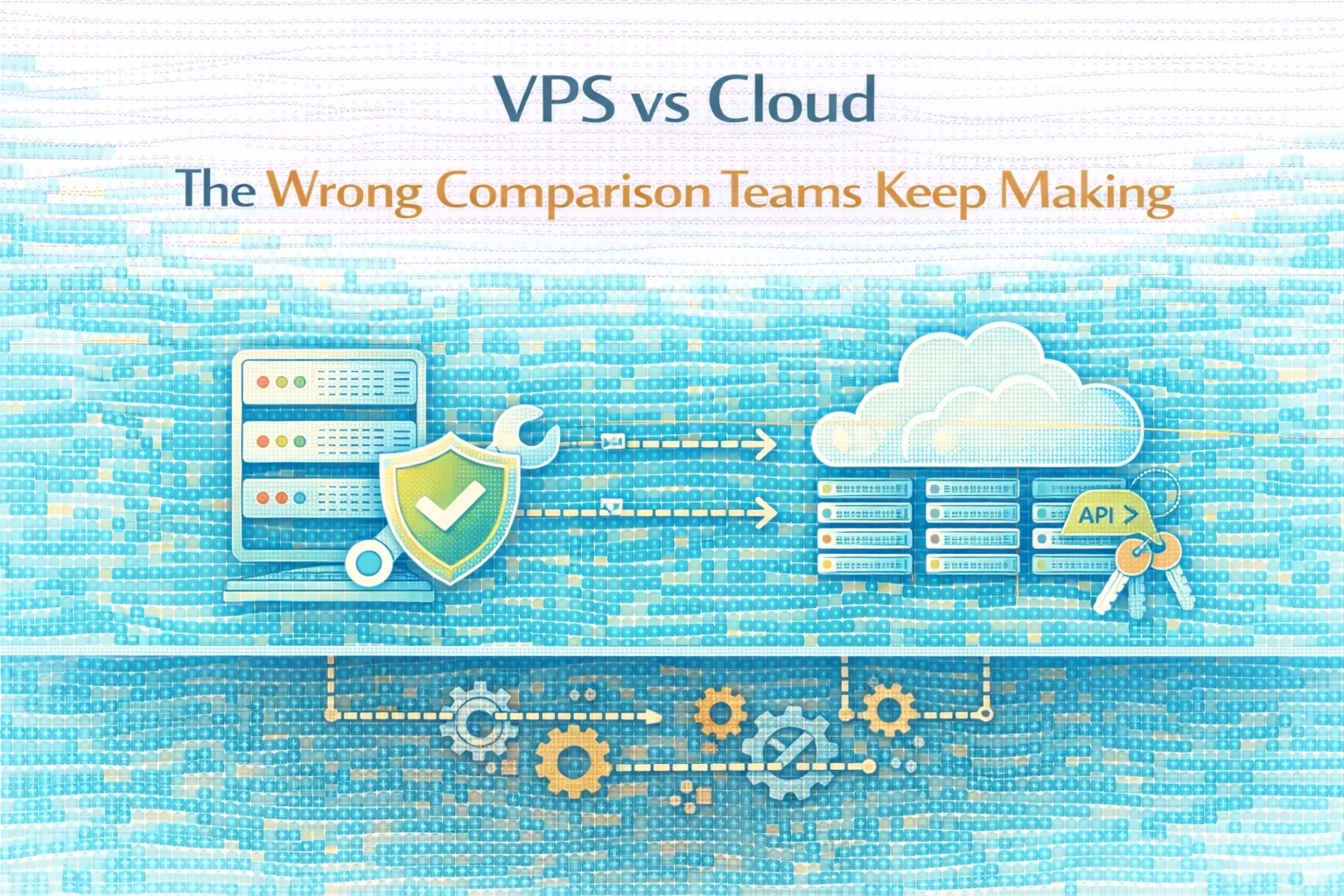
A VPS provides fixed and explicit resources. By contrast, cloud platforms abstract those same resources behind APIs. Because of this, teams experience different operational trade-offs, even though the underlying capabilities remain similar.
AWS architecture guidance reinforces this point by emphasizing that infrastructure choice does not replace system design discipline:
https://aws.amazon.com/architecture/
2. Teams Compare Features Instead of Responsibilities
Most VPS vs cloud comparisons focus on features.
For example, teams evaluate:
Auto-scaling promises
Managed services
High availability claims
Pricing flexibility
However, responsibility is rarely discussed.
In practice:
VPS environments require explicit operational ownership
Cloud platforms shift responsibility, but never remove it
Because teams misunderstand these boundaries, gaps appear. As a result, systems fail in predictable ways.
3. Cloud Complexity Is Often Underestimated
At the same time, cloud platforms reduce some friction. However, they also introduce complexity.
Common cloud failure patterns include:
Misconfigured networking
Over-permissioned identities
Hidden cost growth
Unexpected performance bottlenecks
Because these issues hide behind abstraction layers, teams often notice them late.
4. VPS Predictability Is Often Undervalued
By contrast, VPS hosting is often dismissed as outdated.
In reality, VPS environments provide:
Predictable resource limits
Clear failure modes
Simpler capacity planning
Lower operational surface area
Because boundaries are explicit, teams reason about performance more easily.
DigitalOcean’s infrastructure documentation highlights how predictability simplifies reliability planning:
https://www.digitalocean.com/community
5. Performance Problems Are Usually Self-Inflicted
In many cases, teams blame the platform when performance degrades.
However, root causes usually include:
Inefficient application design
Database contention
Missing caching layers
Unmonitored saturation
Unsafe deployment practices
These problems appear on both VPS and cloud platforms.
Google’s SRE research shows that change and misconfiguration cause most outages:
https://sre.google/sre-book/monitoring-distributed-systems/
6. Scaling Is Treated as a Platform Feature
As a result of cloud marketing, teams often assume scaling happens automatically.
In practice:
Applications must support concurrency
Databases must handle load
State must be managed explicitly
When architecture ignores these realities, scaling fails regardless of platform.
Martin Fowler explains that scalability is a design property, not an infrastructure toggle:
https://martinfowler.com/articles/microservices.html
7. Cost Comparisons Ignore Operational Maturity
VPS vs cloud cost debates usually compare hourly pricing.
However, real costs also include:
Engineering time
Monitoring effort
Incident response
Cost governance tooling
Without discipline, cloud environments often grow more expensive over time.
FinOps research consistently shows this pattern:
https://www.finops.org/introduction/what-is-finops/
8. Reliability Comes From Process, Not Platform
In practice, reliable systems share common traits:
Controlled change processes
Monitoring tied to user experience
Capacity planning
Clear ownership
At Wisegigs.eu, we see stable systems running on modest VPS setups. At the same time, we see unstable systems running on premium cloud platforms.
Reliability is built through discipline, not purchased through vendors.
What Teams Should Compare Instead
Instead of asking “VPS or cloud?”, teams should ask:
Who owns reliability?
How is change introduced safely?
How is performance monitored?
How is capacity planned?
How are costs controlled?
How much complexity can the team manage?
Conclusion
VPS vs cloud is the wrong comparison.
Instead, operational discipline determines outcomes.
To summarize:
Both platforms solve the same core problem
Responsibility matters more than features
Cloud complexity is underestimated
VPS predictability is undervalued
Performance issues are architectural
Scaling depends on design
Costs depend on governance
Reliability comes from process
At Wisegigs.eu, the best results come from matching infrastructure choices to team maturity, not trends.
If hosting issues persist despite platform changes, the problem is rarely VPS or cloud. Instead, it is how the system is designed and operated. Contact wisegigs.eu