
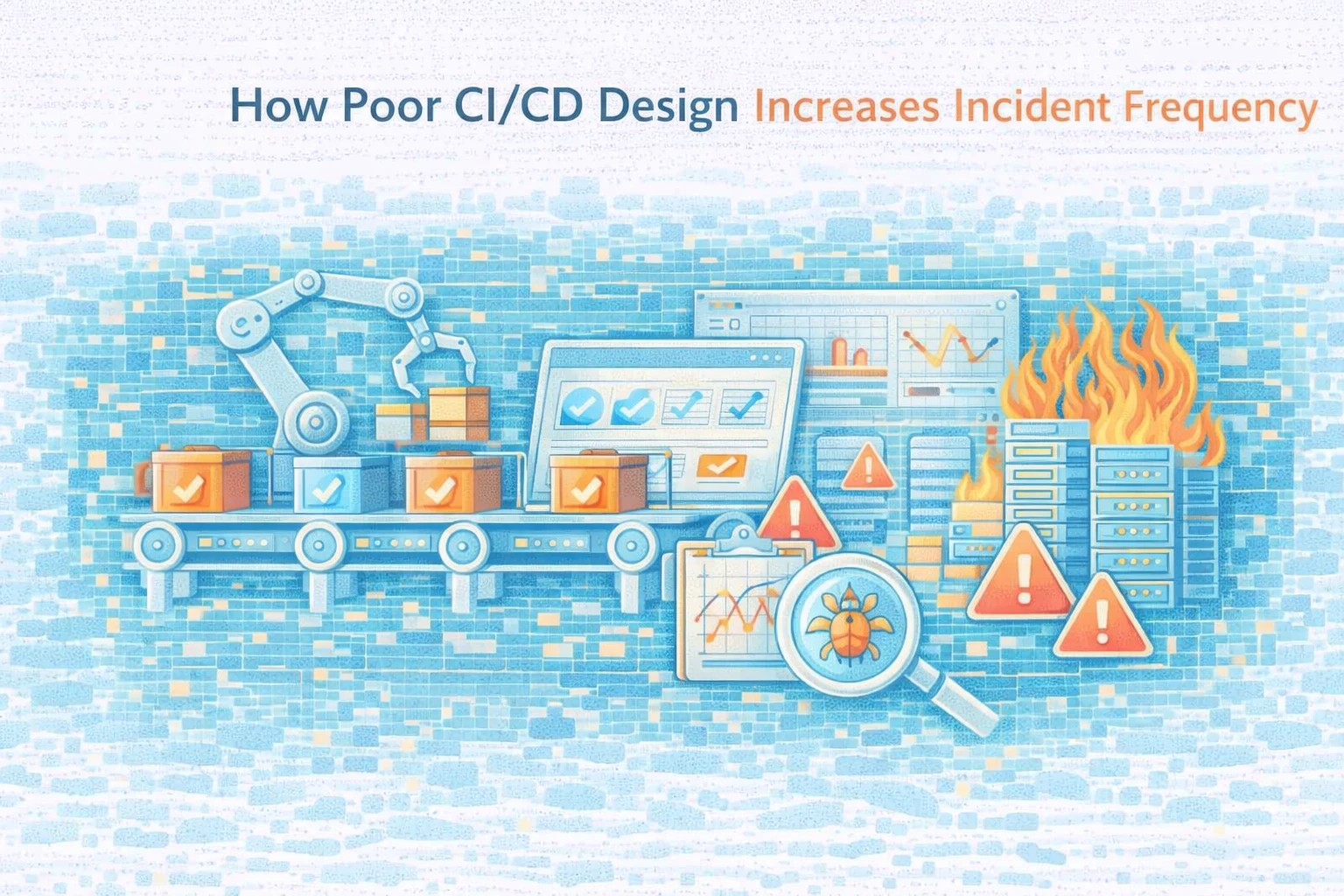
CI/CD pipelines are meant to reduce risk.
They automate deployments, enforce consistency, and remove manual steps that cause human error. In theory, better pipelines should lead to fewer incidents and faster recovery.
In practice, many teams experience the opposite.
At Wisegigs.eu, a significant number of production incidents are not caused by bugs alone. They are caused by poor CI/CD design that increases the frequency and blast radius of failures.
This article explains how weak CI/CD design leads to more incidents, why these patterns repeat across teams, and what disciplined pipelines do differently.
1. Automation Without Control Accelerates Failure
Automation is powerful, but it is not neutral.
Poorly designed CI/CD pipelines optimize for speed without sufficient control. As a result:
Changes reach production faster
Validation happens later or not at all
Risk concentrates at deploy time
When something breaks, it breaks everywhere at once.
Google’s SRE guidance makes it clear that automation must reduce risk, not just increase velocity:
https://sre.google/sre-book/release-engineering/
CI/CD should slow teams down when risk is high and speed them up when it is low.
2. Pipelines Treat All Changes as Equal
One of the most common CI/CD design flaws is uniform treatment of changes.
In many pipelines:
A one-line config change deploys the same way as a major refactor
Database migrations follow the same path as CSS updates
Infrastructure changes lack additional safeguards
This removes contextual risk assessment.
As a result, high-risk changes slip through with minimal scrutiny.
Modern deployment research emphasizes that change impact, not change frequency, drives incident rates:
https://martinfowler.com/articles/continuousIntegration.html
Good pipelines differentiate risk. Poor ones ignore it.
3. Testing Exists, but It Does Not Reflect Reality
Most CI/CD pipelines include tests.
The problem is not the absence of tests. It is what those tests actually validate.
Common gaps include:
Tests that mock production behavior too heavily
No coverage for failure paths
No performance or load validation
No environment parity
Pipelines report success while production conditions differ materially.
This creates false confidence and recurring incidents.
GitHub’s engineering blogs consistently highlight that CI/CD failures often stem from tests that do not represent real-world usage:
https://github.blog/engineering/
4. Configuration Changes Bypass Safeguards
CI/CD pipelines often focus on application code.
Configuration changes receive less attention.
Typical examples include:
Environment variable updates
Feature flag changes
Infrastructure configuration tweaks
Third-party integration updates
These changes frequently bypass:
Review gates
Testing stages
Rollback mechanisms
Yet configuration errors are among the most common causes of outages.
5. Rollbacks Are Assumed, Not Proven
Many pipelines claim to support rollbacks.
In reality, rollback paths are rarely tested.
Common issues include:
Database changes that are not reversible
State changes that persist across deployments
Incomplete artifact versioning
Manual rollback steps under pressure
When incidents occur, rollbacks fail or take longer than expected.
AWS reliability guidance stresses that rollback must be fast, tested, and automated to be effective:
https://aws.amazon.com/builders-library/
Unproven rollback mechanisms increase incident duration and severity.
6. Pipelines Hide Failure Signals Until It Is Too Late
Poor CI/CD pipelines focus on pass or fail outcomes.
They hide degradation signals such as:
Increased latency
Partial errors
Resource pressure
Dependency instability
Deployments succeed technically, but system health worsens.
By the time alerts fire, the change has already propagated.
7. Manual Overrides Reintroduce Human Error
Ironically, rigid pipelines often encourage workarounds.
When CI/CD becomes slow or inconvenient, teams:
Bypass checks
Deploy manually
Disable safeguards temporarily
Push “just this once” fixes
These actions reintroduce the very risks CI/CD was meant to eliminate.
DevOps research shows that unsafe workarounds increase incident frequency more than the absence of automation:
https://cloud.google.com/devops
Poor pipeline design incentivizes unsafe behavior.
8. Incidents Become Normalized Instead of Prevented
Over time, teams adapt to frequent incidents.
Deployments are followed by:
Increased alert vigilance
Manual verification
On-call readiness
Incidents become expected rather than exceptional.
This normalization hides systemic flaws in the pipeline.
At Wisegigs.eu, teams that redesign CI/CD with risk control in mind consistently see incident frequency drop — without slowing delivery.
What Better CI/CD Design Looks Like
Effective CI/CD pipelines share common traits:
Risk-based deployment paths
Strong parity between test and production
Explicit handling of configuration changes
Proven, automated rollback mechanisms
Health signals integrated into deploy decisions
Guardrails that encourage safe behavior
CI/CD works best when it is treated as production infrastructure.
Conclusion
CI/CD does not automatically reduce incidents.
Design does.
To recap:
Automation without control accelerates failure
Uniform pipelines ignore risk differences
Unrealistic tests create false confidence
Configuration changes bypass safeguards
Rollbacks fail when untested
Early failure signals are hidden
Workarounds reintroduce human error
Incidents become normalized
At Wisegigs.eu, reliable delivery pipelines focus on preventing incidents, not just deploying faster.
If your incident rate increases as deployment speed improves, the problem is not DevOps itself.
It is how CI/CD is designed.
Want help reviewing whether your pipeline reduces or amplifies risk? Contact wisegigs.eu