
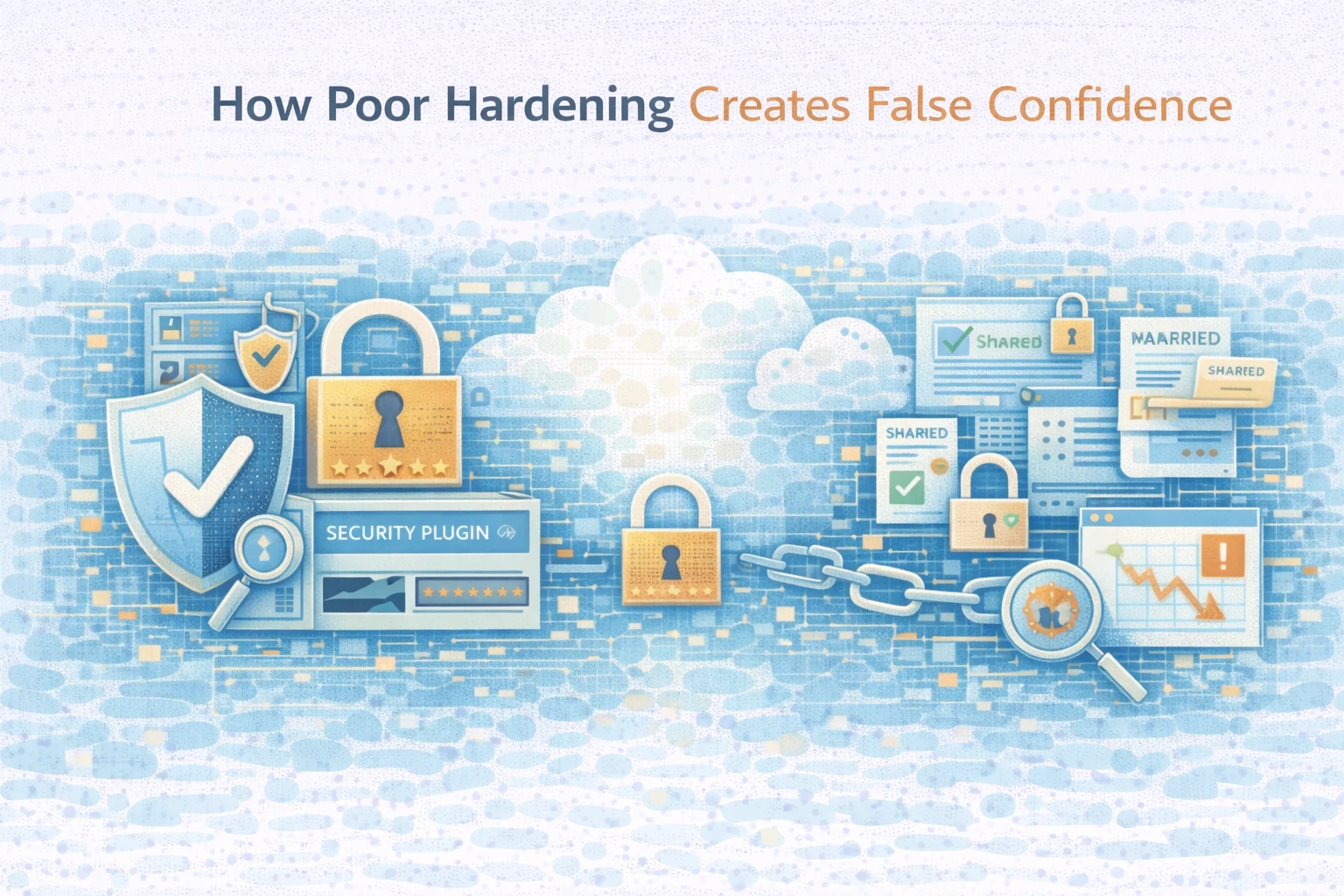
Security hardening is often treated as a checklist.
Disable XML-RPC.
Install a security plugin.
Change the admin URL.
Lock down file permissions.
Once these steps are complete, teams feel protected.
That confidence is dangerous.
At Wisegigs.eu, many WordPress incidents occur on sites that were already “hardened.” Not because hardening is useless, but because poor hardening creates a false sense of security that hides real risk.
This article explains how weak or incomplete hardening misleads teams, why it increases exposure over time, and how to approach hardening as a real security discipline instead of a comfort ritual.
1. Hardening Is Often Confused With Blocking
Many hardening efforts focus on blocking visible threats.
Typical examples include:
Blocking IP ranges
Hiding login endpoints
Disabling features without understanding usage
Restricting access globally
These measures reduce noise, but they rarely address root risk.
Blocking changes what attackers see.
It does not change how the system behaves when something goes wrong.
OWASP consistently notes that security controls must reduce impact, not just block entry points:
https://owasp.org/www-project-top-ten/
Hardening that focuses only on blocking creates confidence without resilience.
2. Plugins Create the Illusion of Coverage
Security plugins are heavily marketed as complete solutions.
They scan files, add firewalls, and display reassuring dashboards.
However, plugins operate at the application layer. They cannot:
Patch the operating system
Fix insecure server configuration
Enforce infrastructure-level isolation
Protect against compromised credentials
When teams rely on plugins alone, they mistake visibility for protection.
WordPress core documentation makes it clear that application security depends on the environment it runs in:
https://wordpress.org/support/article/hardening-wordpress/
Poor hardening happens when plugins replace operational controls.
3. Surface Reduction Without Impact Reduction
A common hardening goal is to reduce attack surface.
This is useful — but incomplete.
Examples include:
Disabling REST endpoints
Blocking admin access by location
Removing unused features
While these steps reduce exposure, they do not limit damage once access is gained.
Effective hardening asks a harder question:
If something fails, how much damage can occur?
NIST’s risk management framework emphasizes impact limitation as a core security objective:
https://csrc.nist.gov/projects/risk-management
False confidence appears when surface reduction is mistaken for risk elimination.
4. Over-Hardening Breaks Normal Behavior
Poor hardening often introduces fragility.
Common symptoms include:
Admin actions failing intermittently
Background jobs silently breaking
APIs returning incomplete data
Editors unable to perform routine tasks
When this happens, teams loosen controls ad hoc to “fix” issues.
Security posture becomes inconsistent and undocumented.
CIS benchmarks repeatedly warn that security controls must be validated against real workloads to avoid operational failure:
https://www.cisecurity.org/controls/
Hardening that breaks normal behavior erodes trust in security itself.
5. Lack of Monitoring Makes Hardening Blind
Hardening without monitoring is guesswork.
Many sites apply security controls but never verify:
Whether they work as intended
Whether they block legitimate behavior
Whether attackers adapt around them
Without monitoring:
Failures go unnoticed
Bypasses remain invisible
Confidence grows without evidence
Google’s SRE practices emphasize that controls must be observable to be trusted:
https://sre.google/sre-book/monitoring-distributed-systems/
False confidence thrives in the absence of feedback.
6. Credentials Remain the Weakest Link
Hardening often focuses on the perimeter.
However, most real-world WordPress compromises involve credentials.
Common oversights include:
Shared admin accounts
Excessive privileges
No credential rotation
Weak access auditing
Once valid credentials are used, many hardening controls become irrelevant.
7. Compliance Is Mistaken for Security
Passing a security checklist feels reassuring.
Yet compliance frameworks focus on minimum standards, not threat realities.
This creates confidence without adaptability.
ISO/IEC 27001 documentation explicitly frames compliance as a baseline, not a guarantee of security:
https://www.iso.org/standard/27001
Hardening must evolve with threats, not freeze at audit time.
8. Real Hardening Focuses on Blast Radius
Effective hardening changes outcomes, not appearances.
It focuses on:
Limiting what compromised components can access
Isolating services and users
Enforcing least privilege
Ensuring rapid recovery
When failures occur, damage stays contained.
At Wisegigs.eu, hardened systems are not the ones that never get touched. They are the ones where incidents remain small, predictable, and recoverable.
How to Avoid False Confidence in Hardening
Effective hardening follows clear principles:
Reduce impact, not just exposure
Treat plugins as supplements, not solutions
Validate controls against real usage
Monitor security controls continuously
Prioritize access management
Document and review hardening decisions
Conclusion
Poor hardening does not fail loudly.
It fails quietly by creating confidence where none is deserved.
To recap:
Blocking is not resilience
Plugins do not replace operations
Surface reduction is not impact reduction
Over-hardening creates fragility
Monitoring validates security
Credentials bypass most controls
Compliance is not protection
Blast radius matters most
At Wisegigs.eu, hardening is treated as a risk-management exercise, not a cosmetic one.
If your WordPress site feels “locked down” but lacks visibility, recovery plans, or access discipline, the confidence is likely false.
Need help validating whether your hardening actually reduces risk? Contact Wisegigs.eu.