
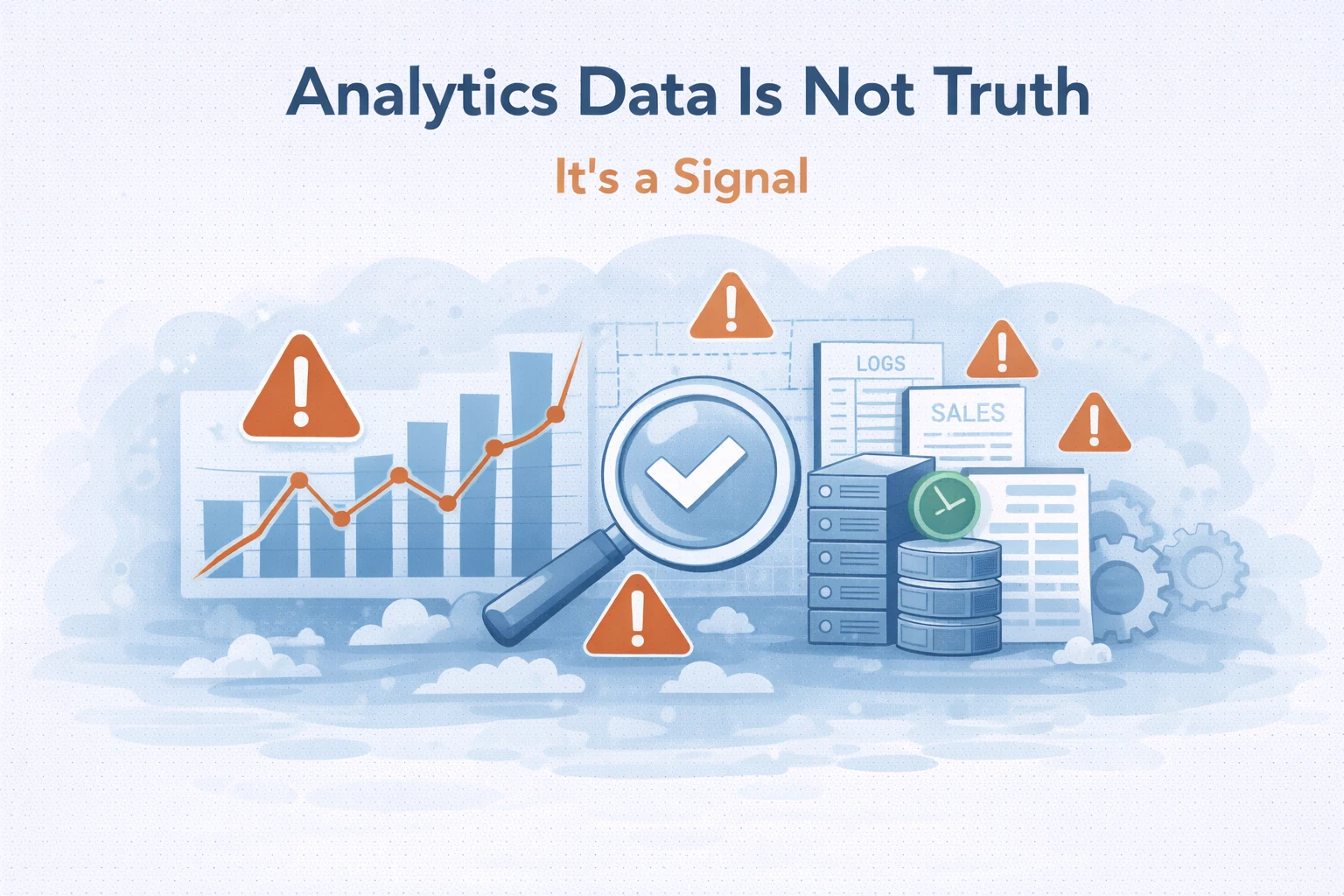
Analytics dashboards feel authoritative.
Numbers update in real time. Charts trend up or down. Reports look precise. As a result, teams often treat analytics data as truth.
That assumption is dangerous.
At Wisegigs.eu, many growth, CRO, and SEO issues trace back to the same root cause: teams make decisions based on analytics data they never validated. The data looks clean, but it does not accurately represent what users are actually doing.
This article explains why analytics data is not truth, how it becomes distorted over time, and how to treat analytics as a signal instead of a verdict.
Why Analytics Feels Like Truth
Analytics systems present data with confidence.
They offer:
Exact numbers
Precise timestamps
Clean visualizations
Aggregated metrics
Because of that, teams assume accuracy by default.
However, analytics platforms only report what they successfully captured, not what truly happened. Any gap between user behavior and data collection quietly changes the story.
Analytics does not describe reality.
It samples reality.
Where Analytics Data Quietly Breaks
Most analytics failures do not appear as obvious errors.
Instead, they emerge gradually.
1. Tracking Depends on Execution, Not Intent
Teams often define tracking requirements clearly.
For example:
“Track checkout completion”
“Track form submissions”
“Track sign-ups”
However, intent does not guarantee execution.
Tracking breaks when:
JavaScript fails to load
Events fire before consent
Network requests are blocked
Tag managers misfire
SPA navigation bypasses triggers
The user completes the action.
The analytics system never records it.
As a result, dashboards show partial reality.
Google’s own documentation notes that analytics data can be affected by implementation issues, browser behavior, and user settings:
https://support.google.com/analytics/answer/1009612
2. Analytics Loses Accuracy Over Time
Even correct tracking degrades.
Common causes include:
Website redesigns
JavaScript refactors
CMS or plugin updates
Tag changes without versioning
New consent rules
Initially, numbers look stable. Over time, drift appears.
Conversion rates decline. Funnels behave strangely. Channels stop matching expectations.
Because changes happen incrementally, teams normalize bad data without realizing it.
At Wisegigs.eu, analytics audits frequently uncover tracking issues that have existed for months — unnoticed because dashboards still “look reasonable.”
3. Aggregation Hides Failure Modes
Analytics tools aggregate data aggressively.
That aggregation hides:
Partial outages
Segment-specific failures
Device-specific issues
Logged-in vs logged-out behavior
For example:
Mobile users experience broken checkout
Desktop users convert normally
Aggregate conversion rate looks acceptable
The signal exists, but it is buried.
Analytics rarely tells you where data is missing — only what remains.
Why Treating Analytics as Truth Leads to Bad Decisions
When teams treat analytics as ground truth, they stop questioning it.
That leads to:
Optimizing the wrong pages
Killing experiments prematurely
Scaling campaigns based on false performance
Ignoring real user friction
The most dangerous outcome is false confidence.
Decisions appear data-driven, but the data itself is flawed.
At Wisegigs.eu, we often see teams optimize perfectly — against the wrong signal.
Analytics as a Signal, Not a Verdict
Reliable teams treat analytics like monitoring, not accounting.
That means:
Data suggests where to look
Data raises questions
Data requires validation
Analytics should initiate investigation, not end it.
This mindset aligns closely with Site Reliability Engineering principles, where metrics are used to detect symptoms, not declare truth:
https://sre.google/sre-book/monitoring-distributed-systems/
How to Validate Analytics Signals
Treat analytics like infrastructure.
1. Verify Critical Events Manually
For key actions:
Form submissions
Purchases
Sign-ups
Teams should periodically:
Perform test actions
Confirm events fire
Verify payloads
Check downstream reporting
Manual validation catches silent failures early.
2. Compare Multiple Signals
Never rely on a single data source.
Useful comparisons include:
Analytics events vs backend logs
Conversion events vs database records
Analytics revenue vs payment processor data
Discrepancies indicate signal distortion.
Analytics should correlate with reality — not replace it.
3. Segment Aggressively
Break down metrics by:
Device type
Browser
Traffic source
Authenticated state
Problems often hide in segments.
If only aggregate metrics are monitored, teams miss critical failures.
Analytics Requires Ownership
Many analytics systems fail because no one owns them.
Common patterns:
Tracking added once and forgotten
Changes deployed without analytics review
No alerts for tracking failures
No validation after updates
Analytics needs an owner who treats it as a living system.
At Wisegigs.eu, analytics ownership is assigned the same way monitoring or CI/CD ownership is assigned — explicitly and continuously.
What Reliable Analytics Systems Actually Do
Trustworthy analytics setups focus on data integrity, not feature count.
They provide:
Clearly defined critical events
Versioned tracking changes
Validation after deployments
Correlation with backend data
Ongoing audits
Analytics that teams trust does not come from dashboards.
It comes from process.
Conclusion
Analytics data is not truth.
It is a signal — incomplete, delayed, and sometimes wrong.
To summarize:
Analytics captures samples, not reality
Tracking degrades over time
Aggregation hides failures
Treating data as truth creates false confidence
Validation restores trust
At Wisegigs.eu, analytics is treated as operational infrastructure. Signals are validated, assumptions are challenged, and decisions are grounded in reality — not dashboards.
If your analytics “looks fine” but decisions keep missing the mark, the issue is rarely insight. It is trust.
Need help validating whether your analytics data actually reflects user behavior?Contact Wisegigs.eu.