
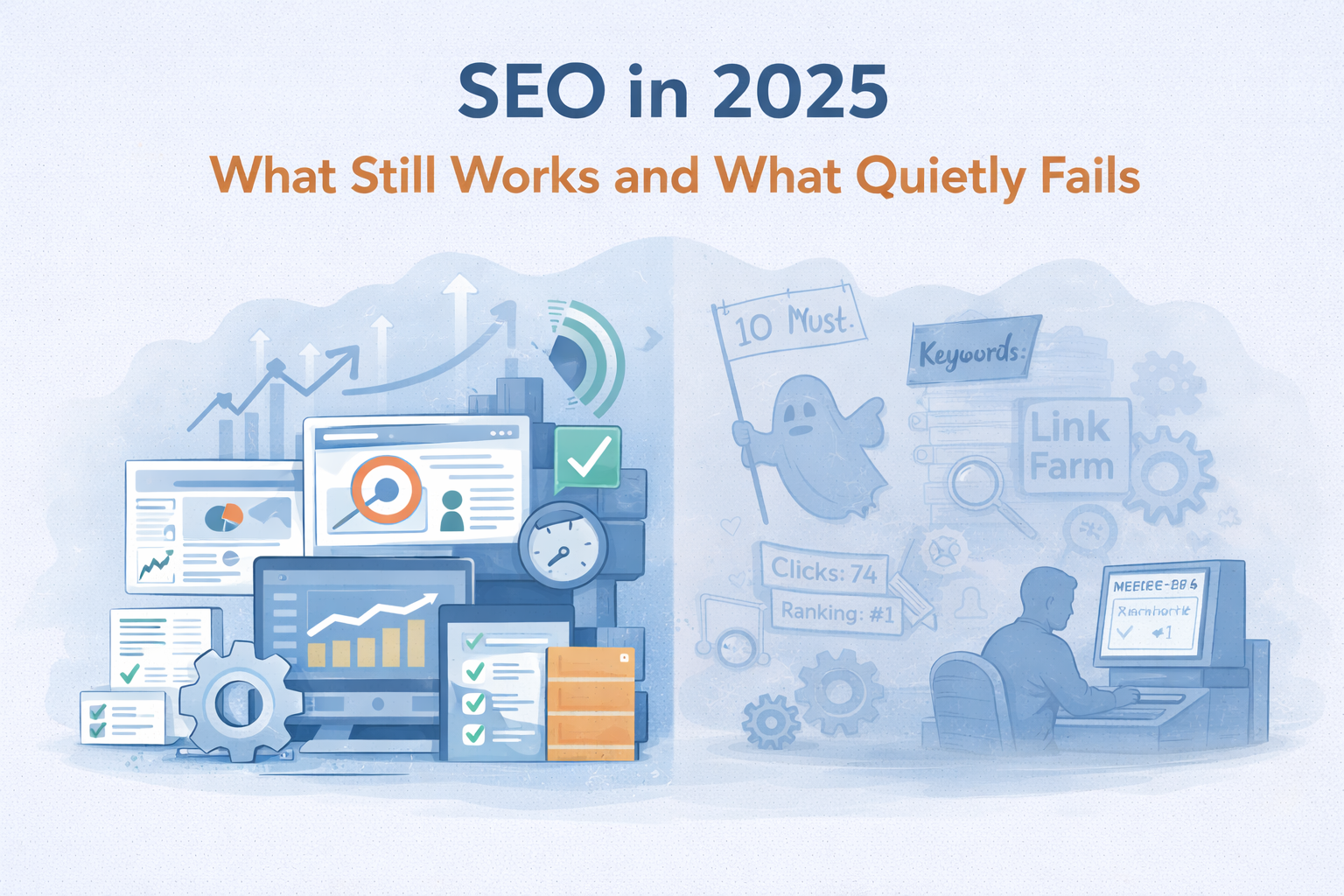
It is about understanding which assumptions are no longer true.
Many sites still follow SEO playbooks written for a very different search landscape — one where ranking signals were simpler, competition was thinner, and publishing more content reliably produced results.
Today, that model quietly fails.
At Wisegigs.eu, we see SEO issues less as ranking problems and more as system design failures: weak foundations, poor signal alignment, and content strategies disconnected from how search engines actually evaluate quality and usefulness.
This article breaks down what still works in SEO in 2025 — and what appears to work, but no longer does.
What Still Works in SEO (When Done Properly)
Some fundamentals have not changed. What has changed is the bar for execution.
1. Search Intent Alignment Still Matters — More Than Ever
Ranking content that does not match intent is harder than it has ever been.
Google has become significantly better at identifying whether a page actually satisfies the query it targets. Keyword inclusion alone is irrelevant if the outcome is wrong.
What still works:
Content written for a specific user intent, not a keyword variant
Clear problem definition early in the page
Structure that mirrors how users scan and decide
Google Search Central repeatedly emphasizes that helpful content must be designed for people first, not search engines:
https://developers.google.com/search/docs/fundamentals/creating-helpful-content
Pages that drift, hedge, or over-optimize quietly lose relevance over time.
2. Technical SEO Still Enables Everything Else
Technical SEO is not a growth lever — it is a failure prevention mechanism.
In 2025, sites that struggle with SEO almost always show:
Crawl inefficiencies
Poor internal linking
Bloated page templates
Slow or inconsistent performance
These issues rarely cause sudden drops. Instead, they cap upside.
At Wisegigs.eu, SEO performance often improves not by adding content, but by removing friction: simplifying architecture, fixing indexation paths, and aligning templates with how search engines crawl.
If search engines cannot reliably access, render, and understand your content, quality becomes irrelevant.
3. Authority Still Compounds — But Only When It’s Coherent
Topical authority still works.
What no longer works is thin authority spread across unrelated topics.
Search engines now evaluate authority at a topic and site level more aggressively. Publishing scattered content creates noise, not trust.
What performs:
Clear topical focus
Internal linking that reinforces subject depth
Fewer, stronger pages instead of many weak ones
This aligns with how modern information retrieval systems evaluate expertise and coverage, as discussed in multiple Google Search Central updates.
What Quietly Fails in SEO (But Still Looks “Correct”)
These are the most dangerous SEO failures — because dashboards often look fine while results stall.
4. Publishing More Content as a Default Strategy
Volume-driven content strategies are one of the biggest silent failures in 2025.
Common symptoms:
Rankings fluctuate but never stabilize
Traffic grows slowly or plateaus
New content cannibalizes existing pages
Publishing more content without pruning, consolidation, or strategy dilutes signals.
More pages increase crawl load and internal competition. Without discipline, growth turns into drag.
5. Keyword Optimization Without Outcome Measurement
Many SEO efforts still stop at rankings.
That is a mistake.
What quietly fails:
Ranking for keywords that do not convert
Optimizing pages without measuring engagement or success
Reporting visibility instead of outcomes
SEO in 2025 must answer:
Does this traffic behave as expected?
Does it complete meaningful actions?
Does it support business goals?
At Wisegigs.eu, SEO performance is evaluated alongside UX, conversions, and reliability — not in isolation.
Traffic without impact is just noise.
6. Ignoring Site Reliability and Performance Consistency
SEO does not fail only because of content.
It fails when sites are unreliable.
Issues that quietly erode SEO performance:
Intermittent slowness
Partial rendering failures
Mobile performance instability
CDN or cache misconfigurations
Google’s documentation makes it clear that page experience and performance stability influence how content is evaluated over time, not just during audits:
https://developers.google.com/search/docs/appearance/page-experience
SEO degradation often correlates with infrastructure issues that teams do not connect to rankings.
7. Treating SEO as a One-Time Project
SEO strategies that succeed in 2025 are operational, not campaign-based.
Quiet failure patterns include:
Audits that are never revisited
Fixes that are not monitored
Content that is never updated or retired
Search ecosystems evolve continuously. Static SEO does not keep up.
This is why SEO increasingly overlaps with SRE, monitoring, and content governance — not just marketing.
What SEO Looks Like When It Actually Works in 2025
Effective SEO today behaves like a system.
It combines:
Intent-driven content design
Clean, crawlable architecture
Performance and reliability monitoring
Content lifecycle management
Outcome-based measurement
SEO success is not about doing more. It is about doing fewer things deliberately and maintaining them well.
Conclusion
SEO in 2025 rewards discipline, not volume.
What still works:
Clear intent alignment
Strong technical foundations
Coherent topical authority
What quietly fails:
Publishing without strategy
Measuring rankings instead of outcomes
Ignoring performance and reliability
Treating SEO as a one-off effort
At Wisegigs.eu, SEO is approached as a long-term system — one that connects content, engineering, and user experience.
If your SEO “looks fine” but growth has stalled, the problem is rarely obvious. It is usually structural.
Need help diagnosing why your SEO efforts are no longer compounding? Contact Wisegigs.eu.