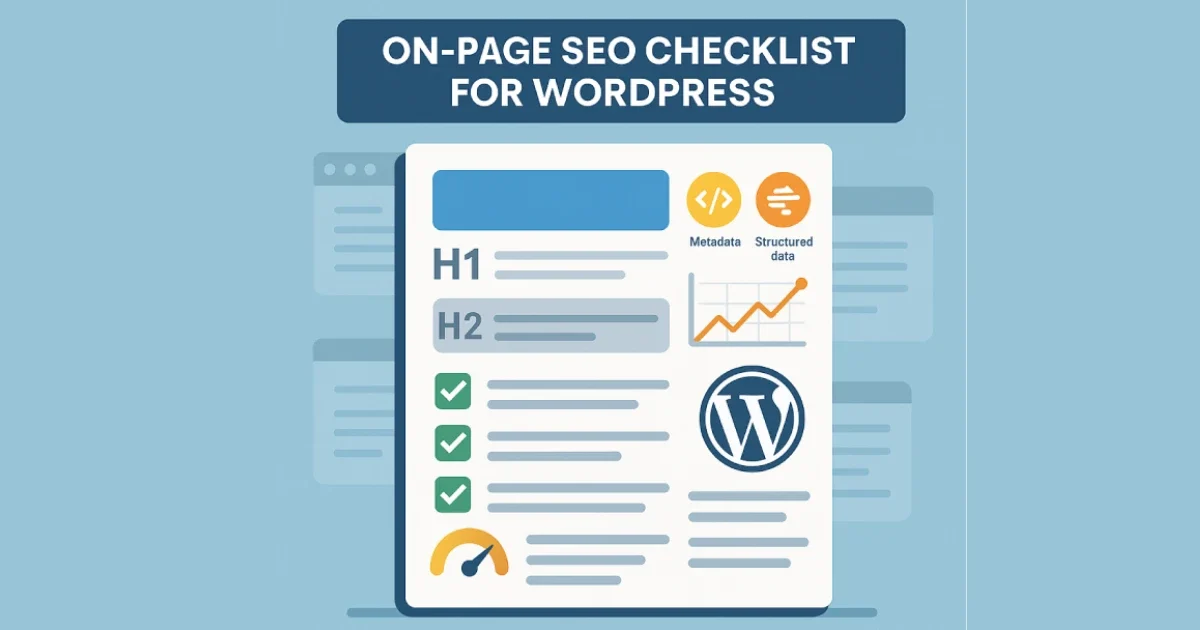
Illustration showing on-page SEO elements: structured content blocks, metadata icons, page speed graphs, and WordPress interface components arranged in a clear layout.
On-page SEO is the foundation of search visibility for any WordPress website. While off-page signals like backlinks support authority, your actual rankings start with how well each page is structured, optimized, and technically sound. Clean HTML, fast loading times, meaningful content hierarchy, and proper metadata all contribute to how Google interprets your content.
At Wisegigs.eu, we build WordPress sites with a performance-first approach — because clean, fast, and structured pages consistently outrank heavy or poorly organized content. This checklist outlines the key on-page elements your WordPress team should refine to boost organic visibility and strengthen long-term search performance.
1. Optimize Your Content Structure (H1, H2, H3, Hierarchy)
Search engines rely on structure to understand meaning.
- Use a single H1 (your page/post title)
- Organize topics with H2 sections
- Use H3–H4 for supporting points
✔ Avoid:
-
Empty headings
-
Redundant headings
-
Headings used only for styling
Google Search Central emphasizes that clear headings help Google interpret page context more accurately:
https://developers.google.com/search/docs/fundamentals/seo-starter-guide
Quick rule:
If a human can scan your page quickly, Google can too.
2. Write Clear, Helpful, Intent-Matching Content
Google’s Helpful Content guidelines reward content that fulfills user intent.
- Match the search intent (informational, commercial, navigational)
- Provide real explanations and frameworks
- Avoid AI-sounding fluff
- Use concise paragraphs & active voice
- Add examples, steps, comparisons, or visuals
- Ensure your first 100 words mention the core topic naturally
This is where many WordPress teams fall short: the content looks nice but doesn’t answer the query.
At Wisegigs.eu, we focus on clarity and usefulness — ranking is a byproduct of solving user problems better than competitors.
3. Optimize Title Tags & Meta Descriptions
Your title tag is your “organic ad copy.” It drives click-through rate.
- Keep titles ≤ 60 characters
- Put the primary keyword near the start
- Use benefit-driven phrasing
- Write compelling meta descriptions (≤ 160 chars)
Bad title = low CTR = decreased ranking potential.
Tools like Ahrefs & Moz consistently reinforce the importance of optimized metadata in organic click-through performance:
https://ahrefs.com/blog
https://moz.com/blog
4. Use Clean, SEO-Friendly URLs
Google prefers simple, readable URLs.
✔ Use short slugs
Example:/on-page-seo-checklist-wordpress
✔ Avoid:
-
Stop words (“and,” “to,” “with”)
-
Query parameters (
?id=123) -
Deep folder structures (
/blog/seo/2025/checklist/article)
A well-organized URL structure makes it easier for search engines to crawl your site and can boost click-through rates.
5. Improve Page Speed (Core Web Vitals)
Slow pages don’t convert and don’t rank well.
Key metrics:
-
LCP < 2.5s
-
INP < 200ms
-
CLS < 0.1
Optimize:
✔ Image compression
✔ Lazy loading
✔ Minified CSS/JS
✔ Avoiding heavy page builders
✔ Reducing DOM size
✔ Using server-side caching
✔ Serving assets via a CDN
Google’s Core Web Vitals documentation highlights how user-centric performance improves search rankings directly:
https://web.dev/vitals/
At Wisegigs.eu, we standardize NGINX FastCGI caching + optimized WordPress themes to minimize LCP and INP across all pages.
6. Optimize Internal Linking (Topic Authority)
Internal links help search engines understand relationships between pages.
- Link to relevant service pages
- Link to related blogs
- Add contextual links in body text
- Use descriptive anchor text
- Avoid keyword-stuffed anchors
Internal linking benefits:
-
Higher crawl efficiency
-
Better topical relevance
-
Stronger ranking signals for pillar pages
7. Add Structured Data (Schema) for Rich Results
Schema helps Google understand entities, content type, and context.
Recommended Schema types:
-
Article
-
FAQ
-
How-To
-
Breadcrumb
-
Product (for WooCommerce)
Tools like SearchEngineJournal consistently show improved CTR and visibility when structured data is implemented correctly:
https://www.searchenginejournal.com/
8. Optimize Media for SEO
Images and videos impact both ranking and performance.
- Use WebP or optimized JPEG/PNG
- Add descriptive alt text
- Compress images under 200 KB
- Serve via CDN
- Lazy-load below-the-fold media
-
Alt text plays a key role in making content accessible and improving image search performance.
9. Ensure Mobile-First Optimization
Most WordPress websites now receive majority mobile traffic.
Checklist:
Responsive layout
Proper spacing for touch targets
Fast mobile page speed
No overlapping elements
No mobile-only CLS issues
Testing tools:
-
Google Mobile-Friendly Test
-
Lighthouse mobile audits
If mobile UX fails, rankings drop regardless of desktop performance.
10. Keep Code & Theme Structure Clean
SEO is not just content — it’s also engineering.
✔ Avoid:
-
Excessive DOM size
-
Unused CSS/JS
-
Overly heavy page builders
-
Multiple analytics scripts loading redundantly
✔ Use:
-
Server-side caching
-
PHP 8+
-
Optimized database tables
-
Minimal plugins
-
Clean HTML output
At Wisegigs.eu, we treat SEO as both a content discipline and a performance engineering practice.
Conclusion
Clean, fast, and structured content is the foundation of on-page SEO for WordPress. When your pages load quickly, follow a logical structure, and serve user intent, search engines are far more likely to rank them competitively.
To recap:
-
Clear heading hierarchy
-
Intent-driven content
-
Optimized titles & meta
-
SEO-friendly URLs
-
Strong Core Web Vitals
-
Smart internal linking
-
Structured data
-
Optimized media
-
Mobile-first design
-
Clean, lightweight code
Want help optimizing your WordPress site for better search rankings? Contact Wisegigs.eu today.