
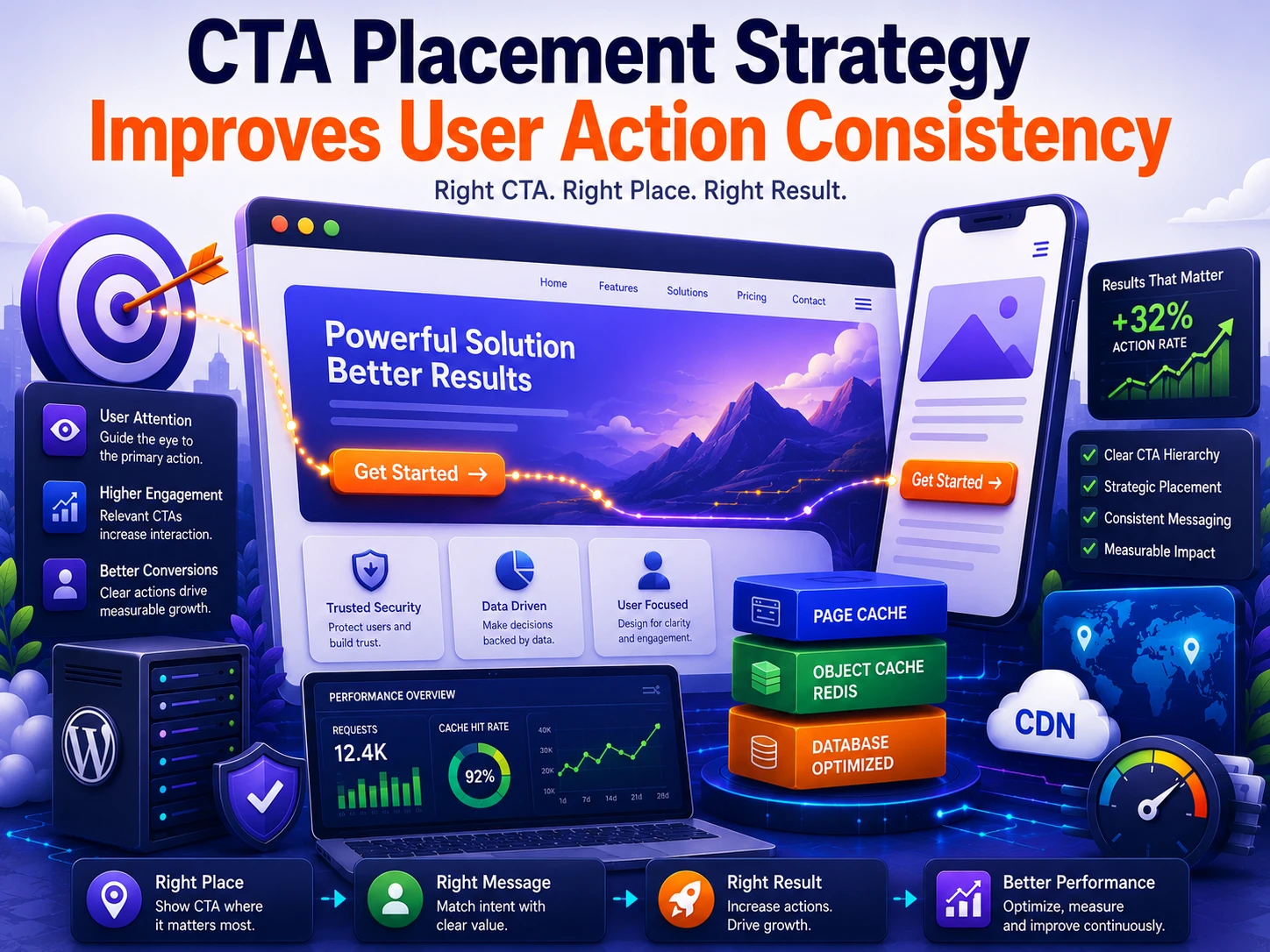
Conversion performance often declines because interface structure becomes inconsistent. Initially, websites may perform adequately. However, additional banners, promotional sections, popups, and competing actions gradually reduce interaction clarity.
Consequently, user decision flow weakens.
Many optimization efforts focus heavily on button colors or wording while ignoring structural placement. In reality, interaction timing and visual hierarchy influence user behavior more consistently than cosmetic adjustments alone.
At Wisegigs, conversion optimization usually begins with interaction mapping before visual redesign occurs. Structure determines reliability.
Why CTA Placement Becomes Ineffective
Most CTA problems emerge gradually through interface expansion.
Over time, websites commonly add:
- promotional banners
- sticky notifications
- newsletter forms
- floating chat widgets
- retargeting overlays
- duplicated action buttons
Individually, each addition may appear useful. Collectively, however, competing actions reduce interaction predictability.
Several warning signs typically indicate placement instability:
- low click-through consistency
- strong traffic with weak conversions
- excessive scroll abandonment
- fragmented user navigation
- high mobile bounce rates
- inconsistent funnel progression
Importantly, weak CTA performance often reflects structural friction rather than messaging problems.
According to Google UX Guidance on Visual Hierarchy, user attention patterns depend heavily on layout clarity and interface prioritization.
Understanding User Attention Flow
Users rarely interact with websites linearly.
Instead, attention moves through scanning behavior influenced by:
- visual hierarchy
- spacing consistency
- content density
- directional alignment
- device constraints
- interaction timing
CTA placement should follow these behavioral patterns instead of interrupting them aggressively.
Measurement defines clarity.
For example:
A primary action placed immediately after a high-friction content block often performs poorly because cognitive load remains elevated. Similarly, excessive CTA repetition reduces perceived urgency.
At Wisegigs, interface reviews usually map visual attention flow before repositioning conversion elements.
Structuring Primary and Secondary CTAs
Not all actions should receive equal visual priority.
Many websites unintentionally create competition between actions by emphasizing multiple objectives simultaneously.
A stable CTA structure generally separates:
Primary CTAs
Primary actions represent the main conversion objective.
Examples include:
- contact requests
- product purchases
- consultation bookings
- lead submissions
Primary CTAs should maintain strong visual consistency across the entire experience.
Secondary CTAs
Secondary actions support exploratory behavior.
Examples include:
- case study views
- documentation access
- pricing exploration
- newsletter subscriptions
Importantly, secondary actions should not visually overpower primary goals.
Behavior influences outcome.
Therefore, interaction hierarchy should remain operationally predictable.
Reducing Interface Friction Around Actions
CTA performance depends heavily on surrounding interface conditions.
Several friction sources commonly reduce action consistency:
- overcrowded layouts
- excessive form fields
- disruptive popups
- unclear spacing
- competing navigation paths
- slow-loading sections
Reducing friction improves interaction confidence.
For example:
A clean layout with one clearly defined action often outperforms multiple competing options, even when traffic volume remains identical.
Importantly, spacing and visual isolation influence action visibility more than aggressive animation effects.
According to Nielsen Norman Group UX Research, interface clarity improves decision efficiency and reduces user hesitation during interaction flows.
Mobile CTA Placement Considerations
Mobile environments introduce additional interaction constraints.
Smaller screens compress visual hierarchy aggressively. Consequently, CTA positioning requires stricter prioritization.
Common mobile-specific problems include:
- hidden actions below content walls
- obstructive sticky elements
- oversized banners
- poor thumb reach positioning
- delayed interactive loading
- excessive modal interruptions
Importantly, mobile optimization should focus on interaction simplicity rather than desktop feature parity.
At Wisegigs, mobile CRO reviews typically prioritize:
- reduced navigation friction
- simplified action paths
- scroll interruption control
- consistent thumb-access zones
Complexity reduces predictability.
Therefore, mobile experiences benefit from fewer but clearer conversion paths.
Related Wisegigs articles include:
Measuring CTA Performance Correctly
Conversion analysis should prioritize behavioral consistency rather than isolated click volume.
High click-through rates alone may produce misleading conclusions.
Useful measurement areas include:
- scroll depth correlation
- session progression
- CTA visibility timing
- funnel abandonment rate
- repeat interaction behavior
- device-specific conversion patterns
Importantly, placement analysis should account for user intent differences across traffic sources.
For example:
Paid advertising visitors may require faster CTA exposure, while organic search users often benefit from longer informational progression.
At Wisegigs, CTA testing generally evaluates structural interaction flow before modifying visual styling.
According to MeasureSchool CRO Analytics Articles, reliable conversion measurement depends on consistent event tracking and clearly defined interaction states.
Aligning CTA Strategy With Funnel Stages
Different funnel stages require different action expectations.
Top-of-funnel visitors usually seek:
- educational content
- trust validation
- navigation clarity
Mid-funnel users often focus on:
- pricing evaluation
- comparison analysis
- implementation details
Bottom-of-funnel visitors typically prioritize:
- direct conversion access
- low-friction submission
- operational confidence
Importantly, CTA positioning should reflect behavioral readiness rather than forcing identical actions across all stages.
Structure influences engagement stability.
Therefore, funnel-aware placement improves long-term conversion predictability.
Common CTA Placement Mistakes
Several recurring mistakes reduce interaction consistency significantly.
Overloading Pages With CTAs
Too many actions reduce decision clarity.
Interrupting Users Prematurely
Aggressive popups increase cognitive friction.
Prioritizing Design Over Interaction Flow
Visual aesthetics alone do not improve conversions.
Ignoring Mobile Navigation Constraints
Desktop-first layouts often degrade mobile performance.
Measuring Clicks Without Funnel Context
Clicks alone rarely indicate successful optimization.
Importantly, most CTA problems originate from structural inconsistency rather than weak button design.
Conclusion
CTA placement architecture directly affects conversion reliability.
Consistent interaction flow depends on visual hierarchy, reduced friction, funnel-aware positioning, and behavioral measurement clarity. Consequently, structured CTA systems improve both engagement quality and long-term CRO stability.
Predictable interfaces remain easier to optimize, measure, and scale over time.
Need help improving conversion flow and UX structure on WordPress?
Contact Wisegigs.eu