
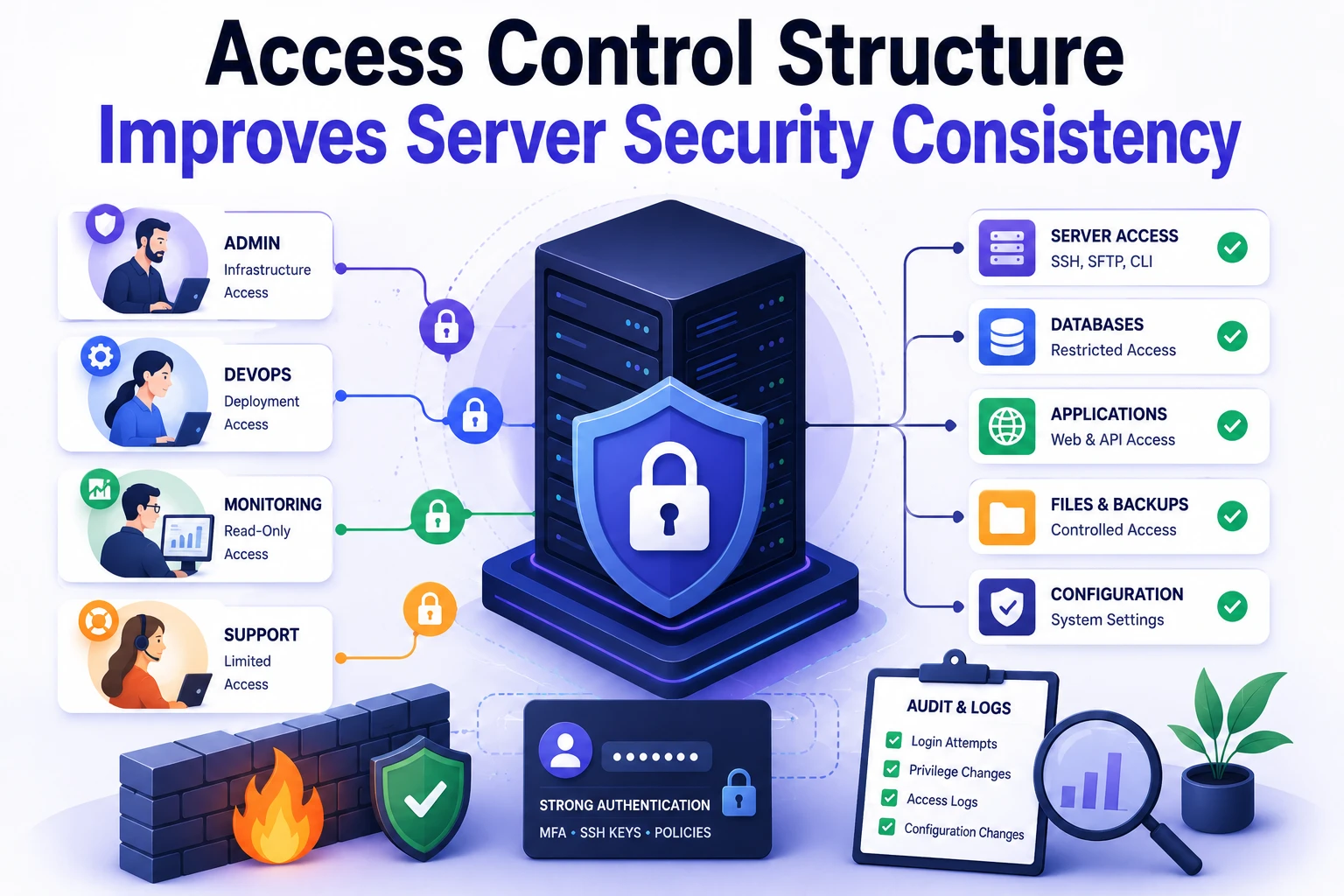
Server security gradually weakens when access policies lack structure. Initially, infrastructure may remain manageable. However, additional administrators, integrations, deployment workflows, and temporary permissions increase complexity quickly.
Consequently, permission visibility decreases.
Many hosting environments prioritize rapid deployment over controlled access governance. As a result, outdated accounts, inconsistent authentication methods, and excessive privileges accumulate over time.
At Wisegigs, infrastructure hardening begins with access segmentation before advanced security tooling is implemented. Structure determines reliability.
Why Access Control Becomes Inconsistent
Most hosting security issues emerge through incremental configuration changes rather than direct attacks.
For example, teams commonly add:
- temporary administrator accounts
- unmanaged SSH keys
- shared root credentials
- unrestricted deployment access
- duplicate control panel users
- excessive file permissions
Individually, these decisions may appear harmless. Collectively, however, they reduce operational predictability significantly.
Several warning signs usually appear before incidents occur:
- unused privileged accounts
- inconsistent authentication policies
- unrestricted server ports
- unclear ownership of credentials
- missing audit visibility
- excessive root-level activity
Importantly, access inconsistency increases recovery difficulty during security incidents.
According to Ubuntu Server Security Documentation, layered access restrictions reduce infrastructure exposure significantly when combined with consistent authentication controls.
Building a Layered Access Structure
Reliable hosting environments separate permissions into clearly defined operational layers.
Without segmentation, administrative boundaries become difficult to enforce.
A structured access model commonly includes:
Infrastructure Layer
This layer controls:
- VPS management
- firewall configuration
- SSH access
- operating system administration
Infrastructure access should remain highly restricted.
Application Layer
Application permissions manage:
- WordPress administration
- deployment workflows
- staging environments
- database access
Importantly, application administrators should not automatically receive server-level privileges.
Support and Monitoring Layer
Support-focused permissions often include:
- log visibility
- monitoring dashboards
- backup verification
- incident reporting
Separating operational visibility from configuration access improves accountability.
At Wisegigs, hosting environments usually isolate infrastructure administration from application management to reduce privilege overlap and simplify auditing.
Separating Administrative Responsibilities
Shared administrative ownership creates accountability gaps.
For example:
A developer may require deployment access without needing firewall modification privileges. Similarly, a support team may need monitoring visibility without direct database access.
Role separation improves infrastructure predictability.
Typical hosting roles include:
- infrastructure administrator
- deployment operator
- monitoring analyst
- backup manager
- application administrator
Importantly, role boundaries should remain operationally enforceable rather than informally documented.
Complexity reduces predictability.
Therefore, fewer overlapping permissions improve long-term security consistency.
Authentication and Credential Management
Authentication architecture directly affects hosting stability.
Weak credential workflows increase exposure even when server configurations appear secure.
A stable authentication structure generally includes:
- SSH key authentication
- multi-factor authentication
- centralized credential rotation
- password policy enforcement
- restricted root login
- access expiration policies
Importantly, authentication should remain consistent across all environments.
For example:
Production infrastructure should never rely on weaker authentication rules than staging or development environments.
According to AWS Identity and Access Management Best Practices, minimizing privileged access and enforcing temporary credentials significantly reduces long-term security risk.
Restricting Server-Level Exposure
Exposed infrastructure increases attack surface rapidly.
Consequently, access control should extend beyond user permissions alone.
A hardened hosting structure commonly restricts:
- open management ports
- unrestricted SSH access
- public database exposure
- direct root authentication
- unnecessary service availability
Firewall segmentation improves visibility and containment during incidents.
Additionally, geographic access restrictions can reduce automated attack traffic substantially.
At Wisegigs, server hardening workflows typically combine firewall isolation, SSH restriction, and application-level segmentation before performance optimization occurs.
Related Wisegigs infrastructure articles include:
Logging and Access Visibility
Security visibility depends on logging consistency.
Without centralized logging, suspicious behavior becomes difficult to investigate.
Important access events typically include:
- login attempts
- privilege escalations
- SSH authentication failures
- firewall rule changes
- deployment activity
- backup access events
Importantly, logging should prioritize operational clarity rather than excessive retention alone.
Measurement defines clarity.
At Wisegigs, infrastructure logging usually focuses on actionable visibility and incident reconstruction instead of storing unnecessary system noise.
According to Cloudflare Learning Center Security Articles, layered visibility improves incident response efficiency and reduces detection delays.
Compliance and Audit Considerations
Compliance requirements frequently expose weak permission structures.
For example, audit reviews often identify:
- excessive privilege inheritance
- undocumented access paths
- missing authentication policies
- inactive accounts
- insufficient logging retention
Importantly, compliance stability depends more on operational consistency than documentation alone.
A predictable access structure simplifies:
- audit preparation
- credential reviews
- incident response
- permission verification
- recovery procedures
Consequently, structured environments reduce operational friction during compliance reviews.
Common Access Control Mistakes
Several recurring mistakes reduce infrastructure security consistency.
Sharing Administrative Credentials
Shared accounts reduce accountability significantly.
Leaving Legacy Accounts Active
Unused accounts increase unnecessary exposure.
Granting Broad Root Access
Excessive privileges complicate incident isolation.
Ignoring Authentication Standardization
Inconsistent policies create weak operational boundaries.
Treating Compliance as Documentation Only
Operational behavior determines actual security posture.
Importantly, many infrastructure weaknesses originate from governance drift rather than technical limitations.
Conclusion
Access control architecture directly affects hosting security stability.
Reliable infrastructure depends on segmented permissions, controlled authentication workflows, restricted exposure, and consistent operational visibility. Consequently, structured access governance improves both security resilience and long-term maintainability.
Predictable systems remain easier to secure, audit, and recover over time.
Need help improving hosting security and infrastructure hardening?
Contact Wisegigs.eu