
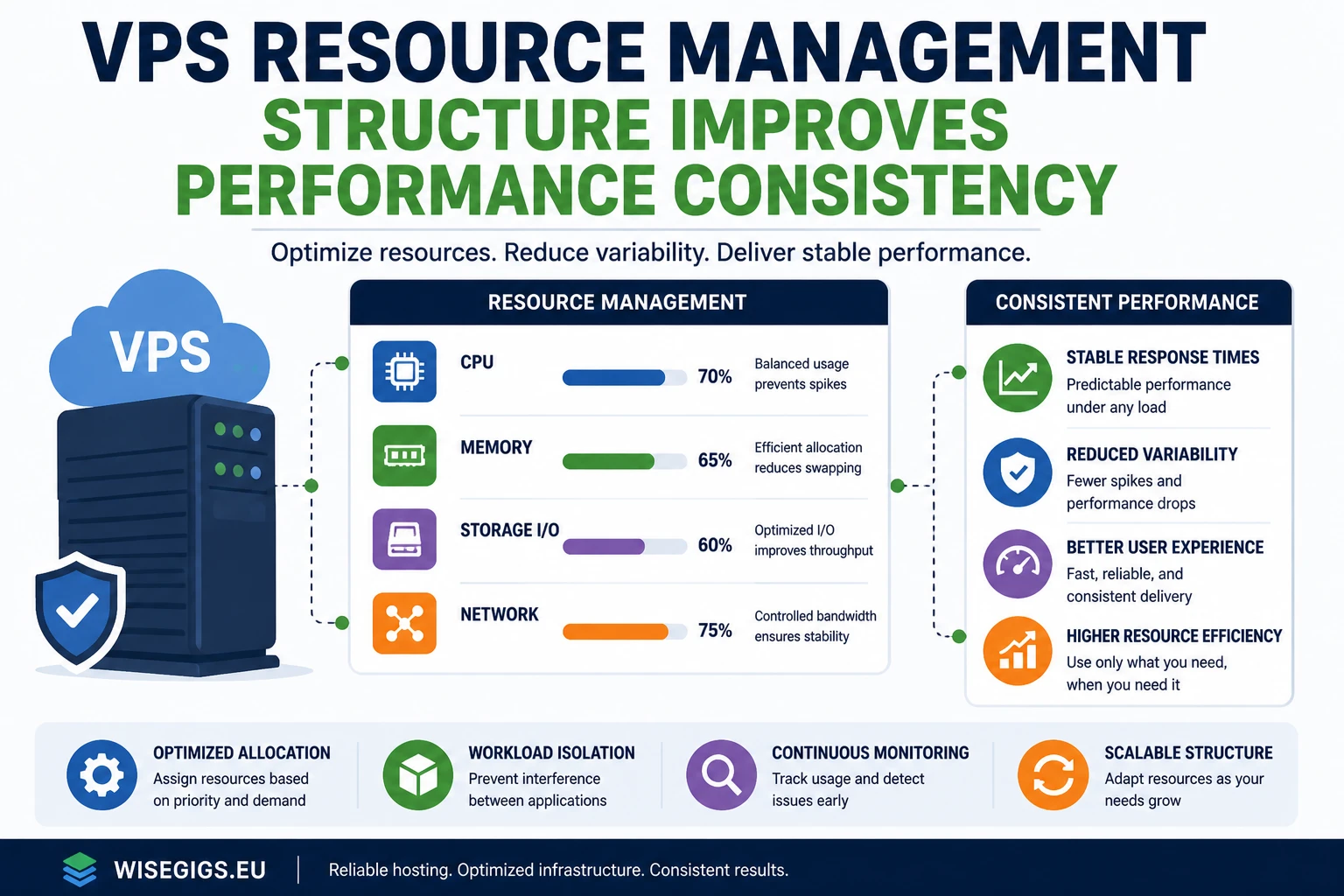
Performance instability rarely comes from insufficient server power.
Most issues originate from inconsistent resource allocation, uncontrolled workloads, or unclear prioritization. When CPU, memory, storage, and network resources are not structured, applications compete unpredictably.
Structure determines performance consistency.
At Wisegigs.eu, infrastructure audits consistently show that performance variability is driven by poor resource management rather than hardware limitations. Systems often have enough capacity, yet inconsistent allocation leads to unstable behavior.
Predictable resource structure improves performance reliability.
Structured management reduces system variability.
Resource Allocation Defines System Behavior
Every VPS distributes finite resources.
Unstructured allocation creates contention. Consequently, applications compete for CPU, memory, and I/O.
Clear allocation defines limits and priorities.
Common allocation inconsistencies include:
- no defined CPU or memory limits
- shared resources across unrelated workloads
- inconsistent resource distribution
- lack of prioritization between services
Structured allocation improves workload balance.
Balanced systems improve performance stability.
Workload Isolation Improves Resource Predictability
Multiple applications often run on the same VPS.
Without isolation, workloads interfere. As a result, performance fluctuates under load.
Clear isolation separates resource usage.
Common isolation inconsistencies include:
- multiple heavy processes sharing the same instance
- lack of containerization or separation
- unclear workload boundaries
- inconsistent process management
Structured isolation improves predictability.
Predictable workloads improve system consistency.
CPU Management Influences Execution Stability
CPU usage affects application speed.
Uncontrolled CPU consumption creates spikes. Consequently, response times become inconsistent.
Clear CPU management stabilizes execution.
Common CPU inconsistencies include:
- no process prioritization
- CPU-intensive tasks running without limits
- lack of scheduling control
- inconsistent workload distribution
Structured CPU management improves stability.
Stable execution improves performance consistency.
Memory Management Reduces System Volatility
Memory usage impacts system responsiveness.
Unmanaged memory leads to swapping. As a result, performance degrades significantly.
Clear memory management prevents overload.
Common memory inconsistencies include:
- lack of memory limits per process
- excessive caching without control
- missing monitoring of usage patterns
- inconsistent memory allocation
Structured memory control improves responsiveness.
Controlled usage reduces performance variability.
Storage I/O Structure Improves Data Performance
Disk operations influence system throughput.
Unstructured I/O creates bottlenecks. Consequently, applications slow down during peak activity.
Clear I/O structure balances data access.
Common storage inconsistencies include:
- shared disk usage across high-demand processes
- lack of I/O prioritization
- missing caching strategies
- inconsistent storage configuration
Structured I/O management improves throughput.
Efficient storage improves stability.
DigitalOcean explains disk performance optimization:
https://www.digitalocean.com/community/tutorials
Network Resource Management Improves Throughput Stability
Network performance affects application responsiveness.
Uncontrolled traffic creates congestion. As a result, latency increases unpredictably.
Clear network management improves consistency.
Common network inconsistencies include:
- no bandwidth prioritization
- shared network across conflicting workloads
- missing traffic control rules
- inconsistent routing logic
Structured network control improves throughput.
Stable throughput improves user experience.
Monitoring Improves Resource Visibility
Resource management requires observation.
Without monitoring, issues remain hidden. Consequently, performance problems escalate.
Clear monitoring provides visibility.
Key monitoring areas include:
- CPU usage patterns
- memory consumption trends
- disk I/O activity
- network traffic behavior
Unmonitored systems increase variability.
Observed systems improve performance stability.
What Reliable VPS Resource Structures Prioritize
Consistent performance depends on predictable resource behavior.
Reliable VPS systems typically prioritize:
- clear resource allocation rules
- structured workload isolation
- controlled CPU and memory usage
- optimized storage I/O handling
- managed network traffic
- continuous monitoring visibility
These characteristics reduce contention.
Reduced contention improves performance consistency.
At Wisegigs.eu, infrastructure strategy focuses on structuring VPS resource management to ensure stable performance across workloads and predictable system behavior.
Structured resources improve long-term reliability.
Need help optimizing your VPS for consistent performance?
Contact Wisegigs.eu