
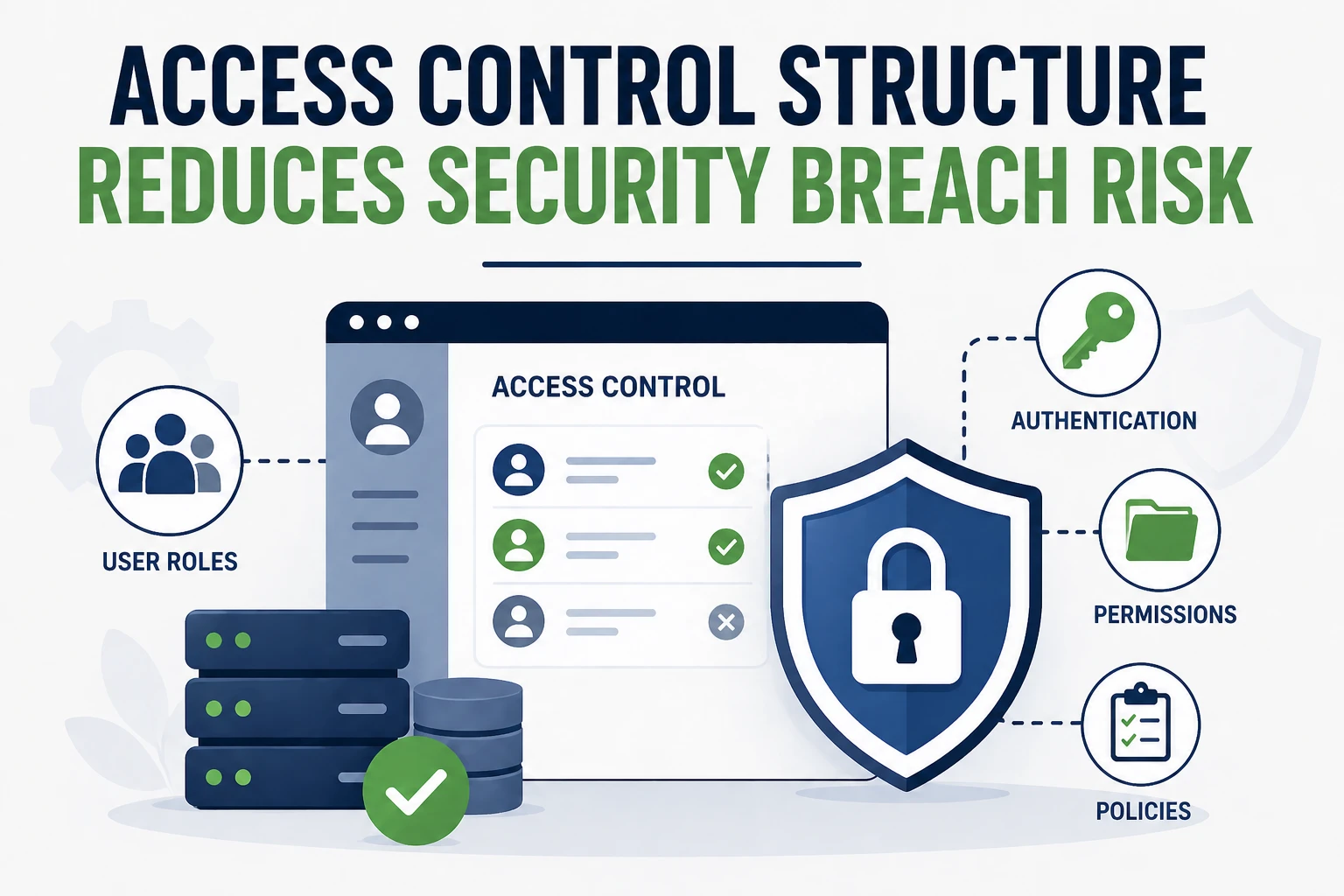
Security breaches rarely originate from unknown vulnerabilities.
Most incidents occur because access boundaries are unclear, inconsistent, or overly permissive. When systems fail to enforce structured access control, unauthorized actions become possible even without advanced attack methods.
Structure influences security outcomes.
At Wisegigs.eu, security audits consistently show that breach risk is more often caused by access misconfiguration than by missing security tools. Systems often appear secure on the surface, yet inconsistent access logic creates hidden exposure paths.
Predictable access structure reduces exploitation probability.
Structured control improves system security stability.
Access Control Defines System Boundaries
Every system operates within defined access limits.
Unstructured access blurs boundaries. Consequently, users gain unintended permissions that expand the attack surface.
Clear access structures define who interacts with specific resources. Therefore, behavior becomes predictable and enforceable.
Common boundary inconsistencies include:
- shared credentials across multiple roles
- unclear ownership of permissions
- fragmented access rules across systems
- inconsistent enforcement between environments
Structured boundaries reduce unauthorized entry points.
Predictable limits improve security reliability.
Role Structure Influences Permission Accuracy
Roles group permissions into manageable units.
Poorly defined roles introduce overlap. As a result, users inherit excessive or irrelevant access rights.
Clear role definitions align permissions with actual responsibilities.
Common role inconsistencies include:
- overly broad roles with unnecessary privileges
- duplicate roles with overlapping permissions
- unclear role hierarchy
- fragmented role mapping across platforms
Structured roles improve permission accuracy.
Accurate permissions reduce exposure risk.
Least Privilege Reduces Exposure Risk
Access should always be limited to necessity.
Excess permissions expand the potential damage of compromised accounts. Therefore, attackers gain more control once access is breached.
Least privilege restricts actions to required capabilities only.
Common privilege inconsistencies include:
- default administrative access
- unused permissions remaining active
- lack of periodic access reviews
- inconsistent privilege assignment across teams
Structured restriction reduces attack surface.
Controlled access improves system stability.
Google Cloud IAM guidelines highlight least privilege as a core security principle:
https://cloud.google.com/security/iam/docs
Authentication Flow Affects Access Integrity
Authentication verifies identity before access is granted.
Weak authentication introduces unauthorized entry points. Consequently, attackers bypass access controls entirely.
Strong authentication ensures identity accuracy and consistency.
Common authentication inconsistencies include:
- reliance on single-factor authentication
- fragmented login systems across services
- inconsistent session management
- missing identity validation layers
Structured authentication improves access integrity.
Reliable identity improves security predictability.
Segmentation Limits Breach Propagation
Systems consist of interconnected components.
Unsegmented environments allow attackers to move laterally. As a result, a single breach escalates into full system compromise.
Segmentation isolates access domains.
Common segmentation inconsistencies include:
- shared environments across applications
- lack of network isolation
- unclear separation of services
- inconsistent segmentation enforcement
Structured segmentation improves containment.
Contained breaches reduce system-wide impact.
Policy Consistency Improves Enforcement Reliability
Access control depends on defined policies.
Inconsistent policies create enforcement gaps. Therefore, systems behave unpredictably under different conditions.
Clear policy structures ensure uniform behavior.
Common policy inconsistencies include:
- conflicting rules across systems
- unclear policy ownership
- fragmented documentation
- inconsistent updates across environments
Structured policies improve enforcement reliability.
Reliable enforcement reduces breach probability.
OWASP identifies broken access control as a top security risk:
https://owasp.org/www-project-top-ten/
Monitoring Validates Access Behavior
Access control must be continuously observed.
Without monitoring, misuse remains undetected. Consequently, security incidents escalate before response.
Structured monitoring provides visibility into behavior.
Key indicators include:
- unusual login activity
- unexpected permission changes
- repeated failed authentication attempts
- access outside normal patterns
Unmonitored systems increase risk.
Observed systems improve security stability.
What Reliable Access Control Structures Prioritize
Security stability depends on predictable access behavior.
Reliable access control systems typically prioritize:
- clear role-based access structures
- strict least privilege enforcement
- consistent authentication workflows
- strong system segmentation
- unified policy enforcement
- continuous monitoring visibility
These characteristics reduce exposure pathways.
Reduced exposure lowers breach probability.
At Wisegigs.eu, security architecture focuses on structuring access control systems that maintain clear boundaries and minimize unauthorized behavior.
Predictable structure improves long-term system resilience. Need help structuring access control for stronger application security?
Contact Wisegigs.eu