
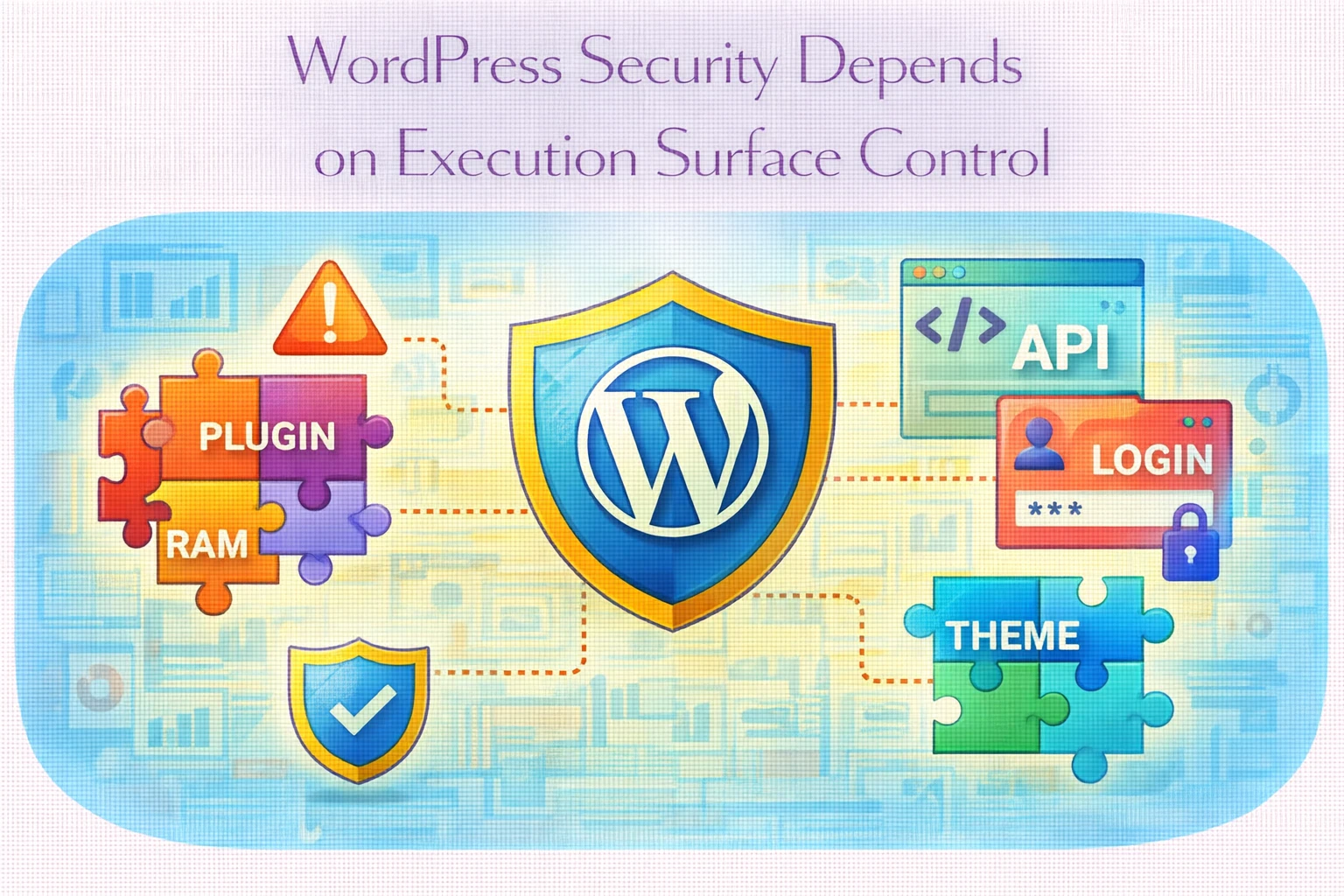
WordPress security depends on exposure boundaries.
Security tools often focus on detection, filtering, or response mechanisms. However, the number of executable entry points strongly influences overall risk level. Each enabled component introduces additional logic paths that may be accessed intentionally or unintentionally.
Execution surface determines attack opportunity.
At Wisegigs.eu, security reviews frequently identify environments where multiple plugins, themes, and interfaces expand the available execution surface significantly. Even when individual components appear safe, combined exposure increases the probability of misconfiguration or vulnerability interaction.
Reducing executable pathways improves predictability.
Predictability improves security stability.
Execution Surface Defines Exposure Scope
Execution surface describes reachable logic.
Each publicly accessible endpoint, script, or process increases the number of possible interaction paths between external actors and internal system behavior.
Execution surfaces include:
- plugin functions exposed through hooks
- theme template logic
- REST API endpoints
- XML-RPC interfaces
- authentication entry points
As the number of reachable paths increases, exposure complexity expands.
Complex exposure surfaces are harder to monitor consistently.
Reducing reachable logic simplifies evaluation.
Every Active Component Introduces Executable Logic
Plugins and themes execute code.
Each active extension introduces functions, scripts, and integration logic. These elements influence application behavior and may interact with user input, database queries, or external services.
Execution expansion occurs through:
- additional request handlers
- additional database queries
- additional administrative interfaces
- additional background processes
More executable logic increases analysis complexity.
Complex systems increase uncertainty.
Simplified environments improve control.
WordPress plugin development documentation explains extension behavior:
https://developer.wordpress.org/plugins/
Understanding execution paths improves risk visibility.
Public Interfaces Expand Attack Opportunities
Public interfaces create accessible endpoints.
Interfaces designed for legitimate use may also expose interaction points for malicious requests. Authentication endpoints, API routes, and form handlers represent potential entry paths.
Common exposure interfaces include:
- login endpoints
- REST API routes
- form submission handlers
- XML-RPC access points
Unrestricted interfaces increase scanning visibility.
Controlled access reduces interaction probability.
Interface limitation improves security posture.
WordPress REST API documentation describes endpoint behavior:
https://developer.wordpress.org/rest-api/
Interface discipline reduces exposure complexity.
Plugin Behavior Influences Execution Predictability
Plugins modify runtime behavior.
Each plugin may register hooks, modify queries, or introduce additional processing layers. Combined behavior across multiple plugins may create unpredictable execution patterns.
Execution unpredictability may include:
- overlapping authentication filters
- redundant security rules
- unexpected execution sequence changes
- inconsistent data validation behavior
Predictable execution simplifies analysis.
Unpredictable interactions complicate hardening strategies.
Controlled plugin selection improves stability.
WP Tavern frequently discusses plugin interaction risks:
Predictability improves evaluation clarity.
Theme Logic Also Contributes to Exposure
Themes influence rendering logic.
Template files may include custom functions, third-party scripts, or conditional logic affecting execution flow. Themes sometimes include embedded functionality that overlaps with plugin responsibilities.
Theme-related exposure factors include:
- custom template functions
- embedded integration scripts
- conditional content logic
- dynamic data rendering logic
Separating presentation from functionality improves clarity.
Clear separation reduces complexity.
Structured templates improve maintainability.
API Endpoints Require Explicit Control
APIs enable integration.
They also expand reachable logic paths. REST API endpoints may expose content, metadata, or operational actions.
API exposure considerations include:
- restricting unnecessary endpoints
- validating request structure
- limiting available methods
- controlling authentication scope
Unrestricted endpoints increase interaction possibilities.
Controlled endpoints reduce attack vectors.
Explicit access rules improve predictability.
Authentication Paths Require Minimization
Authentication endpoints represent critical entry points.
Multiple authentication paths increase credential exposure risk. Simplifying authentication logic improves control over access verification.
Authentication complexity may include:
- multiple login endpoints
- duplicated authentication plugins
- inconsistent session validation logic
- overlapping access control layers
Reducing authentication variation improves monitoring clarity.
Simplified access paths reduce uncertainty.
Clear authentication structure improves visibility.
Reducing Execution Paths Improves Security Stability
Fewer execution paths simplify evaluation.
Reducing unnecessary plugins, limiting exposed endpoints, and removing unused functionality decreases overall exposure complexity.
Inactive plugins still introduce executable code.
Unused themes still introduce logic paths.
Public interfaces still introduce vectors.
Therefore, reducing surface area often yields larger gains than adding controls.
Structural simplification improves predictability.
Predictable environments improve defensive accuracy.
What Reliable WordPress Hardening Prioritizes
Effective hardening reduces unnecessary exposure.
Reliable hardening strategies typically prioritize:
- minimizing active plugins
- removing unused themes
- restricting unnecessary endpoints
- simplifying authentication paths
- maintaining predictable execution logic
- reviewing extension necessity regularly
These practices improve structural clarity.
Clarity improves defensive confidence.
At Wisegigs.eu, WordPress hardening emphasizes execution surface reduction rather than excessive tool layering.
Structure influences resilience.
Conclusion
WordPress security depends on execution surface discipline.
Adding controls does not always reduce exposure.
To recap:
- execution surface defines attack opportunity scope
- each extension introduces executable logic
- public interfaces expand reachable paths
- plugin behavior influences execution predictability
- theme logic contributes to exposure complexity
- API endpoints require controlled access
- authentication paths benefit from simplification
- reducing execution paths improves security stability
At Wisegigs.eu, reliable WordPress security improvements result from structural exposure reduction aligned with predictable execution behavior.
If WordPress environments include numerous plugins, themes, or interfaces, reducing execution surface may improve overall security posture.
Need help hardening WordPress architecture? Contact Wisegigs.eu