
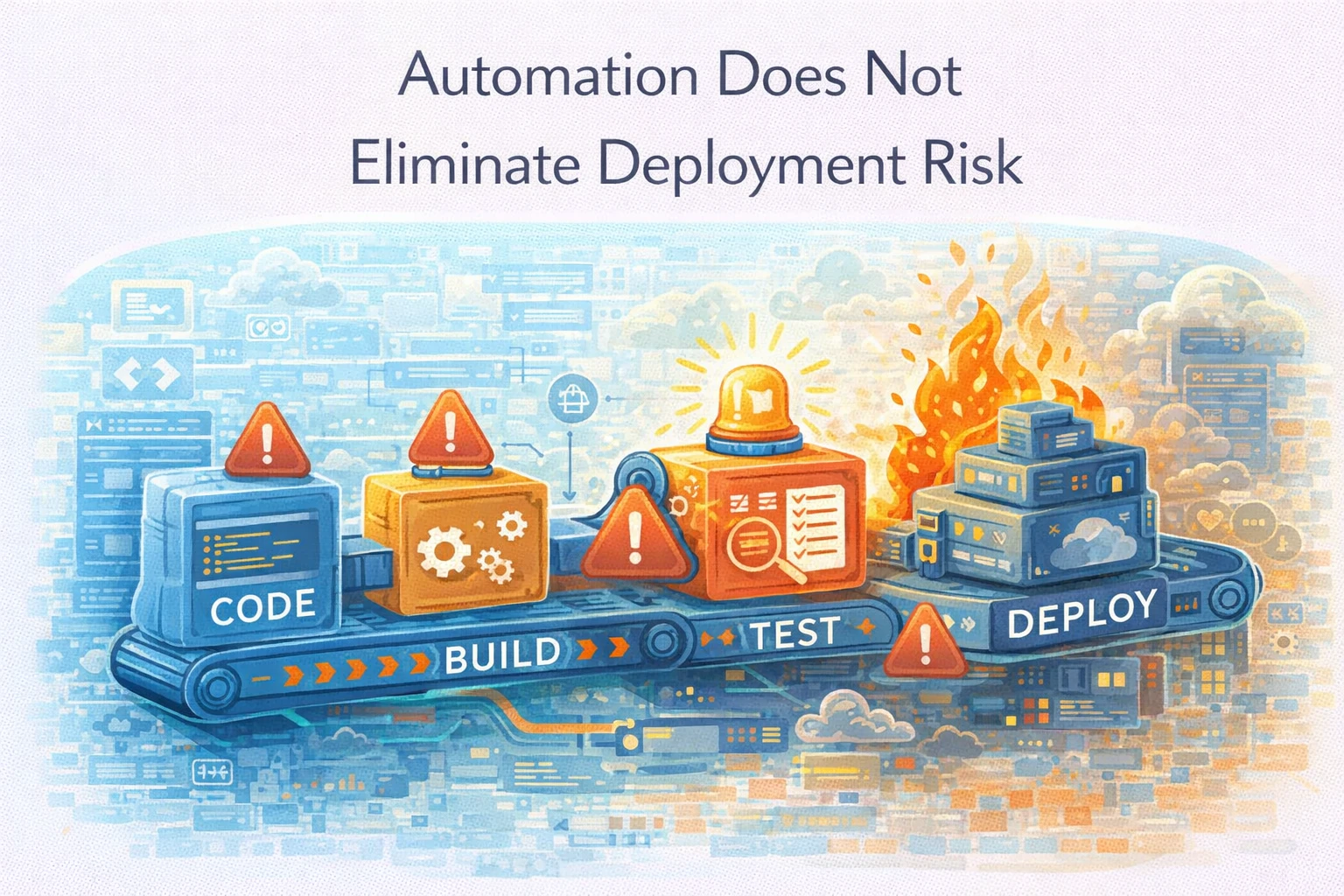
Automation improves deployment efficiency.
CI/CD pipelines reduce manual intervention and enable faster release cycles. Code changes move through structured workflows, and deployment steps become repeatable across environments.
These benefits are significant.
However, automation does not remove deployment risk.
At Wisegigs.eu, infrastructure and deployment reviews often identify environments where automated pipelines function correctly, yet production issues still occur after releases. Despite consistent workflows, unexpected behavior emerges.
Automation standardizes processes.
It does not guarantee correctness.
Automation Improves Consistency but Does Not Remove Risk
CI/CD pipelines enforce repeatable steps.
Build processes, dependency installation, and deployment commands execute consistently. This reduces variability introduced by manual operations.
However, consistent execution does not ensure reliable outcomes.
If underlying configuration errors exist, automation reproduces them consistently.
Incorrect environment variables propagate automatically.
Misconfigured services deploy repeatedly.
Invalid assumptions persist across releases.
Automation increases consistency.
It also increases the speed of error propagation.
Deployment Risk Often Originates in System Complexity
Modern applications rely on multiple components.
Databases, queues, APIs, caching layers, and external services interact during deployment. Each dependency introduces potential variability.
Complex systems behave differently under real workloads.
Even when pipelines execute correctly, system interactions may produce unexpected effects.
Examples include:
- schema changes affecting query performance
- background workers requiring updated configuration
- service dependencies responding differently after updates
Complexity increases uncertainty.
Deployment outcomes depend on system behavior, not only pipeline execution.
Environment Differences Introduce Unexpected Behavior
Development and production environments often differ.
Configuration mismatches create inconsistent results. Applications may perform correctly in staging but fail in production due to differences in infrastructure settings.
Typical differences include:
- PHP or runtime version variations
- database configuration inconsistencies
- file permission differences
- environment variable discrepancies
Even small differences influence application behavior.
Consistent environments reduce deployment variability.
Docker documentation highlights environment consistency as a key advantage of containerization:
Standardization improves predictability.
CI/CD Pipelines Amplify Configuration Errors
Automation accelerates change distribution.
When pipelines deploy updates automatically, configuration errors propagate quickly across environments. Without validation controls, issues may affect multiple services simultaneously.
Common pipeline-related risks include:
- incorrect environment variables applied globally
- deployment scripts modifying unintended resources
- shared configuration affecting multiple applications
- unverified secrets or credentials
Speed increases exposure when validation is insufficient.
Automation must include safeguards.
Automated Testing Does Not Cover All Scenarios
Testing reduces deployment uncertainty.
Unit tests, integration tests, and end-to-end tests validate application behavior under predefined conditions. However, automated testing cannot simulate every real-world scenario.
Limitations include:
- incomplete test coverage
- unexpected data conditions
- dependency behavior under production load
- concurrency-related issues
Testing improves reliability.
It does not guarantee defect-free releases.
GitLab’s CI/CD documentation emphasizes combining automated testing with monitoring:
Multiple validation layers improve confidence.
Dependency Changes Affect Deployment Stability
Applications rely on external libraries.
Updates to dependencies may introduce unexpected changes in behavior. Even minor version updates can alter execution patterns or introduce compatibility issues.
Typical dependency risks include:
- breaking changes in libraries
- performance regressions after updates
- altered API response structures
- changed configuration defaults
Dependency management requires verification.
Automation must include compatibility checks.
Rollback Strategies Must Remain Reliable
Deployment safety depends on recovery capability.
Rollback mechanisms allow teams to restore previous versions when issues occur. Without reliable rollback processes, minor failures may escalate into prolonged incidents.
Effective rollback strategies include:
- versioned deployments
- database migration safety planning
- immutable infrastructure patterns
- configuration version control
Recovery planning reduces operational risk.
Deployment speed must not compromise reversibility.
Observability Supports Safer Deployments
Visibility improves deployment confidence.
Monitoring systems track performance changes after releases. Observability tools reveal anomalies quickly and allow teams to respond before issues escalate.
Useful signals include:
- response time changes
- error rate increases
- dependency performance shifts
- resource usage anomalies
Observability complements automation.
Together, they improve reliability.
Google’s DevOps research highlights monitoring as a critical factor in deployment stability:
https://cloud.google.com/devops
Feedback loops improve deployment quality.
What Reliable CI/CD Strategies Prioritize
Reliable deployment pipelines emphasize discipline.
Effective CI/CD strategies typically prioritize:
- environment consistency across stages
- automated validation checks
- structured dependency management
- reliable rollback mechanisms
- monitoring after each deployment
- incremental release strategies
These practices reduce deployment risk.
At Wisegigs.eu, CI/CD pipelines are designed to increase deployment confidence rather than simply increase release speed.
Speed without control increases instability.
Conclusion
Automation improves deployment efficiency.
However, it does not eliminate risk.
To recap:
- automation ensures consistent execution
- complexity introduces unpredictable interactions
- environment differences influence application behavior
- pipelines amplify configuration errors
- automated tests cannot cover all scenarios
- dependency changes affect stability
- rollback strategies remain essential
- observability improves deployment safety
At Wisegigs.eu, reliable CI/CD pipelines combine automation with validation, observability, and disciplined environment management.
If automated deployments still produce unexpected issues, the underlying cause may lie in system complexity rather than pipeline design.
Need help improving CI/CD reliability or deployment architecture? Contact Wisegigs.eu