
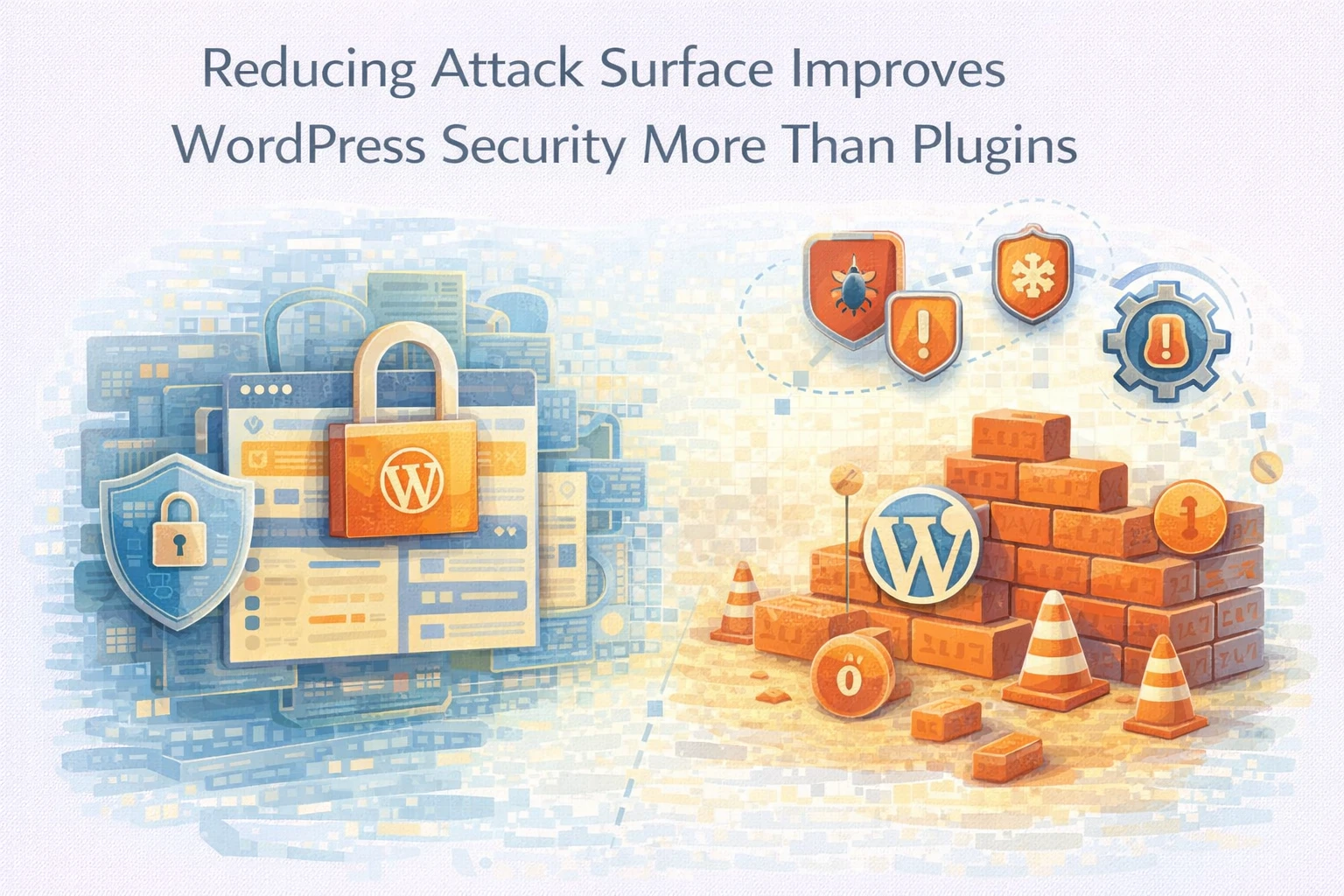
WordPress security often begins with plugin installation.
Many site owners add security plugins immediately after deployment. Firewalls, login protection tools, malware scanners, and activity monitors appear to provide immediate protection.
These tools can be useful.
However, security plugins do not reduce structural risk.
At Wisegigs.eu, security audits frequently reveal WordPress environments where multiple protection layers exist, yet exposure remains high. The underlying issue is rarely missing tools. Instead, excessive functionality expands the attack surface.
Security depends on what is exposed.
Not only on what is protected.
WordPress Security Is Often Treated as a Plugin Problem
Security plugins offer visible reassurance.
Dashboards display blocked login attempts, vulnerability alerts, and firewall statistics. Because these indicators are measurable, teams often interpret plugin installation as meaningful security progress.
However, plugins operate within the existing architecture.
They monitor, filter, or react to activity. They rarely reduce the number of potential entry points.
As a result, the environment may remain complex and difficult to secure.
Security tooling does not automatically simplify systems.
Every Component Expands the Attack Surface
Each installed component introduces executable logic.
Themes, plugins, integrations, and external services all increase the number of possible interaction paths within the application. These paths represent potential vectors for exploitation.
Examples include:
- plugins introducing additional endpoints
- themes including third-party libraries
- integrations creating external communication channels
- administrative tools exposing configuration interfaces
Every additional component increases the total surface area that must be secured.
Complex systems require more defensive controls.
Complexity Increases Exposure
As WordPress environments grow, dependencies multiply.
Multiple plugins interact with each other, share database structures, and modify execution flows. This interconnected behavior increases unpredictability.
In complex environments:
- plugin conflicts introduce unintended behavior
- outdated dependencies create vulnerabilities
- redundant functionality increases code exposure
Each dependency adds maintenance requirements.
Security risk increases with system complexity.
WordPress development documentation emphasizes maintaining minimal, well-maintained plugin stacks:
https://developer.wordpress.org/
Unused Features Still Introduce Risk
Inactive components still affect security posture.
Code that remains installed continues to exist within the system environment. Even when features are disabled, underlying logic may remain accessible through configuration or direct requests.
Unused plugins frequently remain overlooked and continue to introduce executable code paths.
Legacy themes may contain outdated dependencies that expand vulnerability exposure.
Administrative utilities can unintentionally expose sensitive functionality when left accessible.
Reducing unused functionality simplifies security management.
Fewer components reduce maintenance overhead.
Access Points Multiply Security Requirements
Each public interface requires protection.
WordPress environments expose multiple access paths, including login pages, REST APIs, XML-RPC endpoints, and administrative dashboards. Additional plugins often introduce new endpoints.
More endpoints increase monitoring requirements.
Security controls must validate authentication, sanitize input, and enforce permissions across all interfaces.
Limiting exposure points simplifies protection strategies.
Fewer entry points reduce monitoring complexity.
Dependency Chains Expand Vulnerability Scope
Modern plugins rely on external libraries.
JavaScript frameworks, PHP packages, and third-party APIs introduce additional dependencies. Each dependency must remain updated and secure.
When dependencies become outdated, vulnerabilities appear.
A single outdated library may affect multiple plugins simultaneously.
Therefore, dependency management plays an important role in WordPress security.
NIST vulnerability database resources demonstrate how software dependencies influence security risk:
Maintaining fewer dependencies simplifies patch management.
Security Controls Cannot Fully Offset Structural Risk
Protective layers improve resilience.
Firewalls, malware scanners, and login protection mechanisms reduce exploitation probability. However, these controls operate reactively.
They respond to detected patterns.
They do not eliminate exposure points.
If unnecessary functionality remains accessible, security tools must continuously monitor and filter interactions.
Reducing exposure often produces more predictable outcomes than increasing controls.
Structure influences risk more than tooling.
Observability Supports Secure Environments
Security requires visibility.
Logs, authentication records, and request monitoring provide insight into system activity. Observability allows teams to identify unusual behavior and respond quickly.
Useful signals include:
- unexpected login attempts
- abnormal API usage
- unusual request patterns
- configuration changes
Visibility improves response capability.
However, reducing exposure reduces the number of signals requiring analysis.
Simpler systems produce clearer insights.
Cloudflare security learning resources highlight the importance of reducing unnecessary exposure:
https://www.cloudflare.com/learning/security/
What Reliable WordPress Hardening Prioritizes
Effective hardening strategies focus on simplification.
Stable WordPress environments typically prioritize:
- removing unused plugins and themes
- limiting administrative access points
- minimizing external dependencies
- selecting well-maintained components
- maintaining consistent update processes
- monitoring authentication activity
These practices reduce attack surface area.
Security improves as complexity decreases.
At Wisegigs.eu, WordPress hardening begins with structural reduction rather than tool accumulation.
Less exposure creates more predictable environments.
Conclusion
Security depends on exposure management.
Adding protective tools may help.
However, reducing unnecessary functionality often provides greater impact.
To recap:
- security plugins do not reduce structural complexity
- each component expands the attack surface
- complexity increases maintenance requirements
- unused features still introduce risk
- multiple access points increase monitoring requirements
- dependencies expand vulnerability scope
- security controls cannot fully offset structural exposure
At Wisegigs.eu, reliable WordPress security strategies emphasize reducing system complexity, limiting exposure points, and maintaining disciplined architecture.
If your WordPress environment relies heavily on security plugins but still feels difficult to protect, the underlying issue may be excessive attack surface.
Need help auditing or hardening your WordPress environment? Contact Wisegigs.eu