
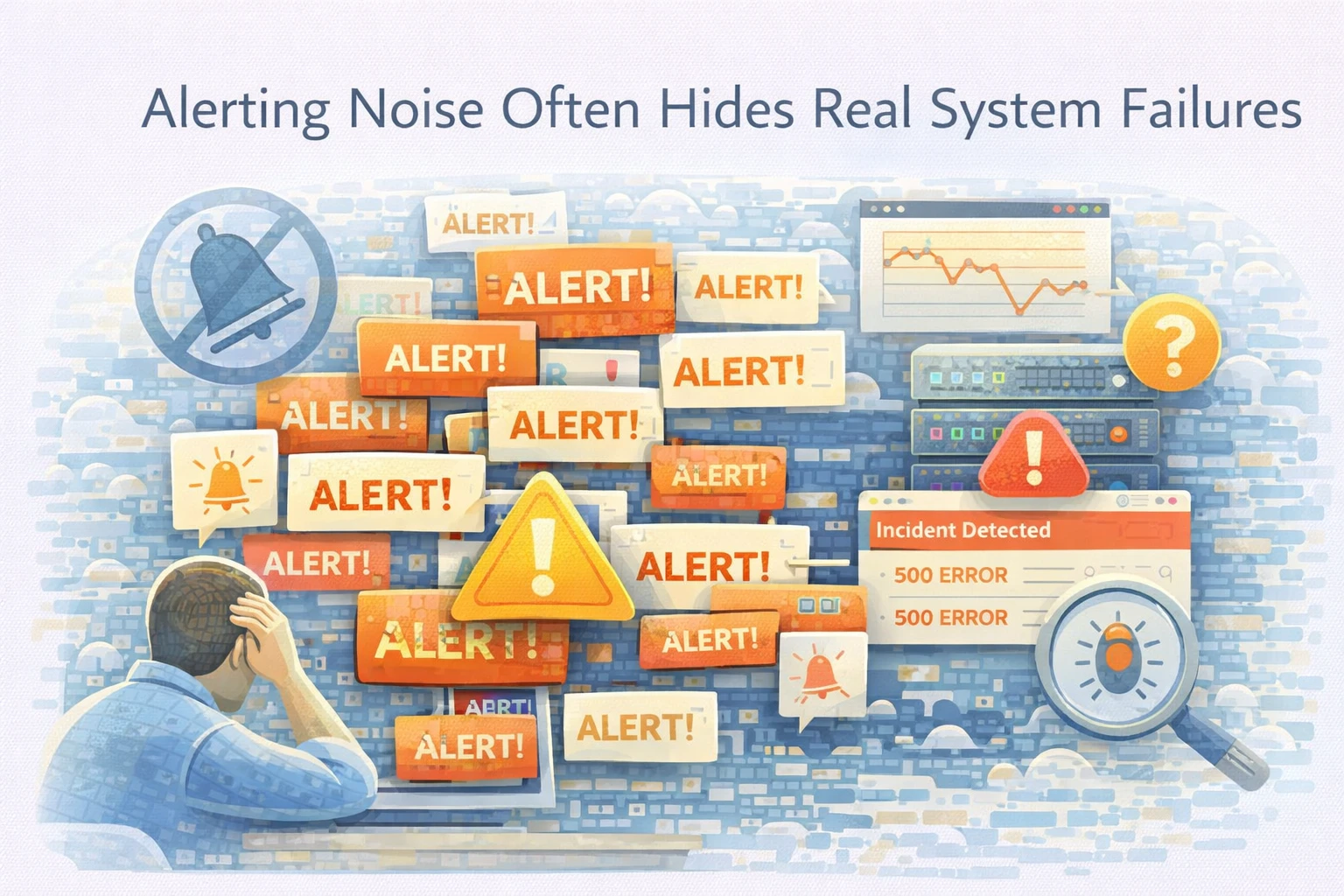
Monitoring systems generate alerts.
When metrics cross predefined thresholds, systems notify engineers about potential issues. In theory, this mechanism ensures rapid detection of incidents and protects system reliability.
However, alerting systems often produce too much noise.
At Wisegigs.eu, infrastructure reviews frequently reveal environments where alert channels are saturated with notifications. Engineers receive frequent warnings about minor fluctuations, non-critical events, or transient anomalies.
As a result, important alerts lose visibility.
Signal becomes indistinguishable from noise.
Monitoring Systems Often Produce Excessive Alerts
Alerting systems are easy to configure.
Teams define thresholds for CPU usage, memory consumption, response time, or error rates. When these thresholds are exceeded, alerts are triggered automatically.
However, many systems treat all threshold breaches equally.
Short-lived spikes trigger the same alerts as sustained failures. Temporary load increases generate notifications indistinguishable from critical incidents.
Consequently, alert volume increases rapidly.
This reduces clarity.
Alert Fatigue Reduces Incident Awareness
Frequent alerts change human behavior.
When engineers receive constant notifications, they begin to ignore them. This phenomenon, known as alert fatigue, reduces responsiveness to real incidents.
Over time:
alerts are acknowledged without investigation
notifications are muted or filtered
escalation processes lose effectiveness
Eventually, critical issues may go unnoticed.
Reliability declines not because alerts are missing, but because they are ignored.
Google’s Site Reliability Engineering guidance highlights alert fatigue as a major operational risk:
Not All Signals Should Trigger Alerts
Monitoring systems collect many signals.
Metrics, logs, traces, and events provide detailed insight into system behavior. However, not every signal requires immediate action.
Alerting should focus on actionable events.
For example:
sustained service outages
significant error rate increases
critical dependency failures
user-impacting latency spikes
By contrast, minor fluctuations should remain observable but not trigger alerts.
Distinguishing between signals and alerts is essential.
Poor Threshold Design Creates Noise
Thresholds define when alerts trigger.
If thresholds are too sensitive, systems generate excessive alerts. If thresholds are too relaxed, critical issues may be missed.
Common threshold problems include:
static thresholds applied to dynamic workloads
thresholds based on averages instead of percentiles
ignoring normal traffic variability
lack of differentiation between peak and off-peak periods
These issues produce unreliable alerts.
Effective thresholds must reflect real system behavior.
Correlation Matters More Than Volume
Single metrics rarely explain system failures.
Complex systems involve multiple components interacting simultaneously. A single alert may not represent a real incident unless correlated with other signals.
For example:
High CPU usage alone may not indicate failure.
Combined with high latency and error rates, it becomes significant.
Correlation reduces false positives.
It helps identify meaningful patterns rather than isolated anomalies.
Missing Context Delays Incident Diagnosis
Alerts without context create confusion.
When engineers receive alerts without supporting information, they must investigate manually. This increases response time and prolongs incidents.
Effective alerts include:
affected services
recent changes or deployments
related metrics and logs
historical comparison data
Context accelerates diagnosis.
Without it, alerts increase workload without improving response.
Observability Improves Signal Quality
Observability enhances monitoring.
Instead of focusing only on metrics, observability integrates logs, traces, and system-level insights. This approach improves understanding of system behavior.
With observability:
alerts are based on real system impact
engineers can trace issues across services
root causes become easier to identify
Cloudflare’s learning resources emphasize observability as essential for reliable systems:
https://www.cloudflare.com/learning/observability/
Better visibility improves alert quality.
Alerting Must Reflect System Behavior
Reliable alerting aligns with real-world conditions.
Systems behave differently under varying load patterns, traffic distributions, and operational contexts. Alerting strategies must adapt accordingly.
This includes:
dynamic thresholds based on historical data
environment-specific alert rules
differentiation between warning and critical alerts
suppression of known non-critical events
Static alerting models often fail in dynamic environments.
What Reliable Alerting Strategies Prioritize
Effective alerting focuses on relevance.
Reliable systems typically prioritize:
reducing alert volume to meaningful signals
designing thresholds based on real usage patterns
correlating multiple metrics before triggering alerts
providing context for faster diagnosis
continuously refining alert rules
These practices improve operational efficiency.
At Wisegigs.eu, alerting systems are designed to surface actionable signals rather than generate noise.
Clarity improves response.
Conclusion
Alerting systems support reliability.
However, excessive alerts reduce their effectiveness.
To recap:
monitoring systems often generate too many alerts
alert fatigue reduces responsiveness
not all signals require alerts
poor thresholds create noise
correlation improves accuracy
context accelerates incident response
observability enhances signal quality
At Wisegigs.eu, effective monitoring strategies prioritize signal clarity, actionable alerts, and continuous refinement.
If your monitoring system generates frequent alerts but fails to detect real incidents, the problem may be noise rather than visibility.
Need help improving monitoring or alerting strategies? Contact Wisegigs.eu