
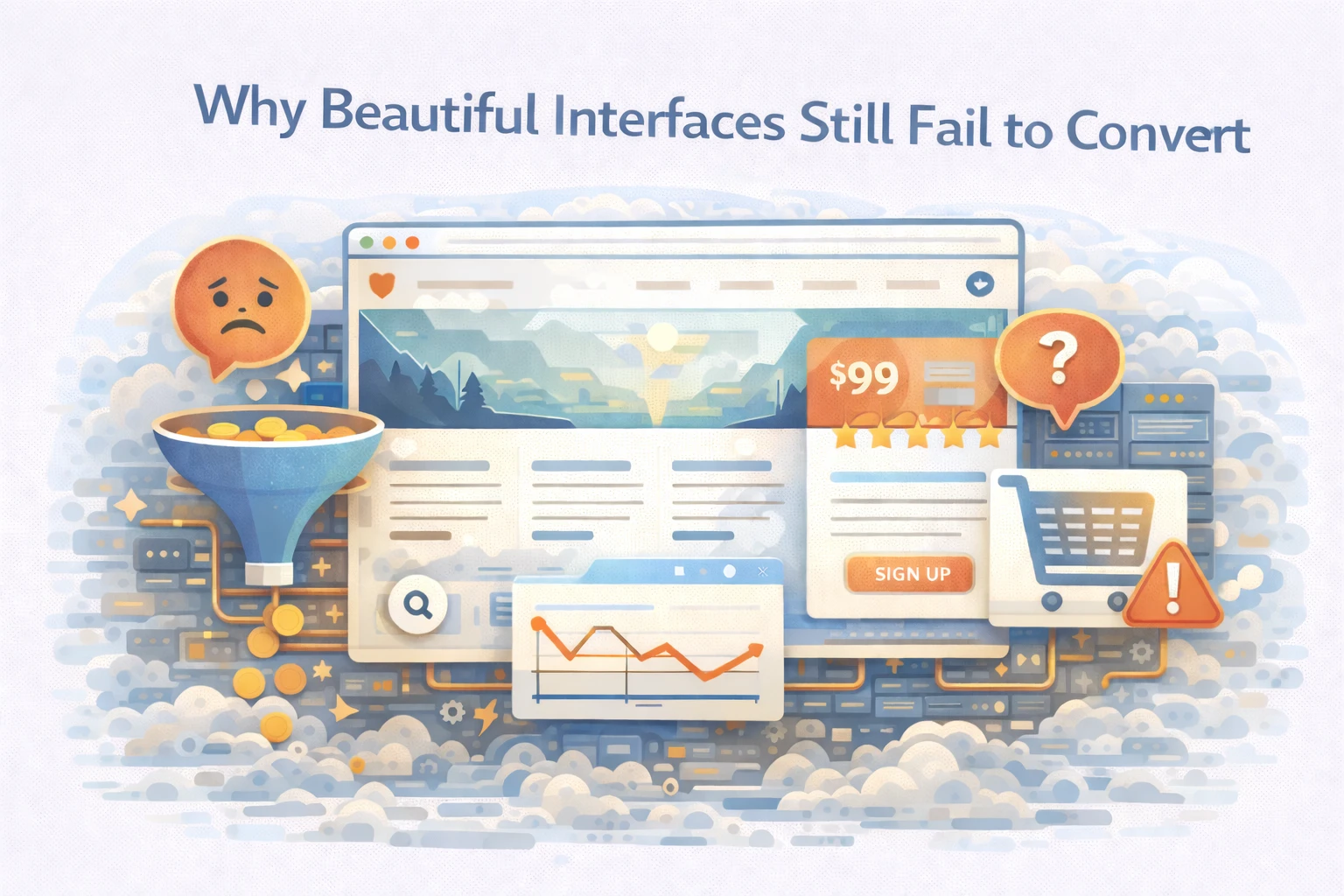
Design quality receives significant attention in modern digital products.
Organizations invest in visual branding, interface polish, and modern layout frameworks to improve user experience. Because visual improvements are easy to recognize, many teams assume better design automatically leads to higher conversion rates.
However, visual quality alone rarely determines conversion success.
At Wisegigs.eu, CRO audits frequently reveal websites with well-designed interfaces that still underperform in lead generation or product sales. Despite clean layouts and strong visual consistency, visitors fail to complete desired actions.
These results are not surprising.
Conversion behavior depends on psychological and contextual factors beyond visual design.
Visual Quality Does Not Guarantee Conversion Performance
Good design improves usability.
Clear typography, logical layouts, and consistent visual hierarchy help users navigate interfaces efficiently. These characteristics reduce confusion and make interactions smoother.
However, usability improvements do not automatically generate motivation.
Users convert when they perceive value, trust the offering, and understand the next step clearly. If those conditions are missing, a visually impressive interface will not compensate.
Consequently, aesthetic improvements alone rarely produce major conversion gains.
Conversion Behavior Begins Before Interface Interaction
User expectations often form before visiting a page.
Search results, advertising messages, and social media links shape how users interpret the experience they are about to encounter. When the landing page does not match these expectations, friction appears immediately.
For example:
advertisements promise benefits the page does not emphasize
search snippets highlight features the interface hides
messaging tone changes between acquisition and landing
In these situations, users disengage quickly.
Conversion problems therefore may originate before users interact with the interface itself.
Google’s UX research frequently highlights the importance of expectation alignment:
Messaging Alignment Determines User Motivation
Conversion depends heavily on message clarity.
Users must understand what the product or service provides, why it matters, and how it solves their problem. If this value proposition remains ambiguous, visual polish becomes irrelevant.
Common messaging issues include:
vague headlines
unclear product benefits
overly technical explanations
hidden pricing or requirements
When messaging lacks clarity, visitors struggle to evaluate whether the offering fits their needs.
As a result, conversion rates decline.
Visual Design Cannot Replace Value Clarity
Design can support communication.
It cannot replace it.
Beautiful layouts may attract attention initially, but they do not automatically explain the value of a product or service. If the core message remains unclear, visual design simply presents ambiguity more elegantly.
Effective interfaces therefore prioritize communication.
Headlines highlight key benefits.
Supporting text explains functionality clearly.
Calls-to-action describe expected outcomes.
These elements guide decision-making more than aesthetic details.
Interface Friction Often Exists in Micro-Interactions
Conversion barriers frequently emerge in small interactions.
Even minor usability issues can disrupt the decision process. Examples include slow page transitions, confusing form validation, or unclear button labels.
Common friction points include:
long or complex forms
unclear error messages
hidden pricing information
inconsistent navigation behavior
unexpected page redirects
Each friction point reduces user confidence.
Over time, these small obstacles accumulate and discourage conversions.
Trust Signals Influence Conversion Decisions
Trust plays a major role in online conversion behavior.
Visitors must feel confident that a service is legitimate and reliable. Without trust signals, users hesitate to share personal information or complete purchases.
Effective trust indicators include:
customer testimonials
transparent pricing information
security badges
clear company information
recognizable payment providers
These signals reassure users during decision-making.
Without them, even well-designed interfaces may struggle to convert.
Research from the Nielsen Norman Group emphasizes the role of credibility in UX decisions:
Analytics and Behavioral Data Reveal Conversion Barriers
Understanding conversion problems requires data.
Analytics platforms reveal where users enter the site, how they navigate pages, and where they abandon the conversion process. Heatmaps and session recordings further illustrate interaction patterns.
Useful analysis techniques include:
funnel drop-off analysis
user session recordings
heatmap interaction tracking
A/B testing experiments
These tools identify friction points that visual inspection alone may miss.
At Wisegigs.eu, CRO analysis typically combines analytics insights with behavioral testing to identify conversion barriers.
CRO Requires Continuous Experimentation
Conversion optimization is an ongoing process.
User behavior evolves as markets change, competitors introduce new messaging, and product features expand. Consequently, CRO requires structured experimentation.
Typical experimentation strategies include:
testing headline variations
experimenting with call-to-action placement
adjusting form complexity
refining messaging hierarchy
Small improvements accumulate over time.
Disciplined experimentation therefore produces more reliable gains than isolated design changes.
What Reliable Conversion Optimization Prioritizes
Effective CRO focuses on user decision behavior.
Successful optimization strategies typically prioritize:
clear value communication
alignment between acquisition channels and landing pages
simplified conversion flows
transparent trust signals
continuous experimentation
behavioral data analysis
At Wisegigs.eu, CRO work treats conversion problems as systems challenges rather than visual design tasks.
Behavior determines outcomes.
Conclusion
Beautiful interfaces improve perception.
They do not guarantee conversions.
To recap:
visual quality improves usability but not motivation
expectations often form before users arrive
messaging clarity drives decision-making
design cannot replace value communication
small usability issues create cumulative friction
trust signals influence user confidence
analytics reveals real conversion barriers
At Wisegigs.eu, effective CRO strategies combine behavioral analysis, structured experimentation, and clear messaging to improve conversion performance.
If your website looks excellent but conversions remain low, the constraint likely lies in user motivation or decision clarity rather than interface design.
Need help diagnosing CRO or UX performance issues? Contact Wisegigs.eu