
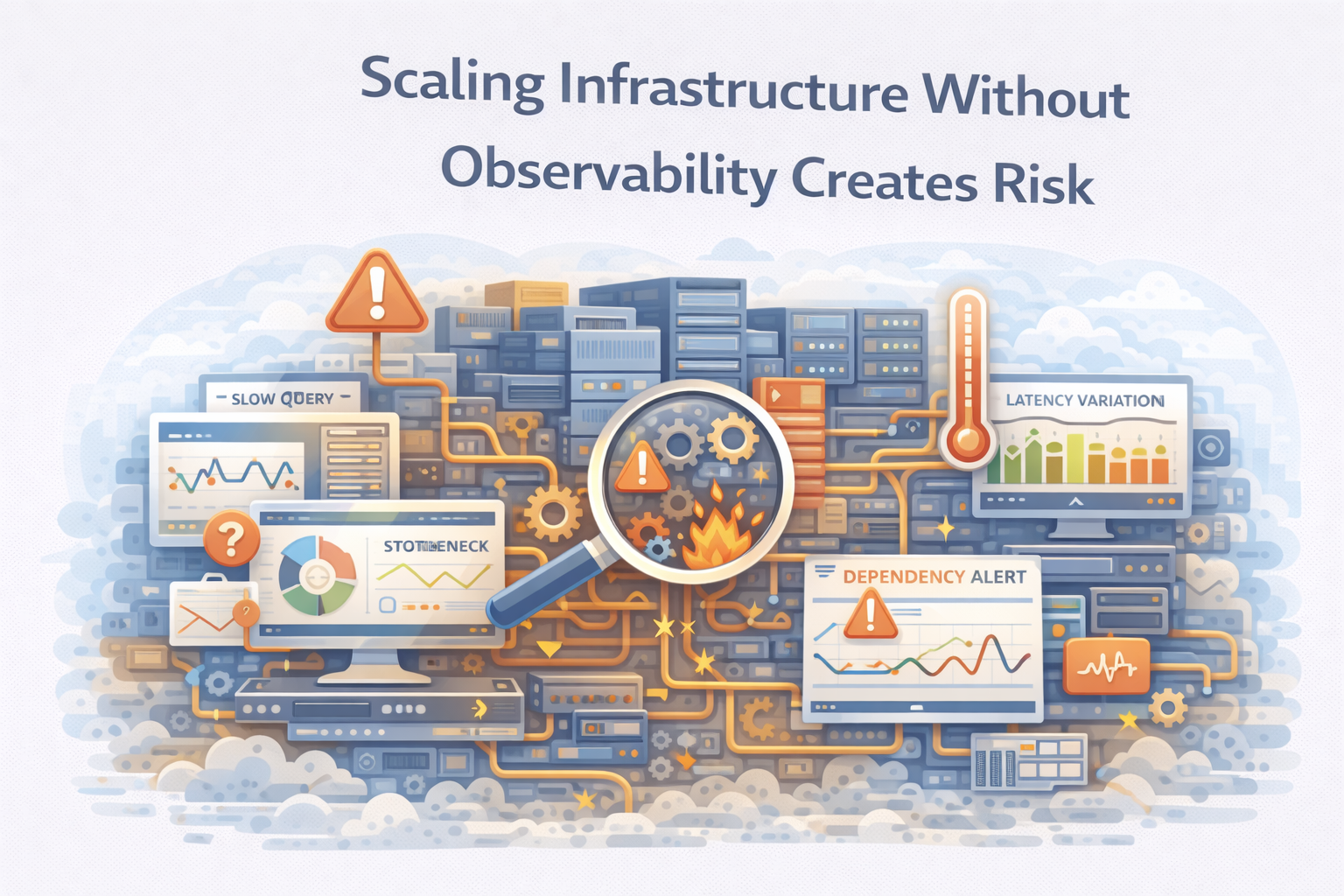
Infrastructure scaling often appears to solve performance problems.
When applications slow down, teams commonly respond by adding more servers, increasing cloud resources, or deploying additional instances behind load balancers. Because these actions increase available capacity, scaling feels like a logical solution.
However, capacity expansion does not automatically improve system reliability.
At Wisegigs.eu, infrastructure investigations frequently reveal environments where scaling operations increase complexity without improving stability. Despite additional servers, applications still experience latency spikes, inconsistent throughput, or unpredictable failures.
These outcomes are not surprising.
Scaling changes system behavior.
Infrastructure Scaling Appears to Solve Performance Problems
Adding infrastructure resources increases potential throughput.
Additional CPU cores increase available computation capacity.
Expanded memory improves caching efficiency and reduces disk access.
Meanwhile, extra servers allow incoming requests to be distributed across multiple nodes.
Consequently, scaling can temporarily reduce performance pressure.
However, infrastructure upgrades often treat symptoms rather than causes.
If underlying system bottlenecks remain unresolved, scaling may simply delay the next performance failure.
Scaling Changes System Behavior
Distributed systems behave differently from single-node environments.
When infrastructure expands, new components introduce additional coordination overhead. Load balancers distribute traffic. Multiple application instances communicate through shared databases or queues. Network latency becomes more influential.
These interactions alter performance dynamics.
For example:
increased synchronization overhead
additional network communication
dependency coordination delays
uneven workload distribution
As a result, scaling frequently introduces new complexity.
Cloud architecture documentation explains these dynamics clearly:
https://aws.amazon.com/architecture/
Observability Reveals Hidden Bottlenecks
Observability provides visibility into system behavior.
Rather than relying solely on resource metrics, observability systems analyze application latency, request traces, and dependency performance. These signals help engineers understand how requests move through distributed systems.
Without observability, diagnosing scaling issues becomes extremely difficult.
For example:
database latency may increase silently
external APIs may slow under load
background queues may accumulate delays
cache performance may degrade
These signals often remain invisible without detailed monitoring.
Google’s Site Reliability Engineering guidance emphasizes observability as a foundation for scalable systems:
Metrics Alone Cannot Explain System Failures
Traditional monitoring tools focus on infrastructure metrics.
CPU utilization, memory usage, and network throughput provide valuable information. However, these metrics rarely explain why a system behaves unexpectedly.
For example:
Low CPU usage does not guarantee fast response times.
Healthy memory utilization does not eliminate database contention.
Application behavior often depends on complex interactions across services.
Therefore, observability must include multiple signal types.
Logs, metrics, and traces together reveal system dynamics.
Dependency Performance Becomes Critical at Scale
Modern applications rely on multiple dependencies.
Databases, message queues, authentication services, caching layers, and external APIs all contribute to request processing. When infrastructure scales, these dependencies experience increased load.
If dependencies cannot scale equally, they become bottlenecks.
Common examples include:
databases overwhelmed by query volume
cache clusters reaching memory limits
third-party APIs throttling requests
message queues accumulating backlog
These failures often appear only after scaling begins.
Scaling Amplifies Latency Variability
Latency rarely increases uniformly.
Instead, distributed systems exhibit tail latency, where a small percentage of requests take significantly longer than average. As systems scale, these slow requests become more visible.
Even if average performance appears stable, user experience may degrade due to unpredictable delays.
Monitoring latency distribution becomes critical.
Cloudflare’s performance documentation highlights the importance of analyzing latency percentiles rather than averages:
https://www.cloudflare.com/learning/performance/
Alerting and Monitoring Must Evolve With Scale
Scaling increases system complexity.
Consequently, monitoring strategies must evolve alongside infrastructure. Alert thresholds configured for small environments may become ineffective in larger systems.
Common monitoring failures include:
excessive alerts caused by minor fluctuations
missing alerts due to outdated thresholds
inability to correlate events across services
Without careful adjustment, monitoring noise increases while signal quality declines.
Observability Improves Incident Response During Growth
Infrastructure incidents become harder to diagnose as systems grow.
Multiple services interact simultaneously, and failures propagate across distributed components. Without observability tools, engineers must rely on guesswork.
Observability improves incident response by providing:
end-to-end request tracing
dependency performance visibility
historical performance comparisons
anomaly detection across services
These insights allow teams to isolate bottlenecks quickly.
At Wisegigs.eu, observability frameworks are introduced before scaling initiatives begin.
Visibility enables safe growth.
What Reliable Scaling Strategies Prioritize
Stable infrastructure scaling requires disciplined engineering practices.
Effective scaling strategies typically include:
implementing observability before infrastructure expansion
monitoring latency distributions and dependency behavior
validating database and cache scalability
testing systems under realistic load conditions
refining alerting thresholds during growth
analyzing request traces across services
These practices ensure scaling improves reliability rather than introducing instability.
Conclusion
Infrastructure scaling increases capacity.
However, without observability, it also increases risk.
To recap:
scaling changes system behavior
additional infrastructure introduces coordination complexity
observability reveals hidden bottlenecks
metrics alone cannot explain distributed failures
dependencies often become the real constraint
latency variability grows with system scale
monitoring must evolve alongside infrastructure
At Wisegigs.eu, reliable infrastructure scaling begins with observability, disciplined monitoring, and careful analysis of system behavior.
If scaling infrastructure introduces instability rather than improvement, the underlying issue may not be capacity — but visibility.
Need help diagnosing infrastructure performance or scaling architecture? Contact Wisegigs.eu