
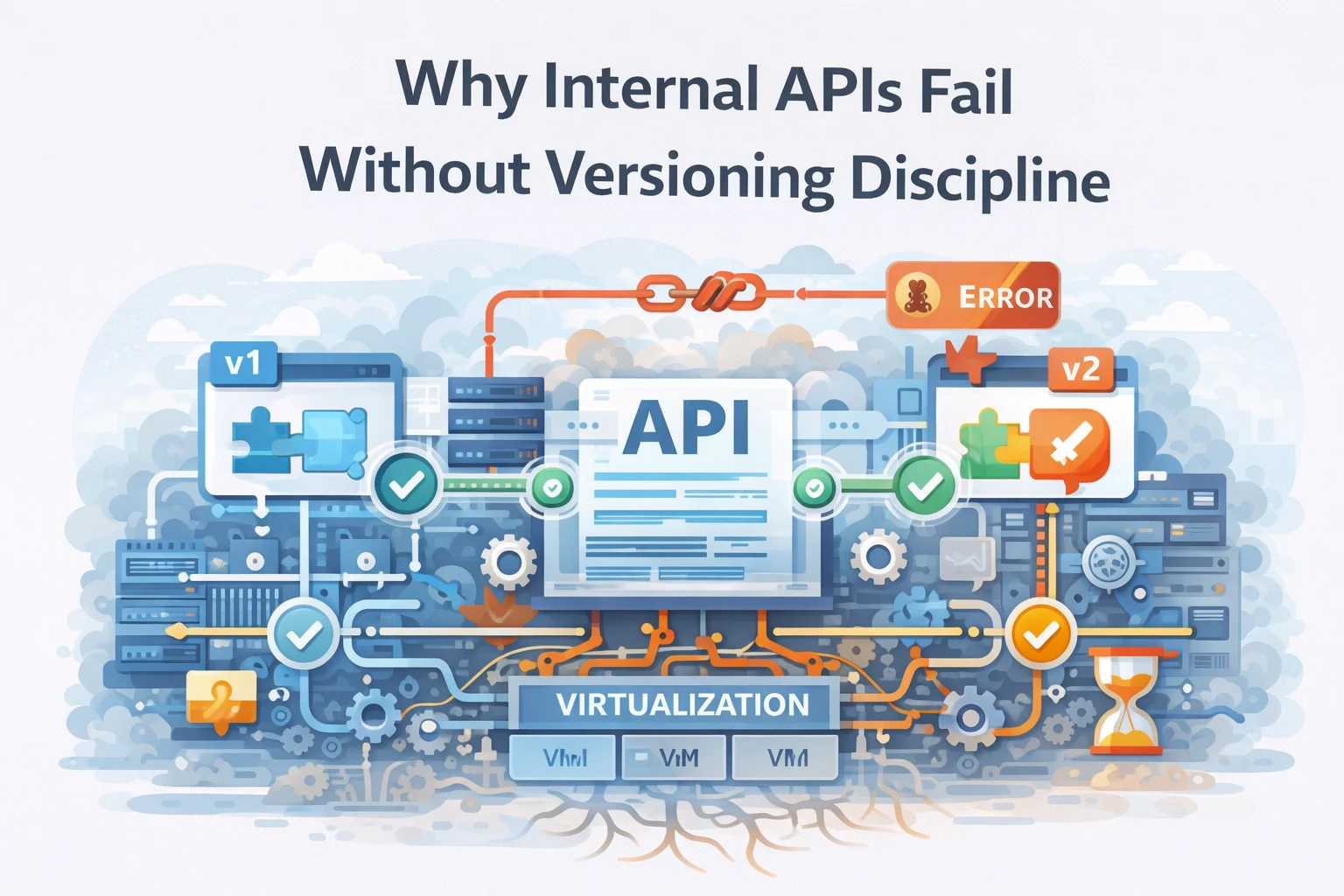
Internal APIs enable modern software architecture.
Microservices, integrations, and automation pipelines depend on structured interfaces to exchange data and trigger operations. Because internal APIs operate inside controlled environments, teams often assume they can evolve quickly without strict governance.
However, internal APIs frequently become a major source of system instability.
At Wisegigs.eu, development investigations regularly reveal environments where minor API changes trigger unexpected failures across dependent services. Authentication flows break. Data schemas become incompatible. Integration pipelines fail unexpectedly.
These incidents rarely originate from major architectural mistakes.
Instead, they emerge from uncontrolled API evolution.
Internal APIs Often Evolve Without Governance
Internal services change continuously.
Developers add fields to responses, modify parameters, or adjust validation logic as application requirements evolve. Because these changes appear small, teams often deploy them without considering downstream effects.
However, even minor adjustments can disrupt dependent systems.
For example:
A renamed field breaks client parsing logic.
A stricter validation rule rejects previously accepted requests.
A new required parameter invalidates existing integrations.
Without versioning discipline, these changes propagate instantly.
Consequently, stability declines as systems grow.
Tight Coupling Emerges Without Versioning
APIs define system boundaries.
When APIs lack versioning, consumers depend directly on the latest implementation behavior. Over time, this creates tight coupling between services.
As a result, independent service evolution becomes impossible.
Any modification to the API requires synchronized updates across all consumers. Therefore, small improvements can trigger large deployment cascades.
This dependency chain introduces operational fragility.
Service architecture becomes constrained by integration risk.
Breaking Changes Propagate Across Systems
Breaking changes are inevitable.
Data structures evolve. Security policies change. Business logic adapts to new requirements. When APIs lack version control, these changes propagate immediately.
Consequently, dependent systems may fail unexpectedly.
For example:
Frontend applications may receive incompatible data formats.
Background jobs may fail due to missing fields.
External integrations may reject new validation rules.
Importantly, these failures often appear far from the original change.
Diagnosis therefore becomes difficult.
Versioning Protects Consumer Stability
API versioning isolates change.
Instead of modifying existing behavior directly, developers introduce new versions while maintaining compatibility with older ones. Consumers migrate gradually rather than experiencing immediate disruption.
This approach provides stability benefits.
Existing integrations continue functioning.
New features become available through updated versions.
Migration timelines remain controlled.
Consequently, system reliability improves significantly.
REST API design guidance frequently recommends explicit versioning:
https://cloud.google.com/apis/design/versioning
Contract-First API Design Reduces Risk
Stable APIs begin with clear contracts.
A contract defines request formats, response structures, authentication rules, and error handling expectations. When contracts remain explicit and versioned, integrations become predictable.
Contract-first design introduces several advantages:
Structured documentation
Clear validation rules
Consistent schema evolution
Improved integration testing
Tools such as OpenAPI support contract definition and validation:
https://swagger.io/specification/
Consequently, development teams can detect breaking changes early.
Backward Compatibility Enables Continuous Delivery
Continuous delivery requires stability.
If APIs change unpredictably, deployment speed must slow dramatically. Teams hesitate to release updates because integrations might break unexpectedly.
Versioning enables safe iteration.
Backward-compatible changes allow new capabilities without disrupting existing consumers. Meanwhile, deprecated versions remain available until migration completes.
This model supports both innovation and reliability.
Documentation and Versioning Must Align
Documentation plays a critical role in API stability.
If documentation does not reflect version differences accurately, developers may use incorrect endpoints or outdated parameters.
Effective API documentation should include:
Version identifiers
Change history
Deprecation timelines
Migration guidelines
Example requests and responses
Consequently, consumers can adapt to changes predictably.
Without this alignment, versioning loses effectiveness.
Common Versioning Strategies in API Design
Several versioning approaches are widely used.
URL Versioning
Version identifiers appear in the endpoint path.
/api/v2/orders
This method provides clear separation and is easy to maintain.
Header-Based Versioning
Clients specify the version in request headers.
This approach keeps URLs stable but requires stricter documentation.
Query Parameter Versioning
Version identifiers appear in query parameters.
While simple, this method may introduce ambiguity in caching behavior.
Each strategy can succeed when applied consistently.
What Stable API Architecture Requires
Reliable API systems depend on disciplined design.
Effective development teams:
Define clear API contracts
Enforce versioning for breaking changes
Maintain backward compatibility when possible
Document changes transparently
Monitor integration errors
Plan structured deprecation timelines
At Wisegigs.eu, custom code and API development emphasize contract stability before implementation flexibility.
Architecture determines integration reliability.
Conclusion
Internal APIs power modern applications.
However, uncontrolled evolution introduces instability.
To recap:
Internal APIs often evolve without governance
Unversioned APIs create tight coupling
Breaking changes propagate across systems
Versioning protects consumer stability
Contract-first design improves reliability
Backward compatibility supports continuous delivery
Documentation must reflect version differences
At Wisegigs.eu, resilient integrations emerge from disciplined API versioning, structured contracts, and predictable evolution strategies.
If internal integrations frequently break after updates, the underlying issue may be missing versioning discipline rather than faulty code.
Need help designing stable APIs or integrations? Contact Wisegigs.eu