
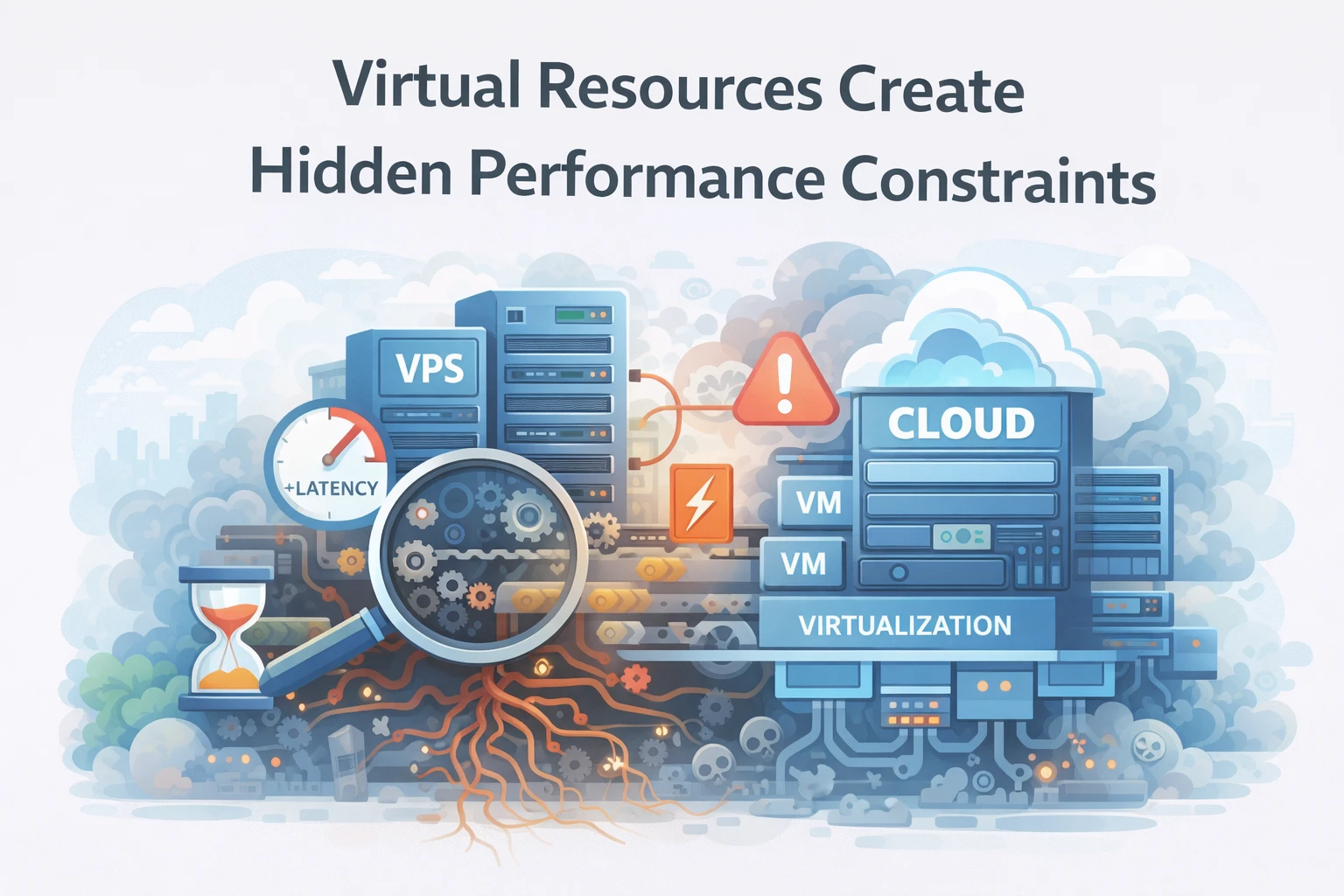
Virtual servers transformed modern hosting.
Instead of relying on dedicated hardware, most workloads now operate inside virtualized environments. Cloud platforms and VPS providers allocate resources dynamically while abstracting underlying infrastructure details. Because this model increases flexibility and cost efficiency, many teams assume performance behaves similarly to traditional servers.
However, virtualization fundamentally changes system behavior.
At Wisegigs.eu, infrastructure investigations frequently reveal applications running on well-provisioned VPS instances that still experience latency spikes, inconsistent throughput, or unpredictable performance degradation.
These issues rarely originate from application logic alone.
Virtualization introduces constraints that remain invisible at the resource specification level.
Virtualization Changes Infrastructure Behavior
Traditional servers provided direct hardware access.
Applications interacted with dedicated CPUs, memory, storage devices, and network interfaces. Consequently, performance characteristics remained relatively predictable.
Virtualized environments behave differently.
Hypervisors manage resource allocation across multiple workloads simultaneously. As a result, applications no longer interact directly with hardware. Instead, they operate through scheduling layers that balance competing demands.
Performance therefore becomes contextual.
Workload behavior depends not only on application design but also on surrounding infrastructure activity.
Resource Allocation Is Dynamic Rather Than Dedicated
VPS resources appear fixed.
A server might advertise a specific number of CPU cores, a defined memory allocation, and guaranteed storage capacity. However, virtualization platforms dynamically schedule these resources across many tenants.
Consequently, availability fluctuates.
CPU time is shared across workloads.
Memory pressure affects neighboring instances.
Disk I/O competes with external activity.
Under low contention conditions, performance appears stable. Under higher load, variability emerges.
This dynamic allocation model explains many unexplained performance fluctuations.
CPU Performance Is Influenced by Hypervisor Scheduling
CPU resources in virtual environments are scheduled.
The hypervisor distributes execution time across virtual machines running on the same host. While allocation policies attempt fairness, scheduling delays can still occur when multiple workloads compete for CPU cycles.
Therefore, identical VPS specifications may produce different results across hosts.
Applications with bursty workloads are particularly sensitive to scheduling variability. When CPU availability changes rapidly, response latency may increase even when average utilization appears normal.
Infrastructure documentation frequently explains these scheduling mechanisms:
Storage Latency Becomes Less Predictable
Virtualized storage systems introduce additional abstraction layers.
Instead of interacting with a physical disk, applications often access network-backed storage systems or shared block devices. Consequently, I/O performance becomes dependent on infrastructure conditions beyond the individual VPS.
Several factors influence behavior:
Shared storage pools
Network congestion
Caching layers
Concurrent workloads
Under these conditions, latency distribution widens.
Short operations remain fast, while occasional requests become significantly slower. These outliers often produce noticeable application delays.
Network Performance Depends on Shared Infrastructure
Virtual networking simplifies infrastructure management.
However, network bandwidth and packet routing may still depend on shared physical interfaces. When multiple virtual machines transmit traffic simultaneously, network contention can occur.
Therefore, throughput metrics may fluctuate even when individual workloads remain constant.
Additionally, routing layers introduce extra processing steps.
Packets travel through virtual switches, software-defined networking layers, and provider-level routing systems before reaching external destinations.
Each step introduces potential latency.
Resource Metrics Often Mask Contention
Monitoring tools report resource usage from the perspective of the virtual machine.
Consequently, CPU utilization, memory usage, and disk metrics may appear healthy even while contention occurs at the hypervisor level.
For example:
CPU usage remains low while execution waits for scheduling
Disk utilization appears normal while I/O queues grow
Network metrics remain stable while packet delays increase
These scenarios create misleading signals.
Observability systems must therefore consider latency distributions and dependency behavior rather than relying solely on utilization metrics.
Scaling Does Not Eliminate Underlying Constraints
Cloud platforms emphasize scalability.
When workloads increase, teams often add more instances or allocate additional resources. While scaling improves throughput capacity, it does not always reduce latency.
Shared infrastructure effects remain present.
More instances may increase coordination overhead.
More traffic may increase storage contention.
More services may increase network complexity.
Consequently, scaling without architectural awareness may introduce new bottlenecks.
Observability Becomes Critical in Virtual Environments
Performance variability requires deeper visibility.
Traditional monitoring focused on resource utilization and service availability. In virtualized environments, however, these indicators often fail to capture emerging problems.
Effective observability focuses on:
Latency distributions
Request-level tracing
Dependency performance
Error rate patterns
Infrastructure correlation signals
These metrics reveal hidden infrastructure interactions that traditional dashboards overlook.
What Reliable VPS and Cloud Performance Requires
Stable cloud infrastructure depends on understanding virtualization behavior.
Effective strategies include:
Designing applications tolerant to latency variability
Monitoring tail latency rather than averages
Reducing dependency coupling
Maintaining consistent infrastructure configuration
Testing under realistic workload conditions
Evaluating provider-level performance characteristics
At Wisegigs.eu, VPS and cloud environments are evaluated as distributed systems rather than isolated machines.
Performance depends on interaction patterns.
Conclusion
Virtual infrastructure increases flexibility.
However, it also introduces hidden constraints.
To recap:
Virtualization changes hardware interaction models
Resource allocation becomes dynamic
CPU scheduling introduces variability
Storage latency becomes less predictable
Network performance depends on shared infrastructure
Utilization metrics may hide contention
Scaling does not eliminate structural constraints
Observability becomes essential for diagnosis
At Wisegigs.eu, stable VPS and cloud deployments emerge from understanding virtualization behavior, designing resilient architectures, and monitoring real system dynamics.
If your VPS appears adequately provisioned but performance remains inconsistent, the root cause may lie within hidden virtualization constraints.
Need help diagnosing VPS or cloud performance issues? Contact Wisegigs.eu