
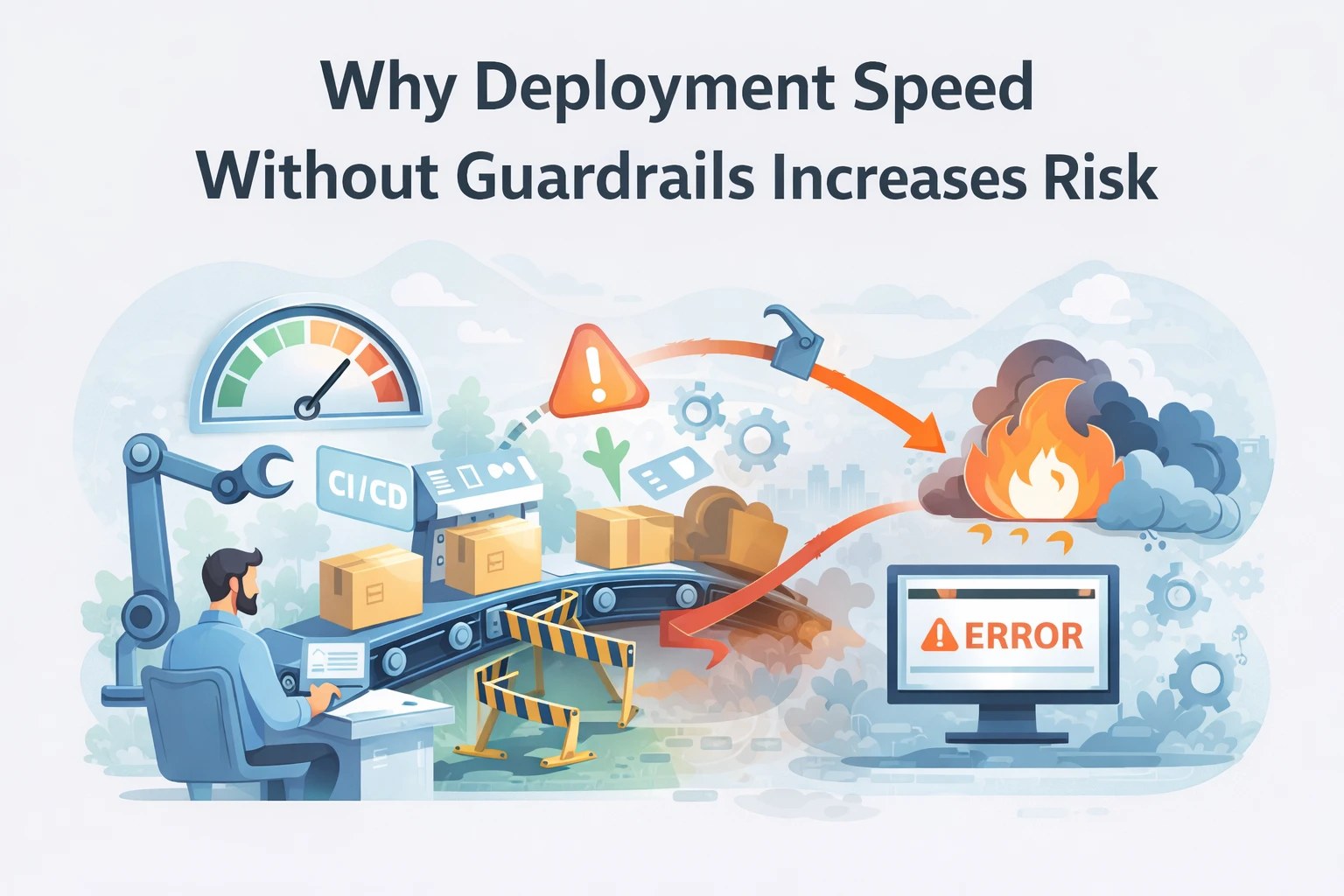
Deployment speed is widely celebrated in modern development culture.
Teams optimize pipelines to ship faster. Releases become more frequent. Automation replaces manual gates. Consequently, delivery velocity becomes a primary success metric.
However, speed alone does not define reliability.
At Wisegigs.eu, production incidents frequently trace back to deployment processes optimized for velocity but lacking structural safeguards. Although pipelines execute successfully, latent defects reach production and surface under real conditions.
This outcome is predictable.
Acceleration without constraint increases exposure.
Speed Is a Capability, Not a Control Mechanism
CI/CD pipelines reduce friction.
They automate builds, tests, and deployments. As a result, teams can release changes continuously instead of batching updates. In principle, this improves responsiveness and adaptability.
Nevertheless, automation does not validate architectural integrity.
A pipeline ensures repeatability.
It does not guarantee correctness.
Without guardrails, faster releases simply propagate defects more efficiently.
GitLab’s DevOps research consistently emphasizes balancing speed with control:
https://about.gitlab.com/topics/devops/
Continuous Delivery Amplifies System Behavior
Every deployment modifies production state.
Under controlled conditions, small changes reduce risk. However, when validation layers are weak, even minor modifications can trigger cascading effects.
For example:
Configuration drift introduces inconsistency
Schema changes break downstream services
Feature flags expose incomplete logic
Environment mismatches alter runtime behavior
Importantly, rapid iteration magnifies systemic weaknesses.
Speed amplifies architecture quality.
It does not compensate for its absence.
Guardrails Define Safe Delivery Boundaries
Guardrails constrain risk.
They formalize checks that prevent unstable code from reaching users. Without these boundaries, pipelines become mechanical conveyors rather than reliability mechanisms.
Effective guardrails typically include:
Automated test enforcement
Static analysis thresholds
Security scanning gates
Infrastructure validation
Rollback validation
Environment parity checks
When these controls are absent, deployment becomes a gamble.
CI/CD best practices repeatedly highlight gated validation:
https://docs.github.com/en/actions
“It Passed CI” Is Not a Reliability Guarantee
Passing CI means predefined checks succeeded.
It does not confirm runtime behavior under production load. Many incidents emerge from interactions not covered by automated tests.
Common blind spots include:
Edge-case data patterns
Dependency latency variance
Concurrency contention
Configuration-specific behavior
Infrastructure scaling anomalies
Therefore, validation depth matters more than validation speed.
Short pipelines are not inherently superior.
Rollback Strategy Determines Confidence
Deployment confidence depends on reversibility.
Without reliable rollback mechanisms, teams hesitate to deploy or struggle during incidents. Consequently, response time increases and recovery complexity escalates.
A disciplined rollback model includes:
Immutable build artifacts
Versioned infrastructure
Database migration rollback paths
Feature flag isolation
Clear deployment state tracking
Importantly, rollback must be tested intentionally.
Unverified rollback paths introduce false confidence.
The Twelve-Factor App principles emphasize reproducibility and reversibility:
Infrastructure as Code Reduces Drift Risk
Environment inconsistency frequently causes production failures.
Manual server adjustments, undocumented configuration changes, and environment-specific tweaks introduce unpredictability. As a result, deployments behave differently across stages.
Infrastructure as Code (IaC) mitigates this risk.
Version-controlled infrastructure definitions
Repeatable provisioning
Explicit dependency declarations
Automated environment parity
These practices reduce variability between staging and production.
Consequently, deployment stability improves.
Deployment Frequency Without Observability Is Dangerous
Speed increases change velocity.
Without observability, change velocity increases incident probability. Detection must scale with deployment frequency.
Key requirements include:
Latency distribution monitoring
Error rate anomaly detection
Dependency health tracking
Real-time rollback triggers
Trace-based execution visibility
Otherwise, fast pipelines generate fast failures.
At Wisegigs.eu, DevOps processes integrate monitoring directly into deployment workflows. Observability becomes part of delivery, not an afterthought.
For deeper context, review our insights on monitoring dynamics:
https://wisegigs.eu/why-observability-changes-incident-response-dynamics/
Guardrails Reduce Cognitive Load
Developers make decisions under time pressure.
When pipelines lack enforced safeguards, mental overhead increases. Engineers manually verify assumptions, monitor deployments closely, and react defensively.
In contrast, structured guardrails externalize risk control.
Automated validation reduces ambiguity.
Standardized workflows reduce variability.
Consistent environments reduce uncertainty.
Consequently, deployment confidence increases.
Common Failure Patterns in Fast Pipelines
Several recurring patterns appear in unstable CI/CD environments:
Skipping integration tests for speed
Allowing direct production changes
Merging without peer review
Lack of migration validation
Overreliance on manual rollback
Ignoring staging-production parity
Each pattern reduces friction temporarily.
However, cumulative risk increases.
What Safe CI/CD Actually Prioritizes
Reliable DevOps maturity balances velocity with stability.
Effective delivery models:
Automate comprehensively but validate intentionally
Enforce code review discipline
Gate production merges behind test coverage thresholds
Isolate risky changes behind feature flags
Maintain reproducible infrastructure definitions
Monitor deployments in real time
Test rollback processes regularly
At Wisegigs.eu, DevOps strategy emphasizes guardrails as structural constraints rather than bureaucratic overhead.
Speed remains valuable.
Stability remains mandatory.
For related hardening principles, see our WordPress architectural security guide:
https://wisegigs.eu/wordpress-hardening-architectural-thinking/
You may also find our infrastructure scaling analysis relevant:
https://wisegigs.eu/scaling-infrastructure-performance/
Conclusion
Deployment speed increases capability.
It does not guarantee safety.
To recap:
Automation amplifies system behavior
Pipelines ensure repeatability, not correctness
Guardrails constrain risk
Rollback defines deployment confidence
Infrastructure drift increases instability
Observability must scale with velocity
Skipping validation accelerates failure
At Wisegigs.eu, sustainable DevOps performance emerges from disciplined guardrails, reproducible environments, and observable deployments.
If your pipeline prioritizes speed but production incidents persist, the constraint likely lies in missing safeguards rather than insufficient automation.
Need help designing a stable CI/CD pipeline? Contact Wisegigs.eu